
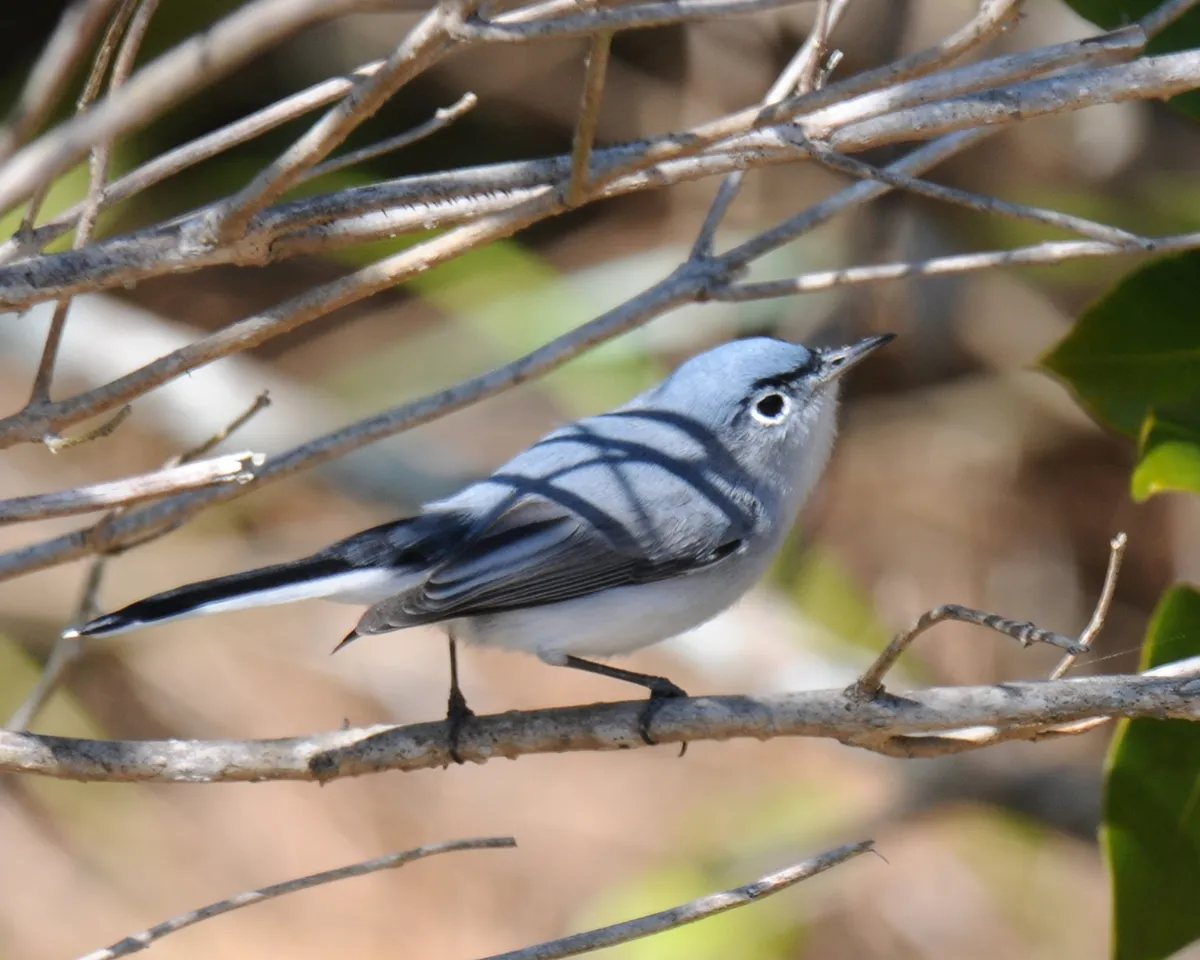
Gobemoucheron gris-bleu— Quebec wildlife
Polioptila caerulea
PolioptilidaeNo period published by Québec.ca
Québec.ca publishes no hunting or trapping period for this species. Check the official regulations.
Wikipedia
Gobemoucheron gris-bleu
The blue-gray gnatcatcher (Polioptila caerulea) is a very small gnatcatcher native to North America.
Description
It is 10–13 cm (3.9–5.1 in) in length, 6.3 in (16 cm) in wingspan, and weighing only 5–7 g (0.18–0.25 oz). Adult males are blue-gray on the upperparts with white underparts, slender dark bill, and a long black tail edged in white. Females are less blue, while juveniles are greenish-gray. Both sexes have a white eye ring.
Reproduction
Both parents build a cone-like nest on a horizontal tree branch, and share feeding the young. The incubation period is 10–15 days for both sexes, where the female lays a clutch of 4–5 eggs. The blue-gray gnatcatcher can raise up to two broods in a season.
Text from Wikipedia — Blue-gray gnatcatcher, revision 1357345723, CC BY-SA 4.0, retrieved 2026-09-04. Encyclopedic text reused under CC BY-SA 4.0. Sentences about hunting or regulation are removed: on this site, the rule comes from Québec.ca.
Other names
French
English
Presence in Quebec
- Origin
- Indigène
- Occurrence
- Régulier
- Population status
- Reproducteur
- Certainty
- Confirmé
Conservation
Québec.ca
Official periods
Source: Québec.ca — tables reproduced as published (retrieved 2026-08-30).
Regulations change. Always check Québec.ca before hunting or trapping.
Where this data comes from
This species is listed in an official government dataset. The identification and status shown in the data sheet are reproduced from it.
Source: List of Quebec’s vertebrate wildlife (LFVQ) — Ministère de l’Environnement, de la Lutte contre les changements climatiques, de la Faune et des Parcs. File LFVQ_25_03_2026.csv, retrieved 2026-08-30 · CC BY 4.0.
Measurements, habitat, diet and reproduction are not shown: no official source is attached to them yet.