
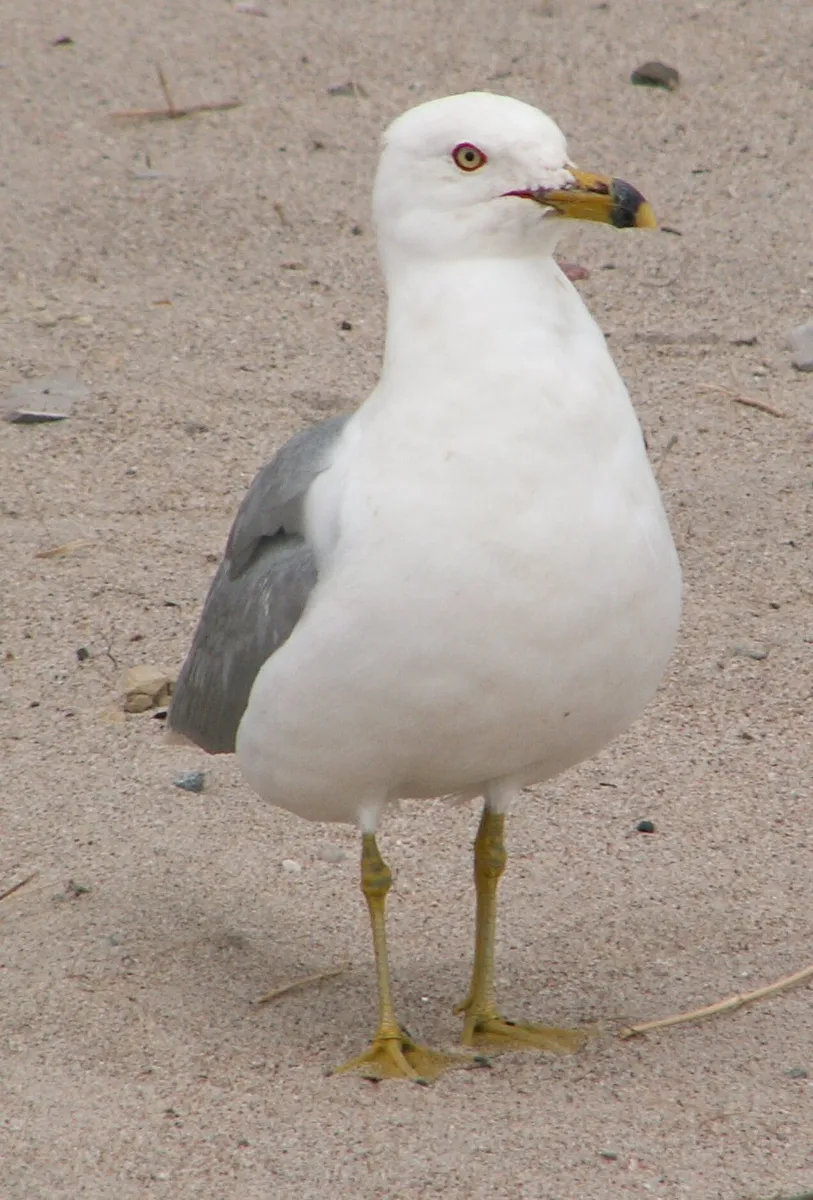
Goéland à bec cerclé— Quebec wildlife
Larus delawarensis
LaridaeNo period published by Québec.ca
Québec.ca publishes no hunting or trapping period for this species. Check the official regulations.
Wikipedia
Goéland à bec cerclé
The ring-billed gull (Larus delawarensis) is a medium-sized gull native to North America, breeding in Canada and the northern Contiguous United States, and wintering mainly in the United States and northern Mexico. The genus name is from Latin Larus which appears to have referred to a gull or other large seabird. The specific delawarensis refers to the Delaware River.
Description
The ring-billed gull is a medium-sized gull, having an average length of 43 to 54 centimetres (16.9 to 21.3 in) and a wingspan that ranges from 105 to 117 centimetres (41.3 to 46.1 in). Adults weigh from 300 to 700 grams (10.6 to 24.7 oz). The head, neck and underparts are white; the relatively short bill is yellow with a black ring; the back and wings are silver grey with black wingtips with white 'mirrors'; and the legs are yellow. The eyes are yellow with red rims. This gull takes three years to reach its breeding plumage starting with the largely brown juvenile plumage, its appearance changing with each fall moult. The average lifespan of an individual that reaches adulthood is 10.9 years. The oldest ring-billed gull on record was observed in Cleveland in 2021, still alive at the age of 28 years.
Diet
Ring-billed gulls forage in flight or pick up objects while swimming, walking or wading. They also steal food from other birds and frequently scavenge. They are omnivorous; their diet may include insects, fish, grain, eggs, earthworms and rodents. These birds are opportunistic and have adapted well to taking food when discarded or even left unattended by people. It is regarded as a pest by many beach-goers because of its willingness to steal unguarded food on crowded beaches. The birds congregate at beaches, marinas, docks and parks where people will hand feed them. The gull's natural predators are rats, foxes, dogs, cats, raccoons, coyotes, eagles, hawks (although they have been seen in pairs chasing hawks), and owls.
Text from Wikipedia — Ring-billed gull, revision 1349256403, CC BY-SA 4.0, retrieved 2026-09-04. Encyclopedic text reused under CC BY-SA 4.0. Sentences about hunting or regulation are removed: on this site, the rule comes from Québec.ca.
Other names
French
English
Presence in Quebec
- Origin
- Indigène
- Occurrence
- Régulier
- Population status
- Reproducteur
- Certainty
- Confirmé
Conservation
Québec.ca
Official periods
Source: Québec.ca — tables reproduced as published (retrieved 2026-08-30).
Regulations change. Always check Québec.ca before hunting or trapping.
Where this data comes from
This species is listed in an official government dataset. The identification and status shown in the data sheet are reproduced from it.
Source: List of Quebec’s vertebrate wildlife (LFVQ) — Ministère de l’Environnement, de la Lutte contre les changements climatiques, de la Faune et des Parcs. File LFVQ_25_03_2026.csv, retrieved 2026-08-30 · CC BY 4.0.
Measurements, habitat, diet and reproduction are not shown: no official source is attached to them yet.