
No period published by Québec.ca
Québec.ca publishes no hunting or trapping period for this species. Check the official regulations.
Wikipedia
Goéland à bec court
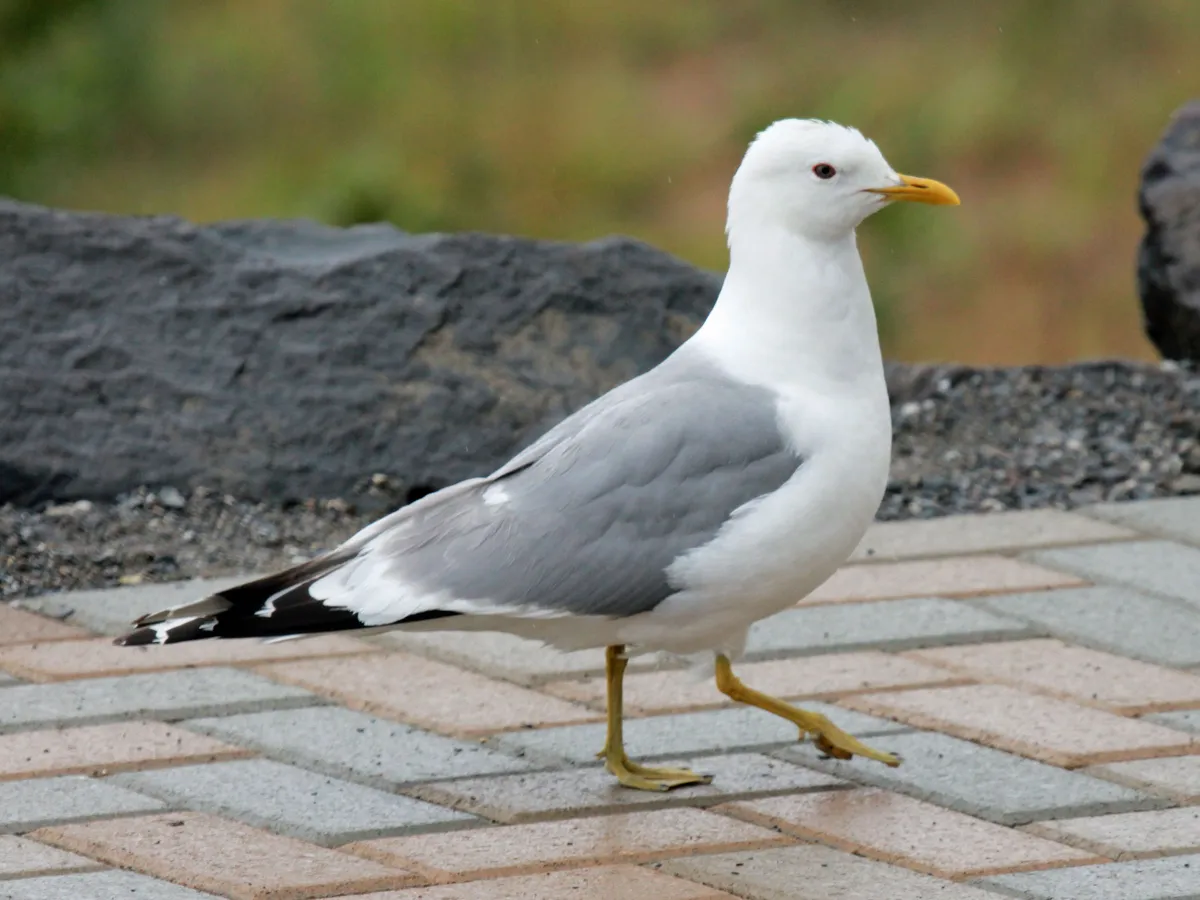
The short-billed gull (Larus brachyrhynchus) is a species of gull that breeds in northwestern North America. In North America, it was previously known as the mew gull, when it was considered conspecific with the palearctic common gull (Larus canus). Most authorities, including the American Ornithological Society in 2021, have split the two populations as distinct species.
Description
The short-billed gull has a length 40–45 cm (16–18 in) and a wingspan 100–120 cm (39–47 in). It is smaller than other gulls in the Common gull complex, with a shorter bill and longer wings. Its wings appear long and narrow in flight relative to its short body. In breeding plumage, adults have a white head, pale eyes surrounded by a red orbital skin, yellow legs and bill with no markings. In winter, the head is marked with brown mottling, the eye orbital skin becomes grayish and the bill becomes duller with a faint dark marking. In flight, the two outermost primary feathers (p9 and p10) have conspicuous white spots or "mirrors". Between p5 and p8, the primaries have white "tongue tips" which form a 'string of pearls' transitioning to the broad white trailing edge. p4 usually has a black markings in many birds. In comparison, common gulls have a larger bill and shorter wings. The wingtips of common gulls have more extensive black wingtips with smaller mirrors on p9-10, a narrower trailing edge, and typically lack black markings on p4 as well as the white tongue tip on p8. Short-billed gulls take 3 years to attain breeding plumage. Juveniles are brownish overall with dark brown wingtips. They appear darker and more smudged on the head and neck, compared to the paler and finely-marked common gull, which more closely resembles Ring-billed gull at this stage. Many first-year birds retain juvenile plumage through the winter, but some grow grayish saddle feathers intermixed with juvenile feathers. The bill becomes pink at the base with a black tip by the first winter. Second-year birds resemble adults but may have brown wing covert feathers and black markings on the tertials, lacking white spots on the wingtips except the p10 mirror. Third-year birds are similar to adults but may have dark markings on primary coverts, secondaries, underwing and tail, with more extensive black on the wingtips.
Habitat and range
The short-billed gull breeds in colonies along coastal areas and inland wetlands, mainly in Alaska and Northwest Canada. Most birds winter along the Pacific coast down to the Sacramento Valley, and less frequently to Baja California, the Northern Rockies and Ontario. It is a very rare visitor to eastern North America and a vagrant to east Asia. There are two records of short-billed gull in Europe, on the Azores in 2003 and the Faroe Islands in 2026.
Text from Wikipedia — Short-billed gull, revision 1363124175, CC BY-SA 4.0, retrieved 2026-09-04. Encyclopedic text reused under CC BY-SA 4.0. Sentences about hunting or regulation are removed: on this site, the rule comes from Québec.ca.
Presence in Quebec
- Origin
- Indigène
- Occurrence
- Accidentel/non régulier
- Population status
- Migrateur
- Certainty
- Confirmé
Conservation
Official remark
La sous-espèce du Goéland cendré Larus canus brachyrhynchus a été élevée au rang d’espèce en 2021 (Goéland à bec court – Larus brachyrhynchus). Il y a 8 mentions d'acceptées pour le Québec selon le rapport du CHORQ de Mars 2022.
Québec.ca
Official periods
Source: Québec.ca — tables reproduced as published (retrieved 2026-08-30).
Regulations change. Always check Québec.ca before hunting or trapping.
Where this data comes from
This species is listed in an official government dataset. The identification and status shown in the data sheet are reproduced from it.
Source: List of Quebec’s vertebrate wildlife (LFVQ) — Ministère de l’Environnement, de la Lutte contre les changements climatiques, de la Faune et des Parcs. File LFVQ_25_03_2026.csv, retrieved 2026-08-30 · CC BY 4.0.
Measurements, habitat, diet and reproduction are not shown: no official source is attached to them yet.