
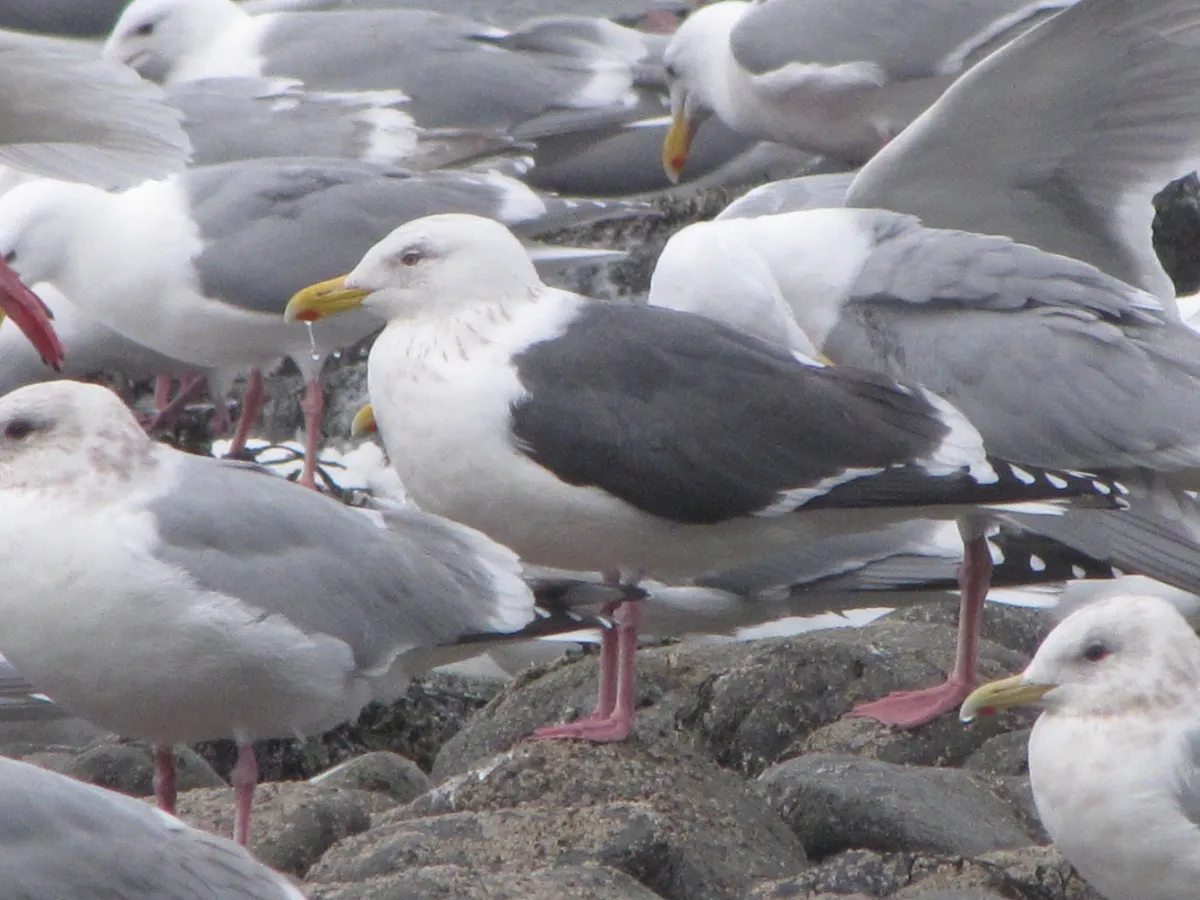
Goéland à manteau ardoisé— Quebec wildlife
Larus schistisagus
LaridaeNo period published by Québec.ca
Québec.ca publishes no hunting or trapping period for this species. Check the official regulations.
Wikipedia
Goéland à manteau ardoisé
The slaty-backed gull (Larus schistisagus) is a large, white-headed gull that breeds on the north-eastern coast of the Palearctic, but travels widely during nonbreeding seasons. It is similar in appearance to the western gull and the glaucous-winged gull. Another alternate name is Pacific gull, though it also applies to a Southern Hemisphere species, L. pacificus.
Description
It is tied with the yellow-footed gull for fourth-largest gull species, measuring 55–68.5 cm (21.7–27.0 in) in length, 132–160 cm (52–63 in) in wingspan, and 1.05–1.7 kg (2.3–3.7 lb) in weight. Among standard measurements, the wing chord is 40 to 48 cm (16 to 19 in), the bill is 4.8 to 6.5 cm (1.9 to 2.6 in), and the tarsus is 6 to 7.6 cm (2.4 to 3.0 in). It has a white head, belly, and tail with a dark slaty-gray back and wings with a broad white trailing edge. The wings and back are slightly darker than those of the western gull (Kodak grey scale 9.5 to 12 compared to Kodak 9 to 11 of the darker southern subspecies of Western Gull). On the outer primaries (p9 and p10), there are white spots called mirrors. The inner webs to primaries are pale grey, and the mid-primaries have long grey tongues tipped with large white crescents, forming a "string of pearls" pattern connecting to the broad white trailing edge of the secondaries. Its eyes are yellow surrounded by purple to deep pink orbital skin. The legs are pink and short when compared with those of similar-looking gulls, and the body appears more stout with a "pot-bellied" appearance. The bill is yellow with orange-red subterminal spot (the spot near the end of the bill that chicks peck to stimulate regurgitative feeding). Immature gulls' plumage is brown, similar to that of the great black-backed gull, but paler, and is practically indistinguishable from the immature herring gull in the field.
Text from Wikipedia — Slaty-backed gull, revision 1353450998, CC BY-SA 4.0, retrieved 2026-09-04. Encyclopedic text reused under CC BY-SA 4.0. Sentences about hunting or regulation are removed: on this site, the rule comes from Québec.ca.
Other names
Former scientific names
Presence in Quebec
- Origin
- Indigène
- Occurrence
- Accidentel/non régulier
- Population status
- Migrateur
- Certainty
- Confirmé
Conservation
Québec.ca
Official periods
Source: Québec.ca — tables reproduced as published (retrieved 2026-08-30).
Regulations change. Always check Québec.ca before hunting or trapping.
Where this data comes from
This species is listed in an official government dataset. The identification and status shown in the data sheet are reproduced from it.
Source: List of Quebec’s vertebrate wildlife (LFVQ) — Ministère de l’Environnement, de la Lutte contre les changements climatiques, de la Faune et des Parcs. File LFVQ_25_03_2026.csv, retrieved 2026-08-30 · CC BY 4.0.
Measurements, habitat, diet and reproduction are not shown: no official source is attached to them yet.