
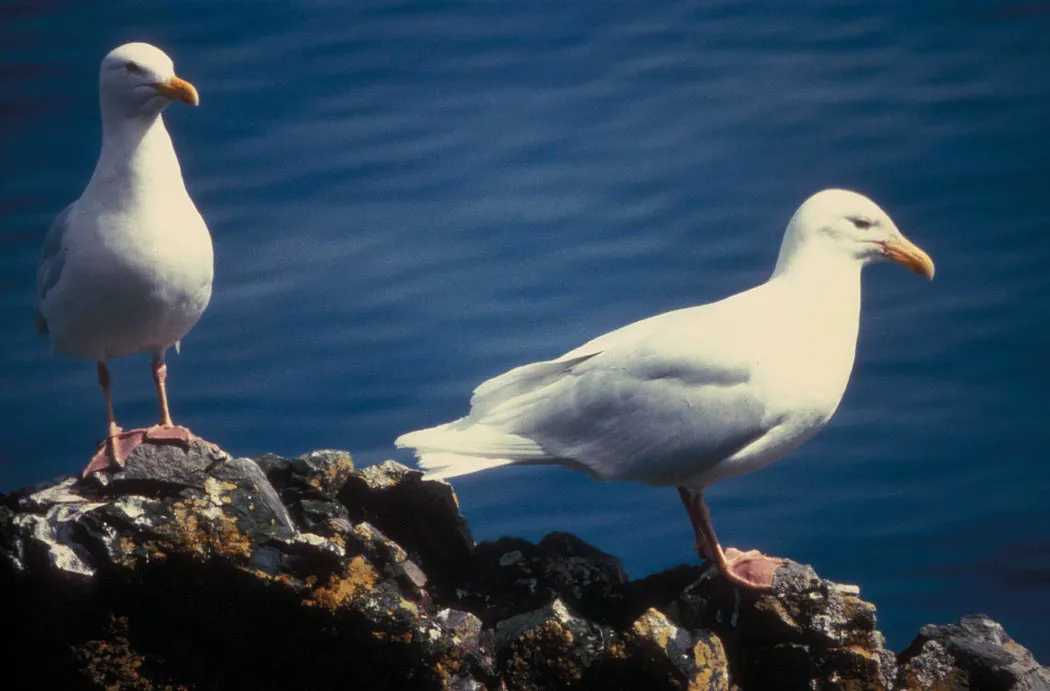
Goéland bourgmestre— Quebec wildlife
Larus hyperboreus
LaridaeNo period published by Québec.ca
Québec.ca publishes no hunting or trapping period for this species. Check the official regulations.
Wikipedia
Goéland bourgmestre
The glaucous gull (Larus hyperboreus) is a large gull, the second-largest gull in the world. The genus name is from Latin larus, which appears to have referred to a gull or other large seabird. The specific name hyperboreus is Latin for "northern" from the Ancient Greek Huperboreoi people from the far north "Glaucous" is from Latin glaucus and denotes the grey colour of the gull. An older English name for this species is burgomaster.
Description
This is a large and powerful gull, second-largest of all gull species and very pale in all plumage, with no black on either the wings or the tail. Adults are pale grey above, with a thick, yellow bill. Juveniles are very pale grey with a pink and black bill. This species is considerably larger, bulkier, and thicker-billed than the similar Iceland gull, and can sometimes equal the size of the great black-backed gull, the oft-titled largest gull species. In some areas, glaucous gulls are about the same weight as great black-backed gulls or even heavier, and their maximum weight is greater. They can weigh from 960 to 2,700 g (2.12 to 5.95 lb), with the sexes previously reported to average 1.55 kg (3.4 lb) in males and 1.35 kg (3.0 lb) in females. At the colony on Coats Island in Canada, the gulls are nearly 15% heavier than some other known populations, with a mean weight 1.86 kg (4.1 lb) in five males and 1.49 kg (3.3 lb) in seven females. One other study claimed even higher weights for glaucous gulls, as on Wrangel Island, 9 males reportedly averaged 2.32 kg (5.1 lb) and 2.1 kg (4.6 lb) in six females, which if accurate, would make the glaucous gull the heaviest gull and shorebird in the world if not (as far as is known) the largest in length on average. These gulls range from 55 to 77 cm (22 to 30 in) in length and can span 132 to 170 cm (52 to 67 in), with some specimens possibly attaining 182 cm (72 in), across the wings. Among standard measurements, the wing chord is 40.8 to 50.1 cm (16.1 to 19.7 in), the bill is 4.9 to 6.9 cm (1.9 to 2.7 in) and the tarsus is 6 to 7.7 cm (2.4 to 3.0 in). They take four years to reach maturity. The call is a "laughing" cry similar to that of the herring gull, but deeper.
Habitat and range
This gull breeds in Arctic regions of the Northern Hemisphere and winters south to shores of the Holarctic. It is migratory, wintering from in the North Atlantic and North Pacific Oceans as far south as the British Isles and northernmost states of the United States, also on the Great Lakes. A few birds sometimes reach the southern USA and northern Mexico.
Text from Wikipedia — Glaucous gull, revision 1314389847, CC BY-SA 4.0, retrieved 2026-09-04. Encyclopedic text reused under CC BY-SA 4.0. Sentences about hunting or regulation are removed: on this site, the rule comes from Québec.ca.
Other names
French
English
Presence in Quebec
- Origin
- Indigène
- Occurrence
- Régulier
- Population status
- Toute l'année
- Certainty
- Confirmé
Conservation
Québec.ca
Official periods
Source: Québec.ca — tables reproduced as published (retrieved 2026-08-30).
Regulations change. Always check Québec.ca before hunting or trapping.
Where this data comes from
This species is listed in an official government dataset. The identification and status shown in the data sheet are reproduced from it.
Source: List of Quebec’s vertebrate wildlife (LFVQ) — Ministère de l’Environnement, de la Lutte contre les changements climatiques, de la Faune et des Parcs. File LFVQ_25_03_2026.csv, retrieved 2026-08-30 · CC BY 4.0.
Measurements, habitat, diet and reproduction are not shown: no official source is attached to them yet.