
No period published by Québec.ca
Québec.ca publishes no hunting or trapping period for this species. Check the official regulations.
Wikipedia
Goéland brun
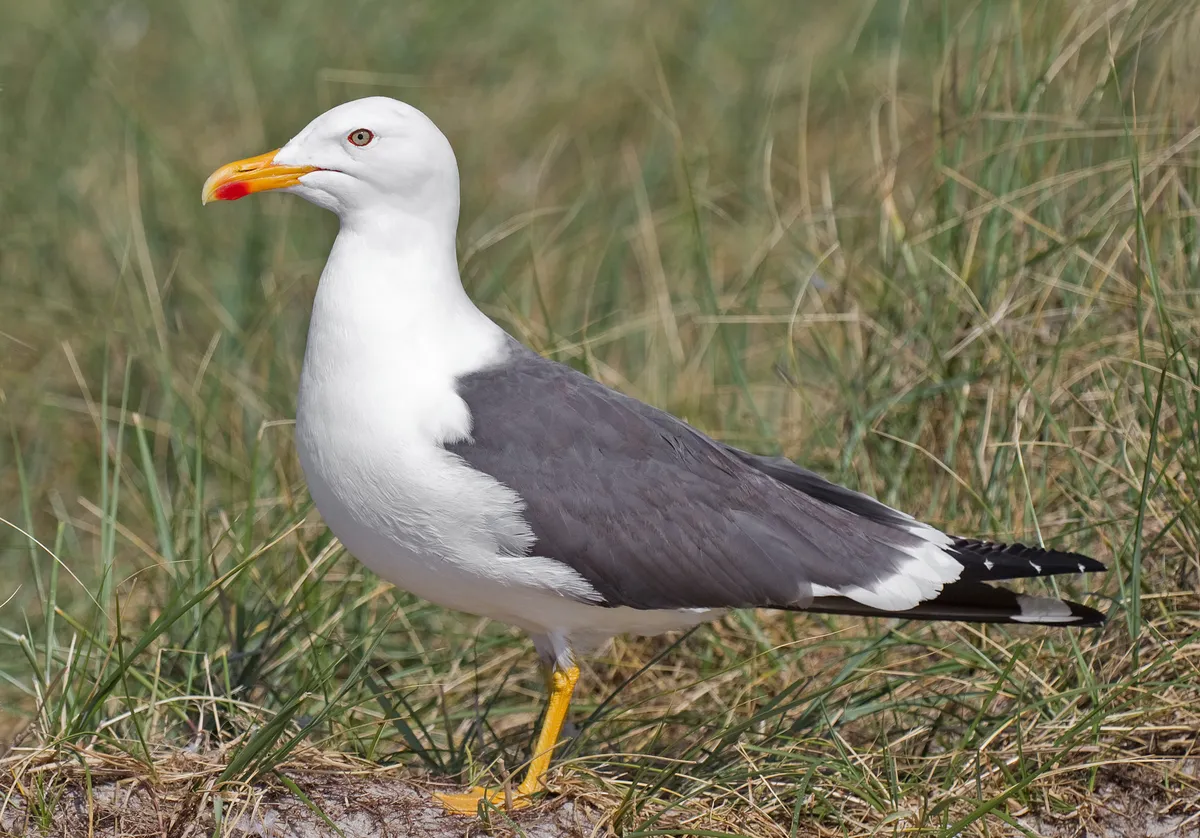
The lesser black-backed gull (Larus fuscus) is a large gull that breeds on the Atlantic and Arctic coasts of Europe. It is migratory, wintering from the British Isles south to West Africa. However, it has increased dramatically in North America, especially along the east coast. Formerly just a winter visitor to North America, it now occurs in large numbers some winters and birds are recorded year-round. However, there is serious concern about decline in many parts of its range. The species is on the UK Amber List because the UK is home to 40 per cent of the European population and more than half of these are found at fewer than ten breeding sites.
Description
The lesser black-backed gull is smaller than the European herring gull. The taxonomy of the herring gull / lesser black-backed gull complex is complicated; different authorities recognise between two and eight species. This group has a ring species distribution around the Northern Hemisphere. Differences between adjacent forms in this ring are fairly small, but by the time the circuit is completed, the end members, herring gull and lesser black-backed gull, are clearly different species. The lesser black-backed gull measures 51–64 cm (20–25 in), 124–150 cm (49–59 in) across the wings, and weighs 452–1,100 g (0.996–2.425 lb), with the nominate race averaging slightly smaller than the other two subspecies. Males, at an average weight of 824 g (1.817 lb), are slightly larger than females, at an average of 708 g (1.561 lb). The wing chord is 38 to 45 cm (15 to 18 in), the bill is 4.2 to 5.8 cm (1.7 to 2.3 in), and the tarsus is 5.2 to 6.9 cm (2.0 to 2.7 in). A confusable species is the great black-backed gull. The lesser is a much smaller bird, with slimmer build, yellow rather than pinkish legs, and smaller white "mirrors" at the wing tips. The adults have black or dark grey wings (depending on race) and back. The bill is yellow with a red spot at which the young peck, inducing feeding (see fixed action pattern). The head is greyer in winter, unlike that of the great black-backed gull. The annual moult for adults begins between May and August and is not complete on some birds until November. A partial prebreeding moult occurs between January and April. Young birds have scaly black-brown upperparts and a neat wing pattern. They take four years to reach maturity. Identification from juvenile herring gulls is most readily done by the more solidly dark (unbarred) tertial feathers. Their call is a "laughing" cry like that of the herring gull, but with a markedly deeper pitch.
Habitat and range
Lesser black-backed gulls have expanded their range westwards, first colonising Greenland in the 1980s. The species has not yet bred in an intraspecific pair in the United States; however, hybrid pairs with American herring gulls, one of which produced offspring, have been recorded twice.
Diet
They are omnivores, like most Larus gulls, and eat fish, insects, crustaceans, worms, starfish, molluscs, seeds, berries, small mammals, eggs, small birds,
Text from Wikipedia — Lesser black-backed gull, revision 1361736318, CC BY-SA 4.0, retrieved 2026-09-04. Encyclopedic text reused under CC BY-SA 4.0. Sentences about hunting or regulation are removed: on this site, the rule comes from Québec.ca.
Other names
French
English
Presence in Quebec
- Origin
- Indigène
- Occurrence
- Régulier
- Population status
- Migrateur
- Certainty
- Confirmé
Conservation
Québec.ca
Official periods
Source: Québec.ca — tables reproduced as published (retrieved 2026-08-30).
Regulations change. Always check Québec.ca before hunting or trapping.
Where this data comes from
This species is listed in an official government dataset. The identification and status shown in the data sheet are reproduced from it.
Source: List of Quebec’s vertebrate wildlife (LFVQ) — Ministère de l’Environnement, de la Lutte contre les changements climatiques, de la Faune et des Parcs. File LFVQ_25_03_2026.csv, retrieved 2026-08-30 · CC BY 4.0.
Measurements, habitat, diet and reproduction are not shown: no official source is attached to them yet.