
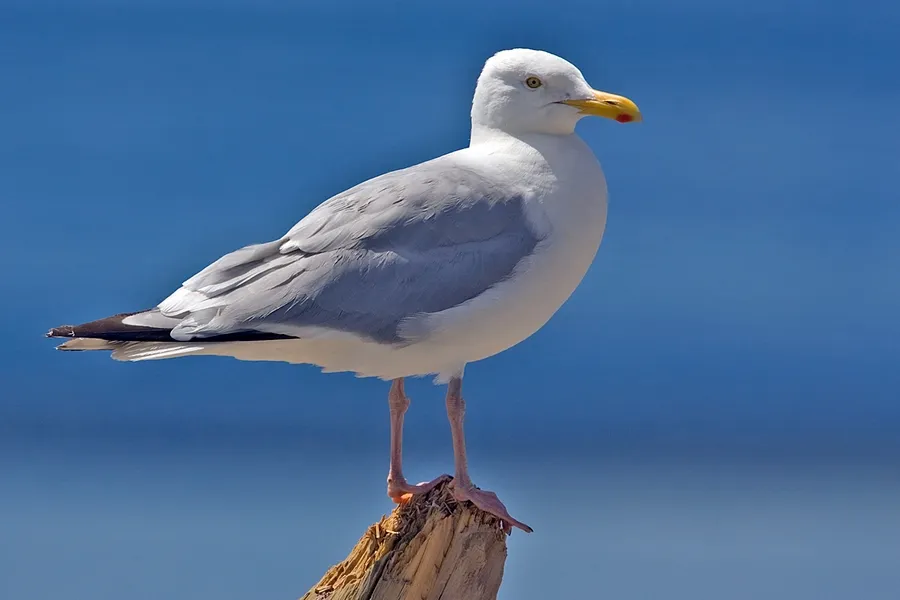
Goéland hudsonien— Quebec wildlife
Larus smithsonianus
LaridaeNo period published by Québec.ca
Québec.ca publishes no hunting or trapping period for this species. Check the official regulations.
Wikipedia
Goéland hudsonien
The American herring gull (Larus smithsonianus or Larus argentatus smithsonianus), also known as the Arctic herring gull or Smithsonian gull, is a large gull that breeds in North America, where it is treated by the American Ornithological Society as distinct from the European herring gull (Larus argentatus). Adults are white with gray back and wings, black wingtips with white spots, and pink legs. Immature birds are gray-brown and are darker and more uniform than European herring gulls, with a darker tail. As is common with other gulls, they are colloquially referred to simply as seagulls. It occurs in a variety of habitats including coasts, lakes, rivers, parking lots and garbage dumps. Its broad diet includes invertebrates, fish, and many other items. It usually nests near water, laying around three eggs in a scrape on the ground.
Description
The herring gull is a heavily built large gull with a long powerful bill, full chest and sloping forehead. Males are 60–66 cm (24–26 in) long and weigh 1,050–1,650 g (2.31–3.64 lb). Females are 53–62 cm (21–24 in) long and weigh 600–900 g (1.3–2.0 lb). The wingspan is 120 to 155 cm (47 to 61 in). Among standard measurements, the wing chord is 41.2 to 46.8 cm (16.2 to 18.4 in), the bill is 4.4 to 6.2 cm (1.7 to 2.4 in) and the tarsus is 5.5 to 7.6 cm (2.2 to 3.0 in). Breeding adults have a white head, rump, tail, and underparts and a pale gray back and upperwings. The wingtips are black with white spots known as "mirrors" and the trailing edge of the wing is white. The underwing is grayish with dark tips to the outer primary feathers. The legs and feet are normally pink but can have a bluish tinge, or occasionally be yellow. The bill is yellow with a red spot on the lower mandible. The eye is bright, pale to medium yellow, with a bare yellow or orange ring around it. In winter, the head and neck are streaked with brown. Young birds take four years to reach fully adult plumage. During this time they go through several plumage stages and can be very variable in appearance. First-winter birds are gray-brown with a dark tail, a brown rump with dark bars, dark outer primaries and pale inner primaries, dark eyes, and a dark bill, which usually develops a paler base through the winter. The head is often paler than the body. Second-winter birds typically have pale eyes, pale bill with black tip, pale head, and begin to show gray feathers on the back. Third-winter birds are closer to adults but still have some black on the bill and brown on the body and wings and have a black band on the tail.
Text from Wikipedia — American herring gull, revision 1366513568, CC BY-SA 4.0, retrieved 2026-09-04. Encyclopedic text reused under CC BY-SA 4.0. Sentences about hunting or regulation are removed: on this site, the rule comes from Québec.ca.
Other names
French
English
Former scientific names
Presence in Quebec
- Origin
- Indigène
- Occurrence
- Régulier
- Population status
- Reproducteur
- Certainty
- Confirmé
Conservation
Québec.ca
Official periods
Source: Québec.ca — tables reproduced as published (retrieved 2026-08-30).
Regulations change. Always check Québec.ca before hunting or trapping.
Where this data comes from
This species is listed in an official government dataset. The identification and status shown in the data sheet are reproduced from it.
Source: List of Quebec’s vertebrate wildlife (LFVQ) — Ministère de l’Environnement, de la Lutte contre les changements climatiques, de la Faune et des Parcs. File LFVQ_25_03_2026.csv, retrieved 2026-08-30 · CC BY 4.0.
Measurements, habitat, diet and reproduction are not shown: no official source is attached to them yet.