
No period published by Québec.ca
Québec.ca publishes no hunting or trapping period for this species. Check the official regulations.
Wikipedia
Goéland leucophée
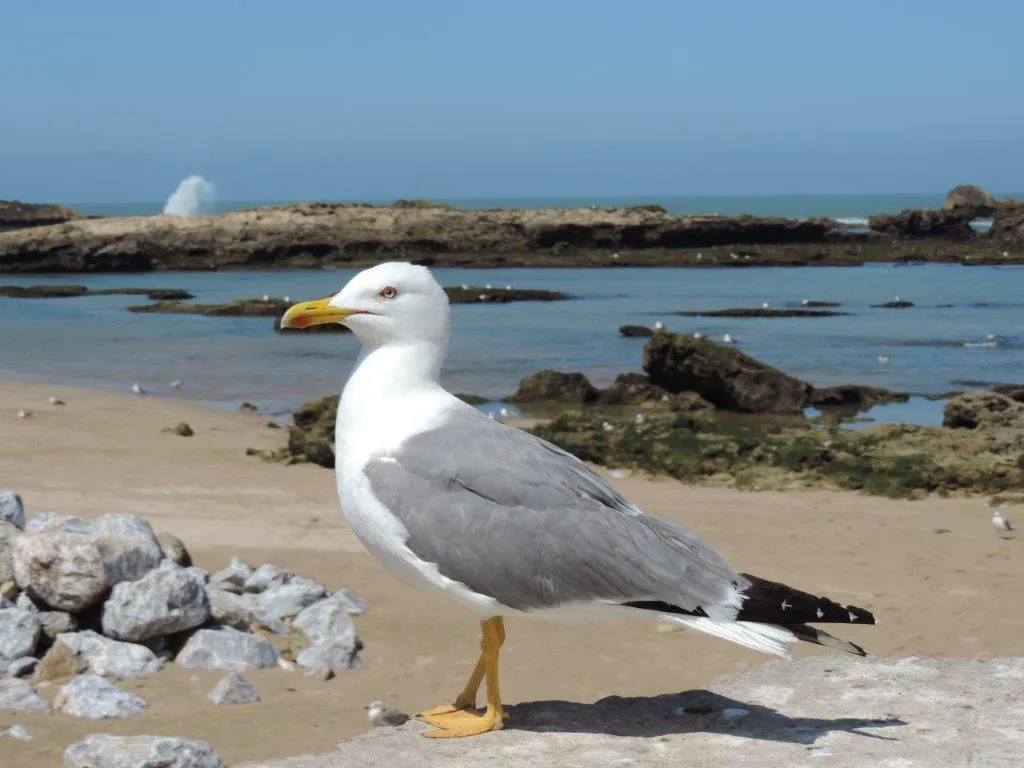
The yellow-legged gull or western yellow-legged gull (Larus michahellis) is a large gull found in Europe, the Middle East and North Africa, which has only recently achieved wide recognition as a distinct species. It was formerly treated as a subspecies of either the Caspian gull L. cachinnans, or more broadly as a subspecies of the herring gull L. argentatus. The genus name is from Latin Larus which appears to have referred to a gull or other large seabird, and the species name honours the German zoologist Karl Michahelles.
Description
The yellow-legged gull is a large gull, though the size does vary, with the smallest females being scarcely larger than a common gull and the largest males being roughly the size of a great black-backed gull. They range in length from 52 to 68 cm (20 to 27 in) in total length, from 120 to 155 cm (47 to 61 in) in wingspan and from 550 to 1,600 g (1.21 to 3.53 lb) in weight. Among standard measurements, the wing chord is 40.8 to 47.2 cm (16.1 to 18.6 in), the bill is 4.6 to 6 cm (1.8 to 2.4 in) and the tarsus is 5.6 to 7.5 cm (2.2 to 3.0 in). Adults are externally similar to herring gulls but have yellow legs. They have a grey back, slightly darker than herring gulls but lighter than lesser black-backed gulls. They are much whiter-headed in autumn, and have more extensively black wing tips with few white spots, just as lesser black-backed. They have a red spot on the bill as adults, like the entire complex. There is a red ring around the eye like in the lesser black-backed gull but unlike in the herring gull which has a dark yellow ring. First-year birds have a paler head, rump and underparts than those of the herring gull, more closely resembling first-year great black-backed gulls in plumage. They have a dark bill and eyes, pinkish grey legs, dark flight feathers and a well-defined black band on the tail. They become lighter in the underparts and lose the upperpart pattern subsequently. By their second winter, birds are essentially feathered like adults, save for the patterned feathers remaining on the wing coverts. However, their bill tips are black, their eyes still dark, and the legs are a light yellow flesh colour. The call is a loud laugh which is deeper and more nasal than the call of the herring gull.
Habitat and range
The breeding range is centred on the Mediterranean Sea. In North Africa, it is common in Morocco, Algeria and Tunisia and increasing in places. Recent breeding has occurred in Libya and Egypt. In the Middle East, a few breed in Israel, Palestine and Syria with larger numbers in Cyprus and Turkey. In Europe, there are colonies all along the Mediterranean coast, and also on the Atlantic islands and coasts north to Brittany and west to the Azores. It also breeds on the western side of the Black Sea; here it overlaps with the Caspian gull but there is a difference in habitat, with the yellow-legged gull preferring sea cliffs and the Caspian gull flatter shores.
Text from Wikipedia — Yellow-legged gull, revision 1367640634, CC BY-SA 4.0, retrieved 2026-09-04. Encyclopedic text reused under CC BY-SA 4.0. Sentences about hunting or regulation are removed: on this site, the rule comes from Québec.ca.
Other names
Former scientific names
Presence in Quebec
- Origin
- Indigène
- Occurrence
- Accidentel/non régulier
- Population status
- Migrateur
- Certainty
- Confirmé
Conservation
Québec.ca
Official periods
Source: Québec.ca — tables reproduced as published (retrieved 2026-08-30).
Regulations change. Always check Québec.ca before hunting or trapping.
Where this data comes from
This species is listed in an official government dataset. The identification and status shown in the data sheet are reproduced from it.
Source: List of Quebec’s vertebrate wildlife (LFVQ) — Ministère de l’Environnement, de la Lutte contre les changements climatiques, de la Faune et des Parcs. File LFVQ_25_03_2026.csv, retrieved 2026-08-30 · CC BY 4.0.
Measurements, habitat, diet and reproduction are not shown: no official source is attached to them yet.