
No period published by Québec.ca
Québec.ca publishes no hunting or trapping period for this species. Check the official regulations.
Wikipedia
Goéland marin
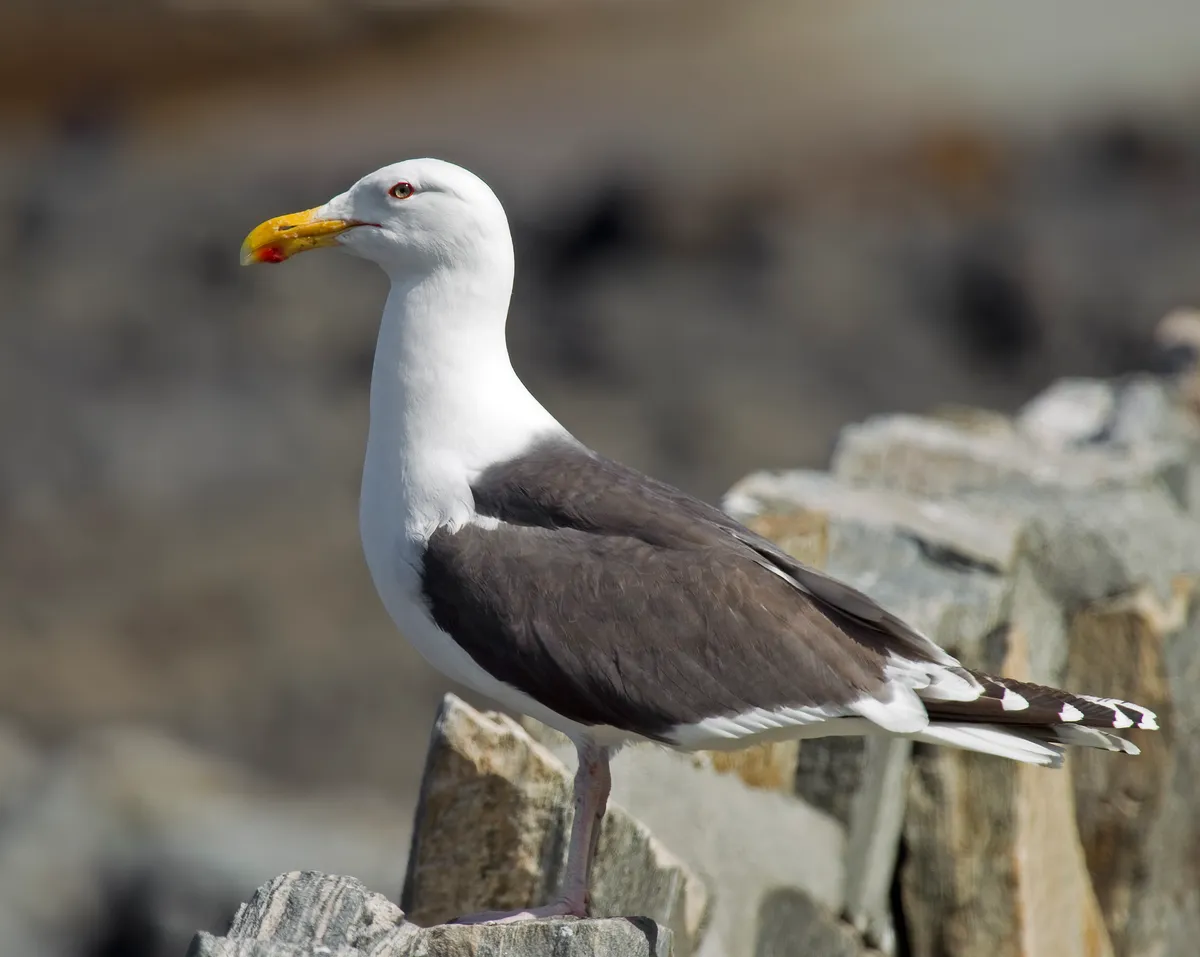
The great black-backed gull (Larus marinus) is the largest member of the gull and tern family Laridae. Southern populations are generally sedentary, while those breeding in the far north (northern Norway, northwest Russia) migrate farther south in winter. A few also move inland to large lakes and reservoirs. The adult has a white head, neck and underparts, dark blackish-grey wings and back, pink legs and the bill yellow with a red spot.
Description
This is the largest gull in the world, considerably larger than a herring gull (Larus argentatus); only two other gulls, glaucous gull (Larus hyperboreus) and Pallas's gull (Ichthyaetus ichthyaetus), come close to matching this species in size. It is 64–79 cm (25–31 in) long with a 1.5–1.7 m (4 ft 11 in – 5 ft 7 in) wingspan and a body weight of 0.75–2.3 kg (1 lb 10 oz – 5 lb 1 oz). In a sample of 2009 adults from the North Atlantic, males were on average 1,830 g (4 lb 1⁄2 oz) and females were on average 1,488 g (3 lb 4+1⁄2 oz). Some adult gulls with access to fisheries in the North Sea can weigh up to roughly 2.5 kg (5+1⁄2 lb) and averaged 1.96 kg (4 lb 5 oz). An exceptionally large glaucous gull was found to outweigh any known great black-backed gull, although usually that species is slightly smaller. The great black-backed gull is bulky and imposing in appearance with a large, powerful bill. The standard measurements are: the bill is 5.4 to 7.25 cm (2+1⁄8 to 2+7⁄8 in), the wing chord is 44.5 to 53 cm (17+1⁄2 to 20+3⁄4 in) and the tarsus is 6.6 to 8.8 cm (2+5⁄8 to 3+1⁄2 in). The adult great black-backed gull is fairly distinctive, as no other very large gull with black on its upper-wings generally occurs in the North Atlantic. In other white-headed North Atlantic gulls, the mantle is generally a lighter grey and, in some species, it is a light powdery grey or even pinkish. It is greyish-black on the wings and back, with conspicuous, contrasting white "mirrors" at the wing tips. The legs are pinkish, and the bill is yellow or yellow-pink with some orange or red near tip of lower bill. The adult lesser black-backed gull (L. fuscus) is distinctly smaller, typically weighing about half as much as a great black-back. The lesser black-back has yellowish legs and a mantle that can range from slate-grey to brownish but it is never as dark as the larger species. A few superficially similar dark-backed, fairly large gulls occur in the Pacific Ocean or in the tropics, all generally far outside this species' range, such as the slaty-backed (L. schistisagus), the western (L. occidentalis) and the kelp gull (L. dominicanus). Juvenile birds of under a year old have scaly, checkered black-brown upper parts, the head and underparts streaked with grey brown, and a neat wing pattern. The face and nape are paler and the wing flight feathers are blackish-brown.
Text from Wikipedia — Great black-backed gull, revision 1371557791, CC BY-SA 4.0, retrieved 2026-09-04. Encyclopedic text reused under CC BY-SA 4.0. Sentences about hunting or regulation are removed: on this site, the rule comes from Québec.ca.
Other names
French
English
Presence in Quebec
- Origin
- Indigène
- Occurrence
- Régulier
- Population status
- Reproducteur
- Certainty
- Confirmé
Conservation
Québec.ca
Official periods
Source: Québec.ca — tables reproduced as published (retrieved 2026-08-30).
Regulations change. Always check Québec.ca before hunting or trapping.
Where this data comes from
This species is listed in an official government dataset. The identification and status shown in the data sheet are reproduced from it.
Source: List of Quebec’s vertebrate wildlife (LFVQ) — Ministère de l’Environnement, de la Lutte contre les changements climatiques, de la Faune et des Parcs. File LFVQ_25_03_2026.csv, retrieved 2026-08-30 · CC BY 4.0.
Measurements, habitat, diet and reproduction are not shown: no official source is attached to them yet.