
No period published by Québec.ca
Québec.ca publishes no hunting or trapping period for this species. Check the official regulations.
Wikipedia
Grand chevalier
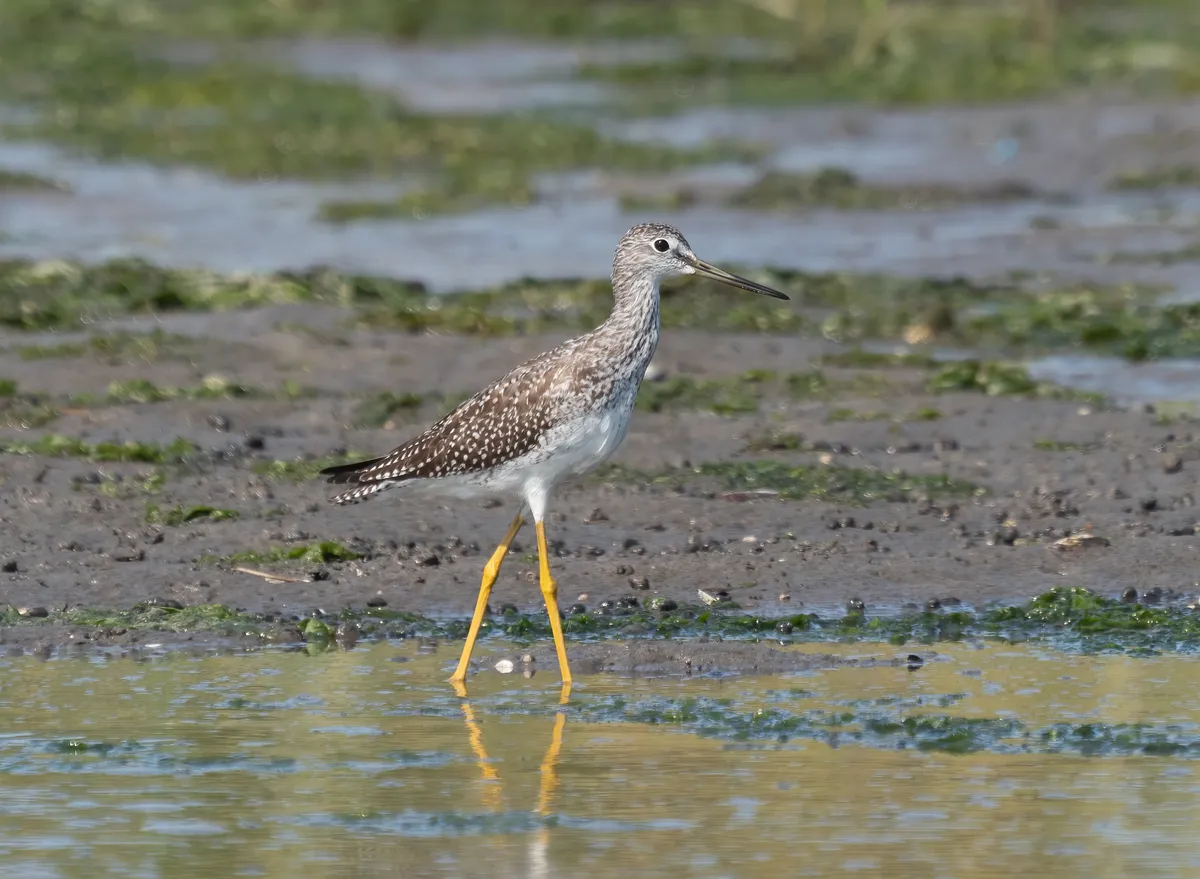
The greater yellowlegs (Tringa melanoleuca) is a large shorebird in the family Scolopacidae. It breeds in central Canada and southern Alaska and winters in southern North America, Central America, the West Indies and South America.
Description
The greater yellowlegs is similar in appearance to the smaller lesser yellowlegs. Its closest relative, however, is the greenshank, which together with the spotted redshank form a close-knit group. Among them, these three species show all the basic leg and foot colours found in the shanks, demonstrating that this character is paraphyletic. They are also the largest shanks apart from the willet, which is altogether more robustly built. The greater yellowlegs and the greenshank share a coarse, dark, and fairly crisp breast pattern as well as much black on the shoulders and back in breeding plumage. Adults have long yellow legs and a long, thin, dark bill which has a slight upward curve and is longer than the head. The body is grey-brown on top and white underneath; the neck and breast are streaked with dark brown. The rump is white. It ranges in length from 29 to 40 cm (11 to 16 in) and in weight from 111 to 250 g (3.9 to 8.8 oz). Wingspan is 23.6 in (60 cm). The call is harsher, louder, and clearer than that of the lesser yellowlegs. They have a three-syllable whistle when flight-calling, with a lower pitched third syllable.
Text from Wikipedia — Greater yellowlegs, revision 1363932371, CC BY-SA 4.0, retrieved 2026-09-04. Encyclopedic text reused under CC BY-SA 4.0. Sentences about hunting or regulation are removed: on this site, the rule comes from Québec.ca.
Other names
French
Presence in Quebec
- Origin
- Indigène
- Occurrence
- Régulier
- Population status
- Reproducteur
- Certainty
- Confirmé
Conservation
Québec.ca
Official periods
Source: Québec.ca — tables reproduced as published (retrieved 2026-08-30).
Regulations change. Always check Québec.ca before hunting or trapping.
Where this data comes from
This species is listed in an official government dataset. The identification and status shown in the data sheet are reproduced from it.
Source: List of Quebec’s vertebrate wildlife (LFVQ) — Ministère de l’Environnement, de la Lutte contre les changements climatiques, de la Faune et des Parcs. File LFVQ_25_03_2026.csv, retrieved 2026-08-30 · CC BY 4.0.
Measurements, habitat, diet and reproduction are not shown: no official source is attached to them yet.