
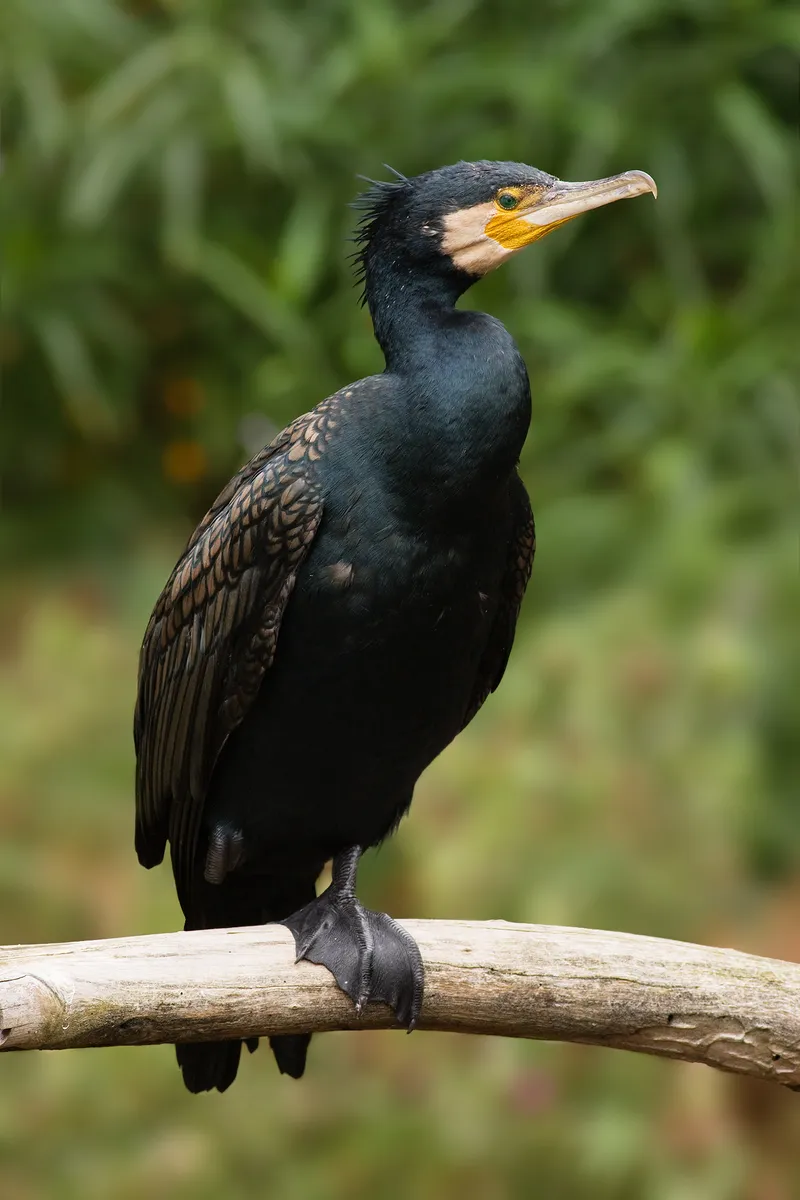
Grand cormoran— Quebec wildlife
Phalacrocorax carbo
PhalacrocoracidaeNo period published by Québec.ca
Québec.ca publishes no hunting or trapping period for this species. Check the official regulations.
Wikipedia
Grand cormoran
The great cormorant (Phalacrocorax carbo), also known as just cormorant in Britain, as black shag or kawau in New Zealand, formerly also known as the great black cormorant across the Northern Hemisphere, the black cormorant in Australia, and the large cormorant in India, is a widespread member of the cormorant family of seabirds. It breeds in much of the Old World, Australasia, and the Atlantic coast of North America.
Description
The great cormorant is a large bird, but there is a wide variation in size in the species' wide range. Weight is reported to vary from 1.5 kg (3 lb 5 oz) to 5.3 kg (11 lb 11 oz). Males are typically larger and heavier than females, with the nominate race P. c. carbo averaging about 10% larger in linear measurements than the smaller subspecies P. c. sinensis. The lightest average weights cited are in Germany (P. c. sinensis), where 36 males averaged 2.28 kg (5 lb 1⁄2 oz) and 17 females averaged 1.94 kg (4 lb 4+1⁄2 oz). The highest come from Prince Edward Island in Canada (P. c. carbo), where 11 males averaged 3.68 kg (8 lb 2 oz) and 11 females averaged 2.94 kg (6 lb 7+1⁄2 oz). Length can vary from 70 to 102 cm (27+1⁄2 to 40 in) and wingspan from 121 to 160 cm (47+1⁄2 to 63 in). They are tied as the second largest extant species of cormorant after the flightless cormorant, with the Japanese cormorant averaging at a similar size. In bulk if not in linear dimensions, the blue-eyed shag species complex of the Southern Oceans is only marginally smaller on average. The plumage is largely black, but with bronze to greenish iridescence on the wings and tail, and purple iridescence on the body. The eyes are a striking deep sea-green in adults, duller dark grey in juveniles. The tail is fairly long, with 14 feathers. The bill is stout, and strongly hooked at the tip, dark grey at the tip, grading to paler at the base; it also has a yellow, or sometimes red, patch of bare gular skin on the throat at the base of the bill. The legs are short but stout, and dark grey; the feet large, and fully webbed between all four toes (totipalmate). In the breeding season, adults have white filoplume patches on the thighs and on the head and upper neck. The two African subspecies P. c. maroccanus and P. c. lucidus also have more extensive white plumage on the foreneck and breast. In winter, the plumage is more uniformly black, slightly duller and less glossy, and the white filoplumes are shed. Juveniles and immatures have pale to whitish underparts, becoming browner in their second year and reaching adult plumage when 3–4 years old. Great cormorants are mostly silent, but they make various guttural noises at their breeding colonies. In European waters the great cormorant can be distinguished from the European shag by its larger size, heavier build, thicker bill, lack of a crest and body plumage with a purple, not green, tinge.
Habitat and range
This is a very common and widespread bird species. It feeds at sea in inshore waters, in estuaries, and on freshwater lakes and rivers.N
Text from Wikipedia — Great cormorant, revision 1339370010, CC BY-SA 4.0, retrieved 2026-09-04. Encyclopedic text reused under CC BY-SA 4.0. Sentences about hunting or regulation are removed: on this site, the rule comes from Québec.ca.
Other names
French
English
Presence in Quebec
- Origin
- Indigène
- Occurrence
- Régulier
- Population status
- Toute l'année
- Certainty
- Confirmé
Conservation
Québec.ca
Official periods
Source: Québec.ca — tables reproduced as published (retrieved 2026-08-30).
Regulations change. Always check Québec.ca before hunting or trapping.
Where this data comes from
This species is listed in an official government dataset. The identification and status shown in the data sheet are reproduced from it.
Source: List of Quebec’s vertebrate wildlife (LFVQ) — Ministère de l’Environnement, de la Lutte contre les changements climatiques, de la Faune et des Parcs. File LFVQ_25_03_2026.csv, retrieved 2026-08-30 · CC BY 4.0.
Measurements, habitat, diet and reproduction are not shown: no official source is attached to them yet.