
No period published by Québec.ca
Québec.ca publishes no hunting or trapping period for this species. Check the official regulations.
Wikipedia
Grand-duc d'Amérique
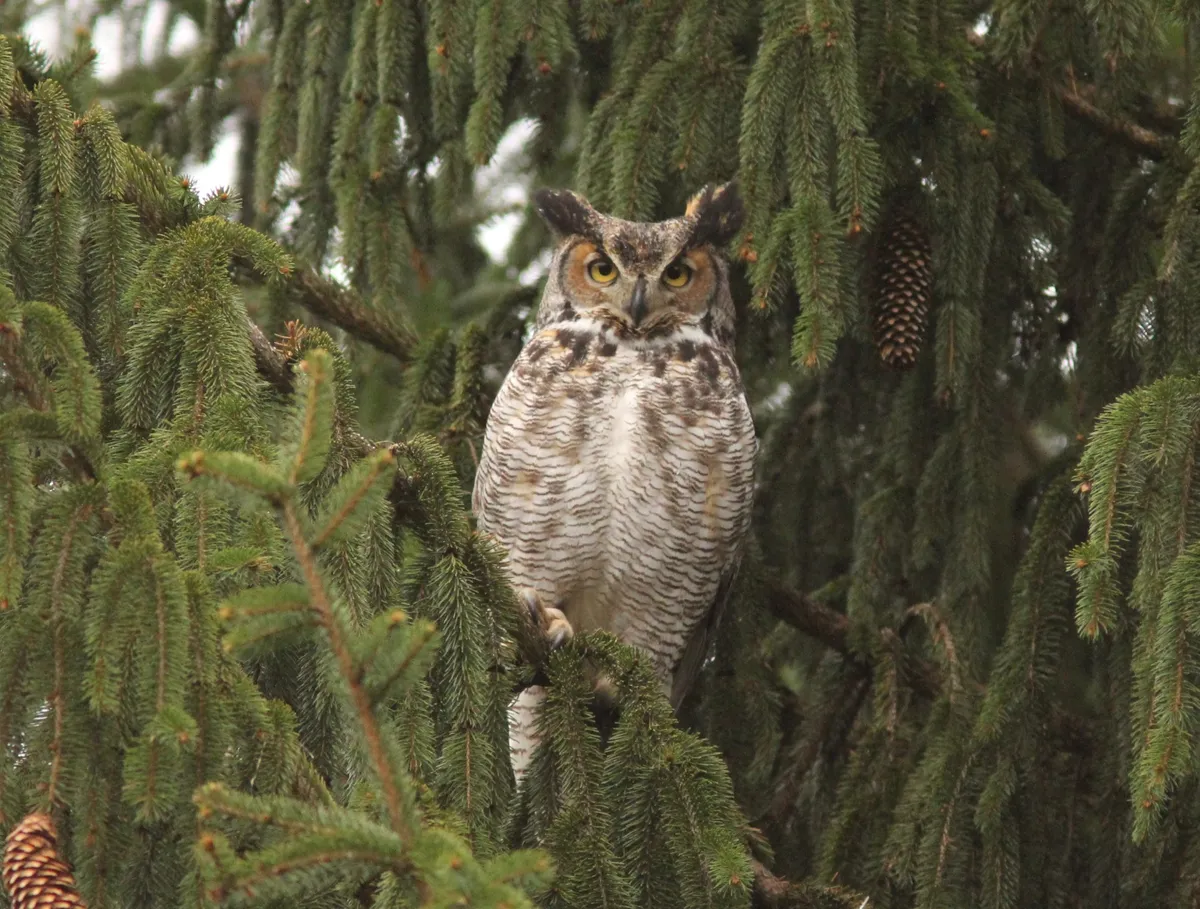
The great horned owl (Bubo virginianus), also known as the tiger owl (originally derived from early naturalists' description as the "winged tiger" or "tiger of the air") or the hoot owl, is a large owl native to the Americas. It is an extremely adaptable bird with a vast range and is the most widely distributed true owl in the Americas. Its diet consists primarily of rabbits and hares, rats and mice, and voles; it remains one of the few regular predators of skunk. In ornithological study, the great horned owl is often compared to the Eurasian eagle-owl (Bubo bubo), a closely related species, which occupies the same ecological niche in Eurasia despite its notably larger size. The great horned owl is also compared to the red-tailed hawk (Buteo jamaicensis), with which it often shares similar habitat, prey, and nesting habits by day; thus the red-tailed hawk is something of a diurnal ecological equivalent. The great horned owl is one of the earliest nesting birds in North America, often laying eggs weeks or even months before other raptorial birds.
Description
The great horned owl is generally colored for camouflage. The underparts of the species are usually light with some brown horizontal barring; the upper parts and upper wings are generally a mottled brown usually bearing heavy, complex, darker markings. All subspecies are darkly barred to some extent along the sides. A variable-sized white patch is seen on the throat. The white throat may continue as a streak running down the middle of the breast even when the birds are not displaying, which in particularly pale individuals can widen at the belly into a large white area. South American great horned owls typically have a smaller white throat patch, often unseen unless actively displaying, and rarely display the white area on the chest. Individual and regional variations in overall color occur, with birds from the subarctic showing a washed-out, light-buff color, while those from the Pacific Coast of North America, Central America, and much of South America can be a dark brownish color overlaid with blackish blotching. The skin of the feet and legs, though almost entirely obscured by feathers, is black. Even tropical great horned owls have feathered legs and feet. The feathers on the feet of the great horned owl are the second-longest known in any owl (after the snowy owl). The bill is dark gunmetal-gray, as are the talons. All great horned owls have a facial disc. This can be reddish, brown, or gray in color (depending on geographical and racial variation) and is demarked by a dark rim culminating in bold, blackish side brackets. This species' eyebrow-like "horns" are tufts of feathers, called plumicorns. The purpose of plumicorns is not fully understood, but the hypothesis that they serve as a visual cue in territorial and sociosexual interactions with other owls is generally accepted.
Reproduction
Great horned owls are some of the earliest-breeding birds in North America, seemingly in part because of the lengthy nightfa
Text from Wikipedia — Great horned owl, revision 1372952868, CC BY-SA 4.0, retrieved 2026-09-04. Encyclopedic text reused under CC BY-SA 4.0. Sentences about hunting or regulation are removed: on this site, the rule comes from Québec.ca.
Other names
French
English
Presence in Quebec
- Origin
- Indigène
- Occurrence
- Régulier
- Population status
- Toute l'année
- Certainty
- Confirmé
Conservation
Québec.ca
Official periods
Source: Québec.ca — tables reproduced as published (retrieved 2026-08-30).
Regulations change. Always check Québec.ca before hunting or trapping.
Where this data comes from
This species is listed in an official government dataset. The identification and status shown in the data sheet are reproduced from it.
Source: List of Quebec’s vertebrate wildlife (LFVQ) — Ministère de l’Environnement, de la Lutte contre les changements climatiques, de la Faune et des Parcs. File LFVQ_25_03_2026.csv, retrieved 2026-08-30 · CC BY 4.0.
Measurements, habitat, diet and reproduction are not shown: no official source is attached to them yet.