
No period published by Québec.ca
Québec.ca publishes no hunting or trapping period for this species. Check the official regulations.
Wikipedia
Grand harle
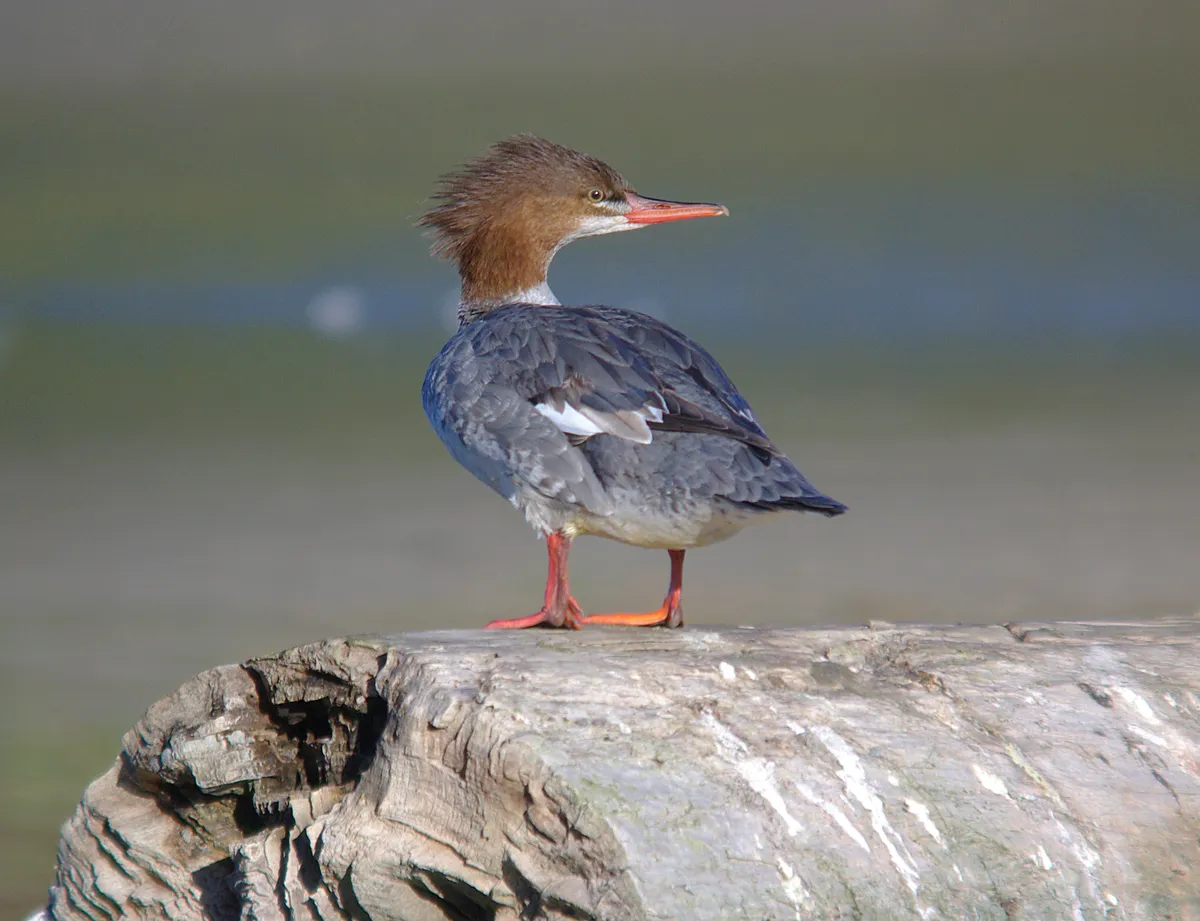
The common merganser or goosander (Mergus merganser) is a large sea duck of rivers and lakes in forested areas of Europe, Asia, and North America. The common merganser eats mainly fish. It nests in holes in trees. The name "common merganser" is used in North America, while "goosander" is used in Eurasia.
Description
It is 58–72 cm (23–28+1⁄2 in) long with a 78–97 cm (30+1⁄2–38 in) wingspan and a weight of 0.9–2.1 kg (2 lb 0 oz – 4 lb 10 oz); males are on average slightly larger than females, but with some overlap. Like other species in the genus Mergus, it has a crest of longer head feathers, but these usually lie smoothly rounded behind the head and do not normally form an erect crest. Adult males in breeding plumage are easily distinguished, the body white with a variable salmon-pink tinge, the head black with an iridescent green sheen, the rump and tail grey, and the wings largely white on the inner half, black on the outer half. Females and males in "eclipse" (non-breeding plumage, July to October) are largely grey, with a reddish-brown head, white chin, and white secondary feathers on the wing. Juveniles (both sexes) are similar to adult females but also show a short black-edged white stripe between the eye and bill. The bill and legs are red to brownish-red, brightest on adult males, dullest on juveniles.
Text from Wikipedia — Common merganser, revision 1367522339, CC BY-SA 4.0, retrieved 2026-09-04. Encyclopedic text reused under CC BY-SA 4.0. Sentences about hunting or regulation are removed: on this site, the rule comes from Québec.ca.
Other names
French
English
Presence in Quebec
- Origin
- Indigène
- Occurrence
- Régulier
- Population status
- Reproducteur
- Certainty
- Confirmé
Conservation
Québec.ca
Official periods
Source: Québec.ca — tables reproduced as published (retrieved 2026-08-30).
Regulations change. Always check Québec.ca before hunting or trapping.
Where this data comes from
This species is listed in an official government dataset. The identification and status shown in the data sheet are reproduced from it.
Source: List of Quebec’s vertebrate wildlife (LFVQ) — Ministère de l’Environnement, de la Lutte contre les changements climatiques, de la Faune et des Parcs. File LFVQ_25_03_2026.csv, retrieved 2026-08-30 · CC BY 4.0.
Measurements, habitat, diet and reproduction are not shown: no official source is attached to them yet.