
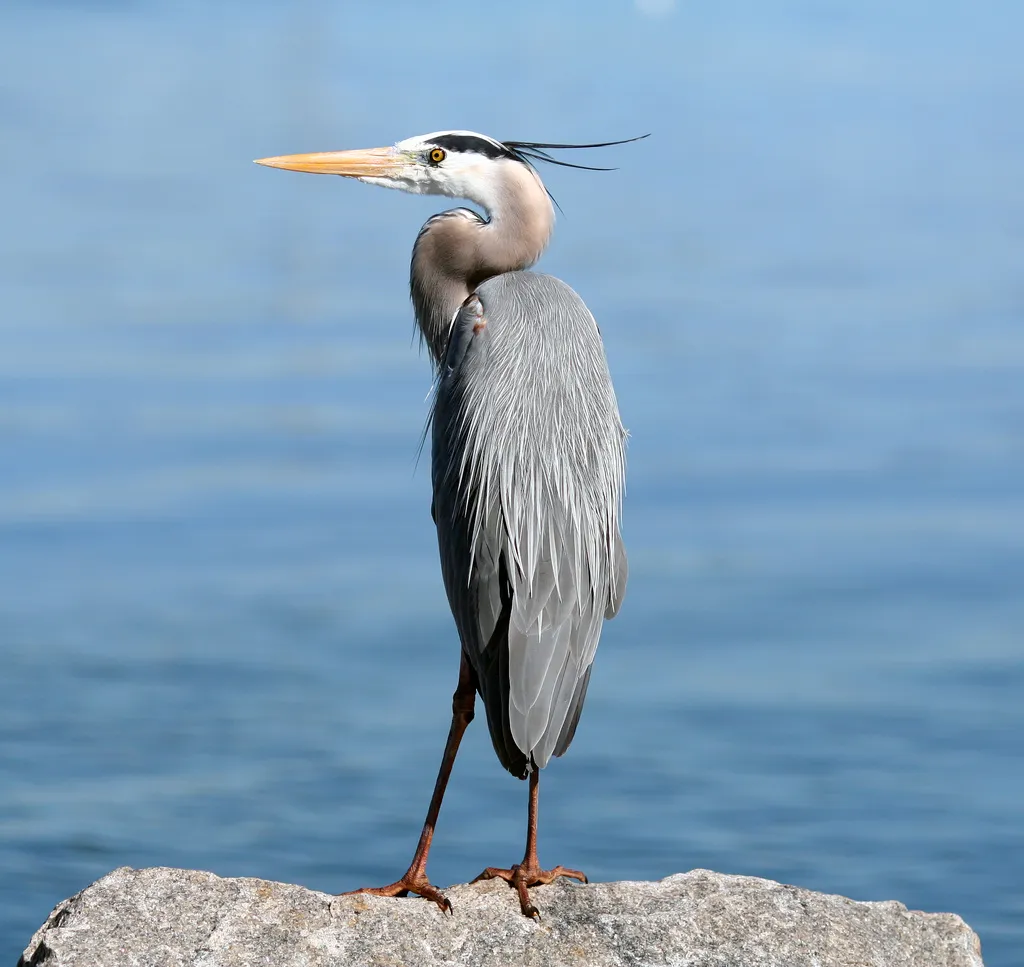
Grand héron— Quebec wildlife
Ardea herodias
ArdeidaeNo period published by Québec.ca
Québec.ca publishes no hunting or trapping period for this species. Check the official regulations.
Wikipedia
Grand héron
The great blue heron (Ardea herodias) is a large wading bird in the heron family (Ardeidae), common near shores of open water and wetlands over most of North and Central America, as well as Northwestern South America, the Caribbean, and the Galápagos Islands. It is occasionally found in the Azores and is a rare vagrant to Europe. An all-white population found in South Florida and the Florida Keys is known as the great white heron. Debate exists about whether these white birds are a color morph of the great blue heron, a subspecies of it, or an entirely separate species.
Description
The great blue heron is the largest heron native to North America. Among all extant herons, it is surpassed in size only by the Goliath heron (Ardea goliath) and the white-bellied heron (Ardea insignis). It exhibits a minor degree of sexual dimorphism; males are slightly larger than females, but otherwise the sexes are not easily outwardly distinguishable. It has a head-to-tail length of 91–137 cm (36–54 in), a wingspan of 167–201 cm (66–79 in), a height of 115–138 cm (45–54 in), and a weight of 1.82–3.6 kg (4.0–7.9 lb). In British Columbia, adult males averaged 2.48 kg (5.5 lb) and adult females 2.11 kg (4.7 lb). In Nova Scotia and New England, adult herons of both sexes averaged 2.23 kg (4.9 lb), while in Oregon, both sexes averaged 2.09 kg (4.6 lb) Thus, great blue herons are roughly twice as heavy as great egrets (Ardea alba), although only slightly taller than them, but they weigh only about half as much as a large goliath heron. Notable features of great blue herons include slaty (gray with a slight azure blue) flight feathers, red-brown thighs, and a paired red-brown and black stripe up the flanks; the neck is rusty gray, with black-and-white streaking down the front; the head is paler, with a nearly white face, and a pair of black or slate plumes runs from just above the eye to the back of the head. The feathers on the lower neck are long and plume-like; it also has plumes on the lower back at the start of the breeding season. The bill is dull yellowish, becoming orange briefly at the start of the breeding season, and the lower legs are gray, also becoming orangey at the start of the breeding season. Immature birds are duller in color, with a dull blackish-gray crown, and the flank pattern is only weakly defined; they have no plumes, and the bill is dull gray-yellow. Among standard measurements, the wing chord is 43–49.2 cm (16.9–19.4 in), the tail is 15.2–19.5 cm (6.0–7.7 in), the culmen is 12.3–15.2 cm (4.8–6.0 in), and the tarsi are 15.7–21.0 cm (6.2–8.3 in). The heron's stride is around 22 cm (8.7 in), almost in a straight line. Two of the three front toes are generally closer together. In a track, the front toes, as well as the back, often show the small talons. The subspecies physically differ only slightly in size and plumage tone, with the exception of A. h.
Text from Wikipedia — Great blue heron, revision 1372320036, CC BY-SA 4.0, retrieved 2026-09-04. Encyclopedic text reused under CC BY-SA 4.0. Sentences about hunting or regulation are removed: on this site, the rule comes from Québec.ca.
Other names
French
English
Presence in Quebec
- Origin
- Indigène
- Occurrence
- Régulier
- Population status
- Reproducteur
- Certainty
- Confirmé
Conservation
Québec.ca
Official periods
Source: Québec.ca — tables reproduced as published (retrieved 2026-08-30).
Regulations change. Always check Québec.ca before hunting or trapping.
Where this data comes from
This species is listed in an official government dataset. The identification and status shown in the data sheet are reproduced from it.
Source: List of Quebec’s vertebrate wildlife (LFVQ) — Ministère de l’Environnement, de la Lutte contre les changements climatiques, de la Faune et des Parcs. File LFVQ_25_03_2026.csv, retrieved 2026-08-30 · CC BY 4.0.
Measurements, habitat, diet and reproduction are not shown: no official source is attached to them yet.