
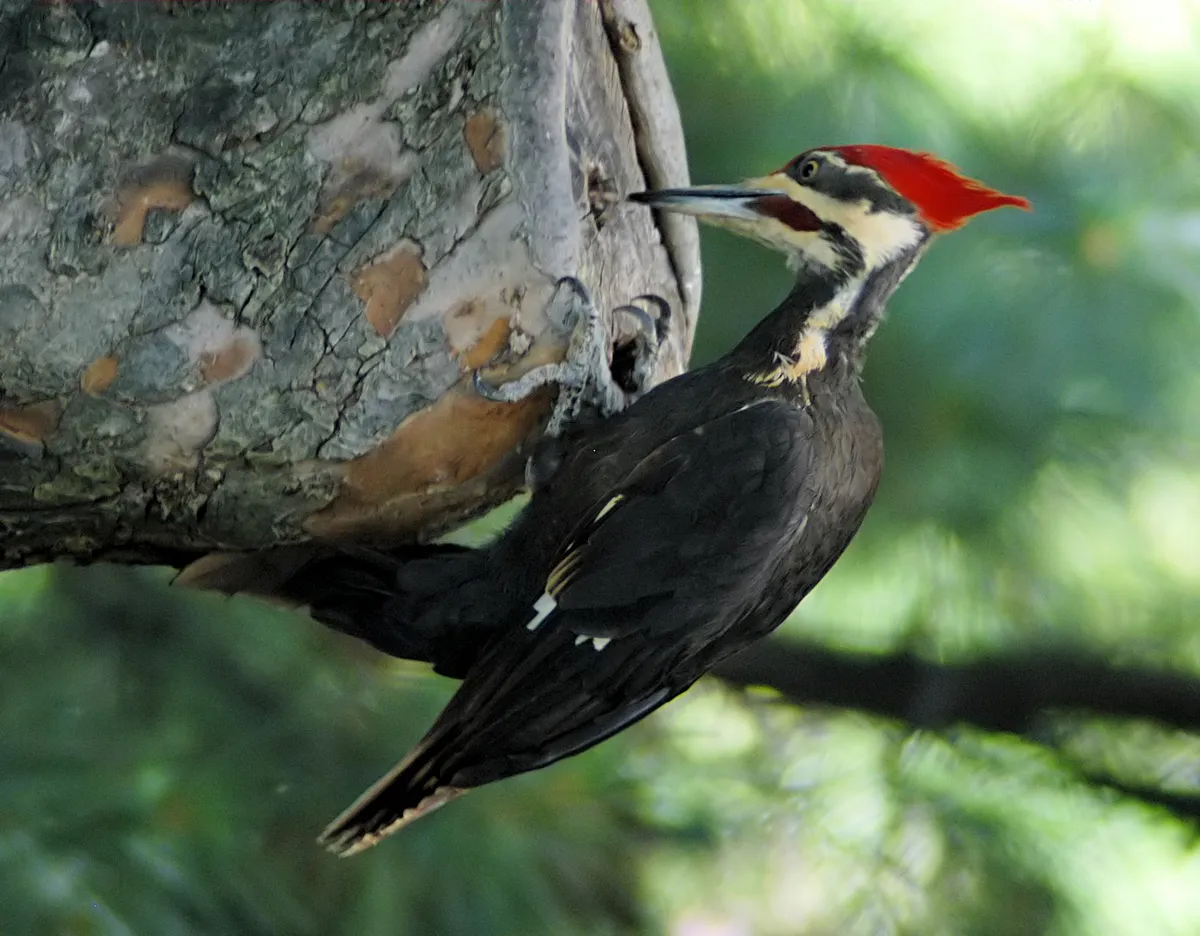
Grand pic— Quebec wildlife
Dryocopus pileatus
PicidaeNo period published by Québec.ca
Québec.ca publishes no hunting or trapping period for this species. Check the official regulations.
Wikipedia
Grand pic
The pileated woodpecker ( PY-lee-ay-tid, PIL-ee-; Dryocopus pileatus) is a large, crow-sized woodpecker with a prominent red crest, white neck stripe, and a mostly black body. This woodpecker is native to North America, where it is the largest confirmed extant woodpecker species and the third-largest extant species of woodpecker in the world, after the great slaty woodpecker and the black woodpecker. It inhabits deciduous forests in eastern North America, the Great Lakes, the boreal forests of Canada, and parts of the Pacific Coast. This woodpecker is primarily an insectivore, eating insects that live in trees; it is famous for making large, nearly rectangular carvings into trees, which are used to extract prey inside the tree or to make a nest. The species has a large range and an increasing population, causing it to be categorized as a species of "least concern" by the IUCN.
Description
Pileated woodpeckers are mainly black with a red crest and have a white line down the sides of the throat. Adult males have a red line from the bill to the throat; in adult females, these are black. They also have white wing feathers that show when in flight. Adults are 40 to 49 cm (16 to 19 in) long, span 66 to 75 cm (26 to 30 in) across the wings, and weigh 225 to 400 g (7.9 to 14.1 oz). The average weight of females and males combined is about 277 g (9.8 oz), with males weighing about 300 g (11 oz) and females weighing about 256 g (9.0 oz) in mean body mass. The wing chord measures 21.4 to 25.3 cm (8.4 to 10.0 in), the tail measures 14.0 to 17.4 cm (5.5 to 6.9 in), the bill is 4.1 to 6.0 cm (1.6 to 2.4 in), and the tarsus measures 3.1 to 3.8 cm (1.2 to 1.5 in). Southern pileated woodpeckers have ebony feathers, less white on the feathers by the wings, and are smaller in overall size compared to their northern counterparts. Northern pileated woodpeckers are larger in wing, tail, and beak size. They also have feathers that are a lighter black with tinges of brown and gray and whiter feathers on their flanks. Juvenile pileated woodpeckers tend to have less curved crests, or "mohawks" as some refer to them. The flight of these birds is strong and direct, but undulates in the way characteristic of woodpeckers. Two species found in the Old World, the white-bellied woodpecker (D. javensis) and black woodpeckers (D. martius), are closely related and occupy the same ecological niche in their respective ranges that the pileated occupies in North America. The only North American birds of similar plumage and size are the (likely extinct) ivory-billed woodpecker of the Southeastern United States and Cuba and the related imperial woodpecker of Mexico.
Text from Wikipedia — Pileated woodpecker, revision 1373124466, CC BY-SA 4.0, retrieved 2026-09-04. Encyclopedic text reused under CC BY-SA 4.0. Sentences about hunting or regulation are removed: on this site, the rule comes from Québec.ca.
Other names
French
English
Presence in Quebec
- Origin
- Indigène
- Occurrence
- Régulier
- Population status
- Toute l'année
- Certainty
- Confirmé
Conservation
Québec.ca
Official periods
Source: Québec.ca — tables reproduced as published (retrieved 2026-08-30).
Regulations change. Always check Québec.ca before hunting or trapping.
Where this data comes from
This species is listed in an official government dataset. The identification and status shown in the data sheet are reproduced from it.
Source: List of Quebec’s vertebrate wildlife (LFVQ) — Ministère de l’Environnement, de la Lutte contre les changements climatiques, de la Faune et des Parcs. File LFVQ_25_03_2026.csv, retrieved 2026-08-30 · CC BY 4.0.
Measurements, habitat, diet and reproduction are not shown: no official source is attached to them yet.