
No period published by Québec.ca
Québec.ca publishes no hunting or trapping period for this species. Check the official regulations.
Wikipedia
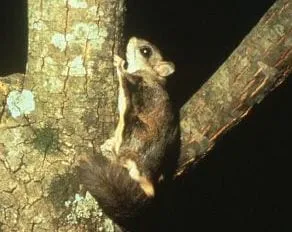
Grand polatouche
The northern flying squirrel (Glaucomys sabrinus) is one of three species of the genus Glaucomys, the only flying squirrels found in North America. They are found in coniferous and mixed coniferous forests across much of Canada, from Alaska to Nova Scotia, and south to the mountains of North Carolina and west to Utah in the United States. They are light brown with pale underparts and grow to a length of 25 to 37 cm (10 to 15 in). They are proficient gliders but uncoordinated walkers on the ground. They feed on a variety of plant material as well as tree sap, fungi, insects, carrion, bird eggs and nestlings. They mostly breed once a year in a cavity lined with lichen or other soft material. Except when they have young, they change nests frequently, and in winter a number of individuals may huddle together in a shared nest. Unlike most members of their family, flying squirrels are strictly nocturnal.
Description
These nocturnal, arboreal rodents have thick light brown or cinnamon fur on their upper body and greyish fur on the flanks and whitish fur underneath. They have large eyes and a flat tail. They can also be identified by their long whiskers, common to nocturnal mammals. The adult northern flying squirrel measures from 25 to 37 cm long, and their weight can range from 110 to 230 grams.
Diet
A major food source for the squirrels are fungi of various species, although they also eat lichens, all mast-crop nuts, tree sap, insects, carrion, bird eggs and nestlings, buds and flowers. The squirrels are able to locate truffles by olfaction, though they also seem to use cues such as the presence of coarse woody debris, indicating a decaying log, and spatial memory of locations where truffles were found in the past. The northern flying squirrel is also known to cache food for when food supplies are lower. These caches can be in cavities in trees, as well as in the squirrels' nest. Lichens and seeds are commonly cached.
Text from Wikipedia — Northern flying squirrel, revision 1370738115, CC BY-SA 4.0, retrieved 2026-09-04. Encyclopedic text reused under CC BY-SA 4.0. Sentences about hunting or regulation are removed: on this site, the rule comes from Québec.ca.
Other names
French
Presence in Quebec
- Origin
- Indigène
- Occurrence
- Régulier
- Population status
- Toute l'année
- Certainty
- Confirmé
Conservation
Québec.ca
Official periods
Source: Québec.ca — tables reproduced as published (retrieved 2026-08-30).
Regulations change. Always check Québec.ca before hunting or trapping.
Where this data comes from
This species is listed in an official government dataset. The identification and status shown in the data sheet are reproduced from it.
Source: List of Quebec’s vertebrate wildlife (LFVQ) — Ministère de l’Environnement, de la Lutte contre les changements climatiques, de la Faune et des Parcs. File LFVQ_25_03_2026.csv, retrieved 2026-08-30 · CC BY 4.0.
Measurements, habitat, diet and reproduction are not shown: no official source is attached to them yet.