
No period published by Québec.ca
Québec.ca publishes no hunting or trapping period for this species. Check the official regulations.
Wikipedia
Grande aigrette
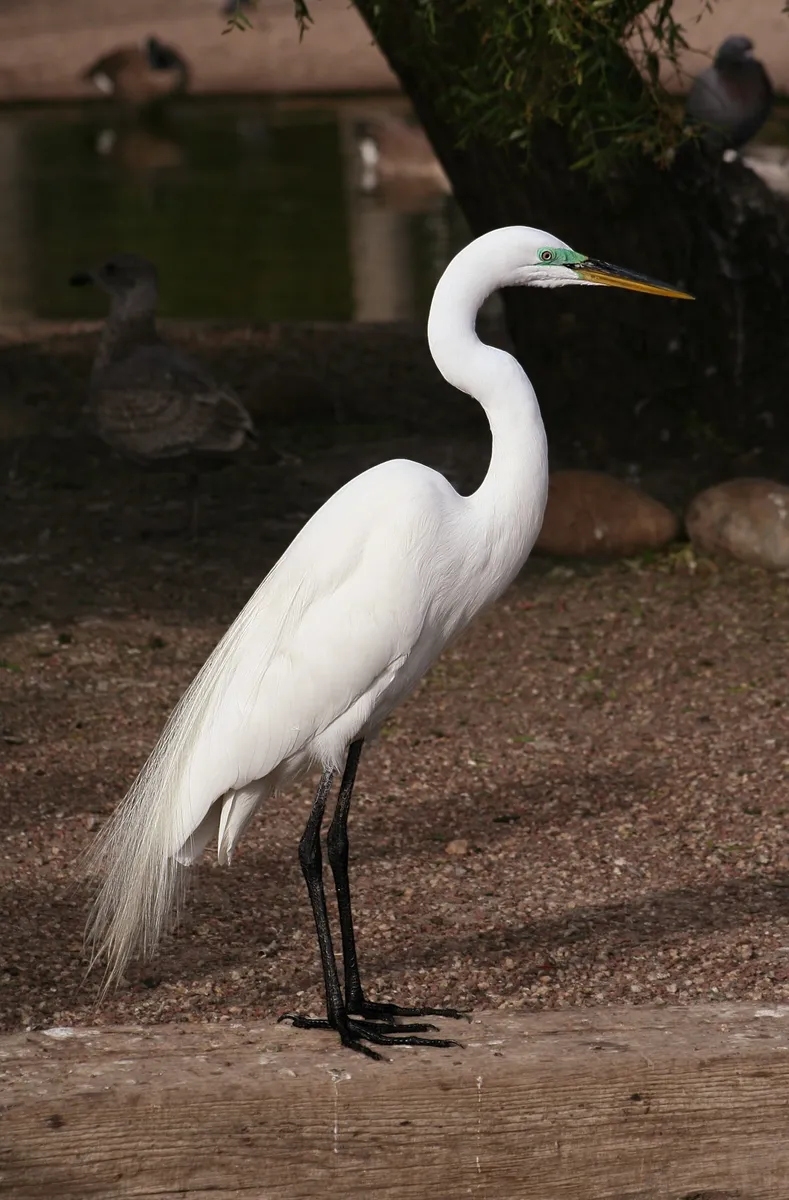
The great egret (Ardea alba), also known as the common egret, large egret, great white egret, or great white heron, is a large, widely distributed egret. The four subspecies are found in Asia, Africa, the Americas, and southern Europe. Recently, it has also been spreading to more northern areas of Europe. Distributed across most of the tropical and warmer temperate regions of the world, it builds tree nests in colonies close to water.
Description
The great egret is a large heron with all-white plumage. Standing up to 1 m (3 ft 3 in) tall, this species can measure 80 to 104 cm (31 to 41 in) in length with a wingspan of 131 to 170 cm (52 to 67 in). Body mass can range from 700 to 1,500 g (25 to 53 oz), with an average around 1,000 g (35 oz). It is thus only slightly smaller than the great blue or grey heron (A. cinerea). Apart from size, the great egret can be distinguished from other white egrets by its yellow bill and black legs and feet, though the bill may become darker and the lower legs lighter in the breeding season. In breeding plumage, delicate ornamental feathers are borne on the back. Males and females are identical in appearance; juveniles look like nonbreeding adults. Differentiated from the intermediate egret (Ardea intermedia) by the gape, which extends well beyond the back of the eye in case of the great egret, but ends just behind the eye in case of the intermediate egret. Its flight is slow with its neck retracted. This is characteristic of herons and bitterns, and distinguishes them from storks, cranes, ibises, and spoonbills, which extend their necks in flight. The great egret walks with its neck extended and wings held close. The great egret is not normally a vocal bird; it gives a low, hoarse croak when disturbed, and at breeding colonies, it often gives a loud croaking cuk cuk cuk and higher-pitched squawks. Owing to its wide distribution across so much of the Americas, as well as Africa, Europe and Asia, the great egret shares its habitat with many other similar species. For example, the little egret (Egretta garzetta), intermediate egret (Ardea intermedia), Chinese egret (Egretta eulophotes), and the western reef heron (Egretta gularis). In the Americas, the snowy egret (Egretta thula)—a medium-sized heron that shares the same habitat as the great egret—is one such species. The snowy egret is readily distinguished from the great egret because it is noticeably smaller, and it has a more slender bill which is black in color and yellow feet, whereas the great egret has a yellow bill and black feet. Another species that—in North America—is easily confused with the great egret is the white morph of the great blue heron (Ardea herodias). The great blue heron is a bit larger, and has a thicker bill than that of the great egret.
Text from Wikipedia — Great egret, revision 1365982155, CC BY-SA 4.0, retrieved 2026-09-04. Encyclopedic text reused under CC BY-SA 4.0. Sentences about hunting or regulation are removed: on this site, the rule comes from Québec.ca.
Other names
French
English
Former scientific names
Presence in Quebec
- Origin
- Indigène
- Occurrence
- Régulier
- Population status
- Reproducteur
- Certainty
- Confirmé
Conservation
Québec.ca
Official periods
Source: Québec.ca — tables reproduced as published (retrieved 2026-08-30).
Regulations change. Always check Québec.ca before hunting or trapping.
Where this data comes from
This species is listed in an official government dataset. The identification and status shown in the data sheet are reproduced from it.
Source: List of Quebec’s vertebrate wildlife (LFVQ) — Ministère de l’Environnement, de la Lutte contre les changements climatiques, de la Faune et des Parcs. File LFVQ_25_03_2026.csv, retrieved 2026-08-30 · CC BY 4.0.
Measurements, habitat, diet and reproduction are not shown: no official source is attached to them yet.