
No period published by Québec.ca
Québec.ca publishes no hunting or trapping period for this species. Check the official regulations.
Wikipedia
Grande musaraigne
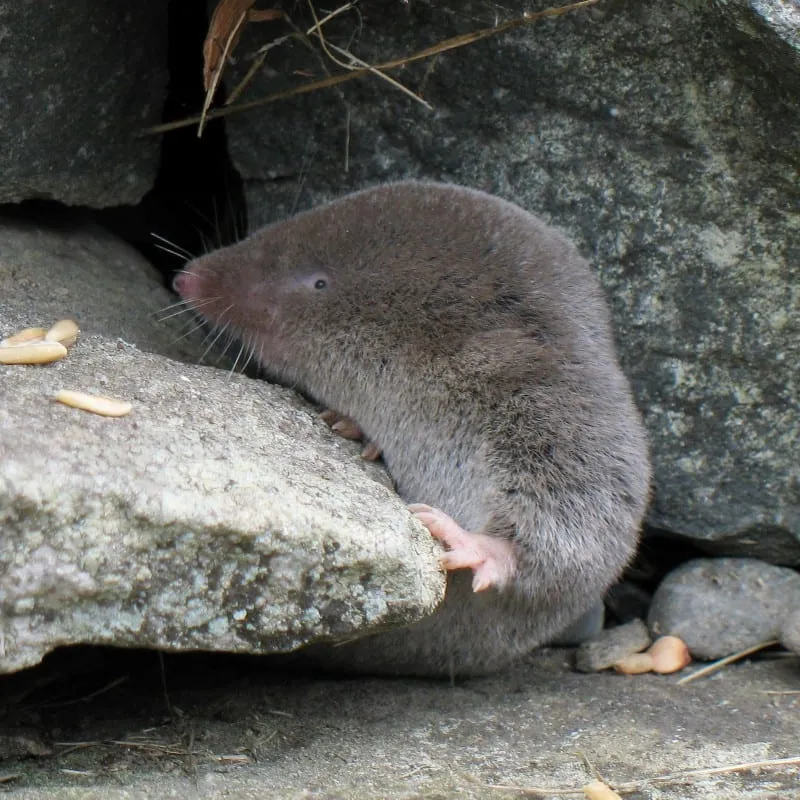
The northern short-tailed shrew (Blarina brevicauda) is the largest shrew in the genus Blarina, and occurs in the northeastern region of North America. It is a semifossorial, highly active, and voracious insectivore and is present in a variety of habitats like broadleaved and pine forests among shrubs and hedges as well as grassy river banks. It is notable in that it is one of the few venomous mammals. The specific epithet, brevicauda, is a combination of the Latin brevis and cauda, meaning "short tail".
Description
This shrew has a total length of 108 to 140 mm (4.3 to 5.5 in), of which 18 to 32 mm (0.71 to 1.26 in) is tail; and weighs 15 to 30 g (0.53 to 1.06 oz). The species exhibits slight sexual dimorphism in size, with the male being slightly larger than the female. The dorsal fur is thick and velvety, and can be black, brownish black, or silvery gray, with the ventral fur being a bit lighter and grayer. The shrew molts from a summer coat which is shorter and paler than the winter pelage in October and November, and back again sometime in February through July. The tail is quite short, amounting to less than 25% of the total length. The dental formula is I 3-3/1-1, C 1-1/1-1, P 3-3/1-1, M 3-3/3-3 = 16/16 = 32. Three well-developed scent glands are present, one on each side of the animal and one ventral; the scent may be used for marking territories, though the shrew's sense of smell is thought to be poor.
Diet
This shrew consumes up to three times its weight in food each day. It eats small quantities of subterranean fungi and seeds, though it is mostly carnivorous. It prefers insects (such as beetles), earthworms, voles, snails, and other shrews for the bulk of its diet, though salamanders, frogs, snakes, birds, and mice are also eaten. This shrew consumes vertebrates more often than other shrews do. The shrew mostly forages within a few hours after sunset, though it is also active during cloudy days. High evaporative water loss requires the shrew to have access to a source of water, though it does obtain water from its food, as well. The shrew often hoards food, especially in the fall and winter, or during a time of prey abundance; one study found it caches 87% of the prey it catches, while 9% is eaten immediately and 4% is left where it was killed.
Reproduction
Mating occurs from March through September, though most births occur early or late in that period. Male shrews in captivity were observed to make clicking sounds while courting a female. During copulation, the male and female are locked together, and the female drags the male along with her. Gestation lasts 21–24 days, and after birth, the six to eight young are suckled for up to 25 days before the babies are weaned. Two litters per season are typical, though three are possible. The female strengthens the nest when the young are nursing, and is more active to support her increased nutritional needs.
Text from Wikipedia — Northern short-tailed shrew, revision 1343448122, CC BY-SA 4.0, retrieved 2026-09-04. Encyclopedic text reused under CC BY-SA 4.0. Sentences about hunting or regulation are removed: on this site, the rule comes from Québec.ca.
Other names
French
Presence in Quebec
- Origin
- Indigène
- Occurrence
- Régulier
- Population status
- Toute l'année
- Certainty
- Confirmé
Conservation
Québec.ca
Official periods
Source: Québec.ca — tables reproduced as published (retrieved 2026-08-30).
Regulations change. Always check Québec.ca before hunting or trapping.
Where this data comes from
This species is listed in an official government dataset. The identification and status shown in the data sheet are reproduced from it.
Source: List of Quebec’s vertebrate wildlife (LFVQ) — Ministère de l’Environnement, de la Lutte contre les changements climatiques, de la Faune et des Parcs. File LFVQ_25_03_2026.csv, retrieved 2026-08-30 · CC BY 4.0.
Measurements, habitat, diet and reproduction are not shown: no official source is attached to them yet.