
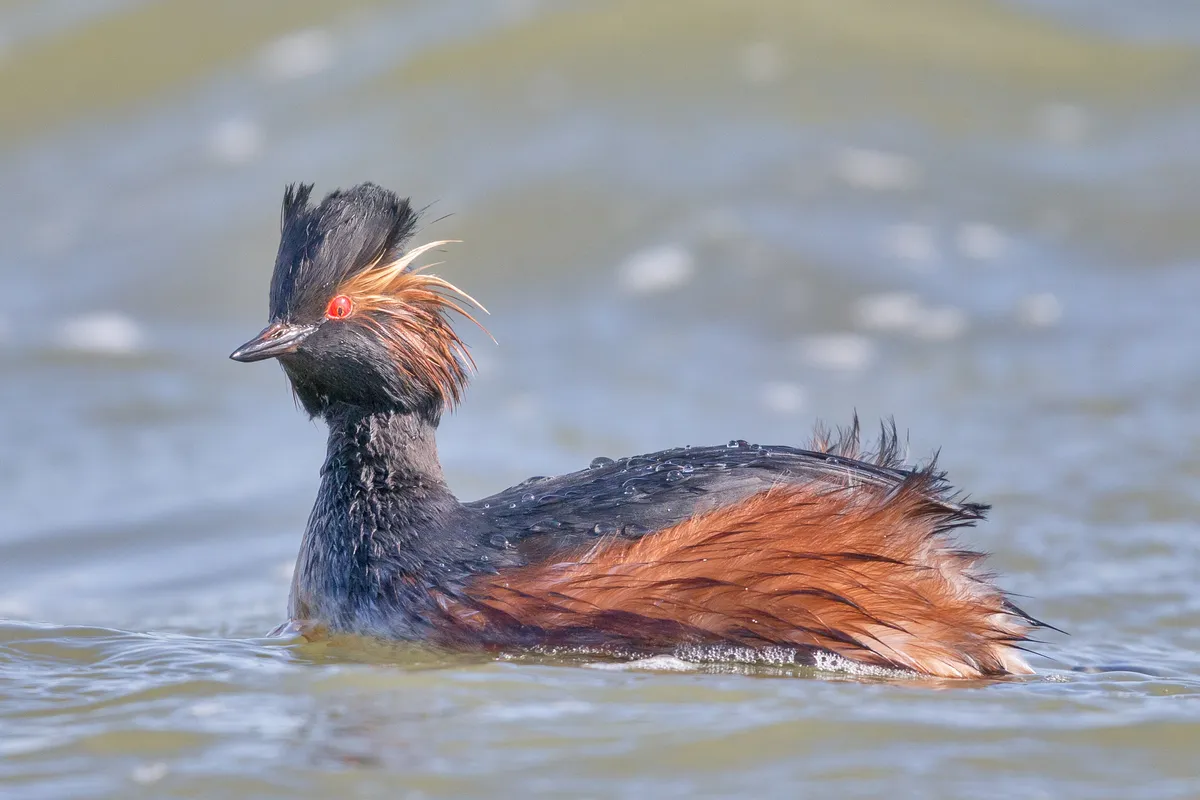
Grèbe à cou noir— Quebec wildlife
Podiceps nigricollis
PodicipedidaeNo period published by Québec.ca
Québec.ca publishes no hunting or trapping period for this species. Check the official regulations.
Wikipedia
Grèbe à cou noir
The black-necked grebe or eared grebe (Podiceps nigricollis) is a member of the grebe family of water birds. It was described in 1831 by Christian Ludwig Brehm. Its breeding plumage features distinctive ochre-coloured feathers which extend behind its eye and over its ear coverts. The rest of the upper parts, including the head, neck, and breast, are coloured black to blackish brown. The flanks are tawny rufous to maroon-chestnut, and the abdomen is white. In its non-breeding plumage, this bird has greyish-black upper parts, including the top of the head and a vertical stripe on the back of the neck. The flanks are also greyish-black. The rest of the body is a white or whitish colour. The juvenile has more brown in its darker areas. This species is present in parts of Africa, Eurasia, and the Americas. The black-necked grebe uses multiple foraging techniques. Insects, which make up the majority of this bird's diet, are caught either on the surface of the water or when they are in flight; this species occasionally practices foliage gleaning. This grebe dives to catch crustaceans, molluscs, tadpoles, and small frogs and fish. When moulting at saline lakes, this bird feeds mostly on brine shrimps (such as Artemia franciscana, and "Artemia parthenogenetica"). The black-necked grebe makes a floating cup nest on an open lake. The nest cup is covered with a disc. This nest is located both in colonies and by itself. During the breeding season, which varies depending on location, this species will lay one (sometimes two) clutch of three to four eggs. The number of eggs is sometimes larger due to conspecific brood parasitism. After a 21-day incubation period, the eggs hatch, and then the nest is deserted. After about 10 days, the parents split up the chicks between themselves. After this, the chicks become independent in about 10 days, and fledge in about three weeks. Although it generally avoids flight, the black-necked grebe travels as far as 6,000 kilometres (3,700 mi) during migration. In addition, it becomes flightless for at least a month after completing a migration to reach an area where it can moult safely. During this moult, the grebe can double in weight. The migration to reach these areas can be dangerous, sometimes with thousands of grebe deaths. In spite of this, it is classified as a least concern species by the International Union for Conservation of Nature (IUCN). It is likely that this is the most numerous grebe in the world. There are potential threats to it, such as oil spills, but these are not likely to present a major risk to the overall population.
Description
The black-necked grebe usually measures between 28 and 34 centimetres (11 and 13 in) in length and has a wingspan range of 56–60 centimetres (22–24 in) in P. n. nigricollis, and 52–55 centimetres (20–22 in) in P. n. californicus. It weighs 215 to 450 grams (7.6 to 15.9 oz), with males being on average heavier than females.
Text from Wikipedia — Black-necked grebe, revision 1371748955, CC BY-SA 4.0, retrieved 2026-09-04. Encyclopedic text reused under CC BY-SA 4.0. Sentences about hunting or regulation are removed: on this site, the rule comes from Québec.ca.
Other names
French
English
Presence in Quebec
- Origin
- Indigène
- Occurrence
- Accidentel/non régulier
- Population status
- Migrateur
- Certainty
- Confirmé
Conservation
Official remark
Présence de l'espèce plutôt imprévisible; elle peut ne pas être observée pendant de longues périodes.
Québec.ca
Official periods
Source: Québec.ca — tables reproduced as published (retrieved 2026-08-30).
Regulations change. Always check Québec.ca before hunting or trapping.
Where this data comes from
This species is listed in an official government dataset. The identification and status shown in the data sheet are reproduced from it.
Source: List of Quebec’s vertebrate wildlife (LFVQ) — Ministère de l’Environnement, de la Lutte contre les changements climatiques, de la Faune et des Parcs. File LFVQ_25_03_2026.csv, retrieved 2026-08-30 · CC BY 4.0.
Measurements, habitat, diet and reproduction are not shown: no official source is attached to them yet.