
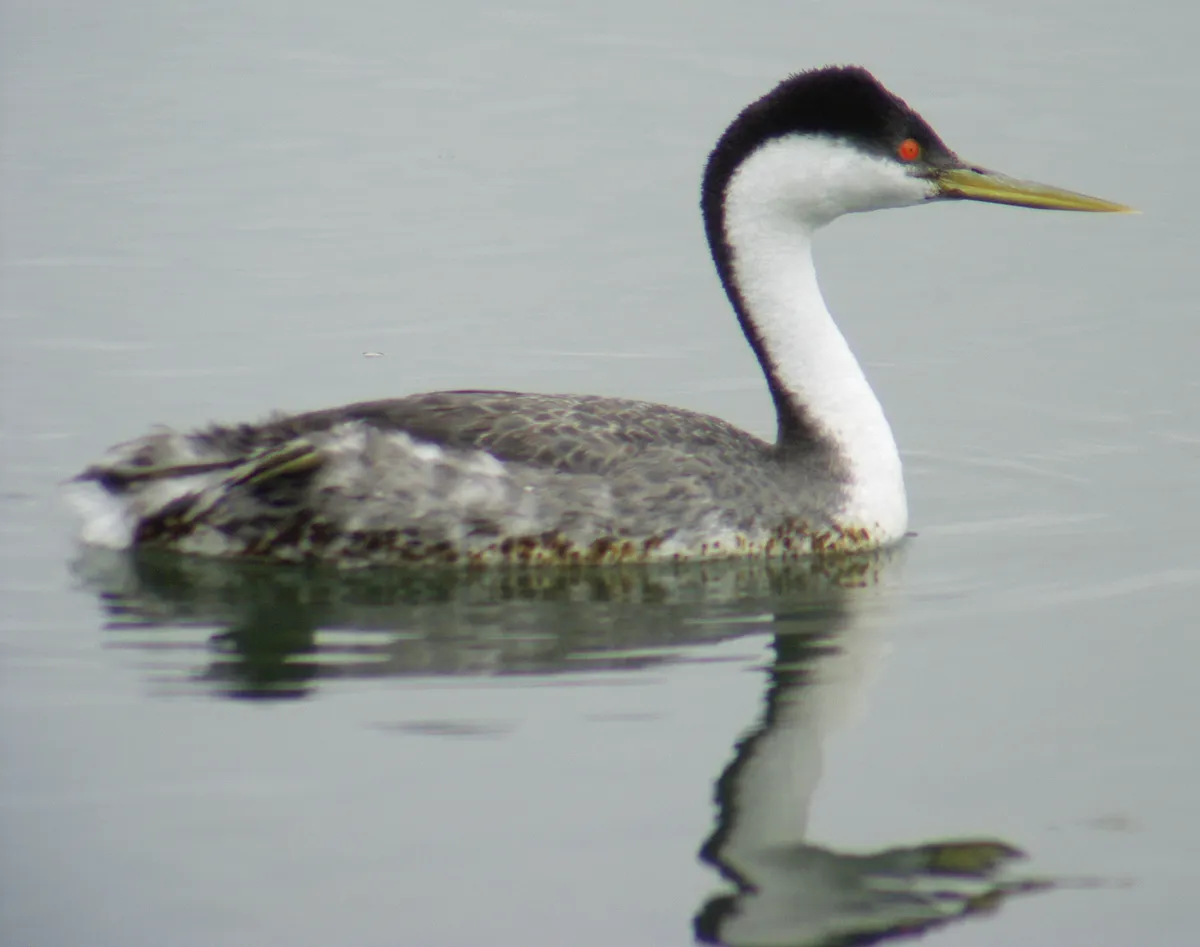
Grèbe élégant— Quebec wildlife
Aechmophorus occidentalis
PodicipedidaeNo period published by Québec.ca
Québec.ca publishes no hunting or trapping period for this species. Check the official regulations.
Wikipedia
Grèbe élégant
The western grebe (Aechmophorus occidentalis) is a species in the grebe family of water birds. Folk names include "dabchick", "swan grebe" and "swan-necked grebe". Western grebe fossils from the Late Pleistocene of southwest North America were described as a distinct species, but later ranked as a paleosubspecies Aechmophorus occidentalis lucasi. Later studies found them to fall within the variation now known to exist in today's birds.
Description
The western grebe is the largest North American grebe. It is 55–75 cm (22–30 in) long, weighs 795–2,000 g (1.753–4.409 lb) and measures 79–102 cm (31–40 in) across the wings. It is black-and-white, with a long, slender, swan-like neck and red eyes. It is easily confused with Clark's grebe, which shares similar features, body size, behavior and habitat, and hybrids are known. Clark's grebes generally populate more of the southern part of North America Other differences are whiter flanks and paler gray backs when comparing Clark's grebe to the western grebe. The western grebe has black around the eyes and a straight greenish-yellow bill whereas Clark's grebe has white around the eyes and an up-turned bright yellow bill. The downy young of western are grey; Clark's downy young are white.
Habitat and range
This species of waterbirds is widespread in western North America and there is no specific place of abundance. Western grebes nest in colonies on lakes that are mixed with marsh vegetation and open water. Western grebe nests are made of plant debris and sodden materials, and the nest-building begins roughly around late April through June. The construction is done by both sexes and is continued on throughout laying and incubation.
Reproduction
Western grebes nest in colonies of hundreds on large inland lakes, sometimes using coastal marshes, in western North America. It has a spectacular courtship display; two birds will rear up and patter across the water's surface. Northern birds migrate west to coastal ocean in winter; birds in the southwest and Mexico may be permanent residents. During the breeding season, the birds advertise themselves through ceremonies. Rushing Ceremony, which can be also called as water dance, race or run, is a ceremony that is the most frequent display to form a pair-bond. This is performed in pairs of either both male Western grebes or one male and one female. One of two individuals initiates Rushing, and the paired individual follows immediately and performs in synchrony. The birds lift their wings stiffly to the side and run in an upright position with its head held forward and neck curved. The males seem to perform the rushing together to attract the attention of females, and when one of two males attracts a female from his rushing behavior, a competition arises between males to get the female. One out of two withdraw and the "winning" male mates with the female by performing Rushing together and continue to perform Weed Ceremony. Weed Ceremony usually precedes the acts of mating and nest building.
Text from Wikipedia — Western grebe, revision 1333975316, CC BY-SA 4.0, retrieved 2026-09-04. Encyclopedic text reused under CC BY-SA 4.0. Sentences about hunting or regulation are removed: on this site, the rule comes from Québec.ca.
Other names
French
English
Presence in Quebec
- Origin
- Indigène
- Occurrence
- Accidentel/non régulier
- Population status
- Migrateur
- Certainty
- Confirmé
Conservation
Official remark
Présence de l'espèce plutôt imprévisible; elle peut ne pas être observée pendant de longues périodes.
Québec.ca
Official periods
Source: Québec.ca — tables reproduced as published (retrieved 2026-08-30).
Regulations change. Always check Québec.ca before hunting or trapping.
Where this data comes from
This species is listed in an official government dataset. The identification and status shown in the data sheet are reproduced from it.
Source: List of Quebec’s vertebrate wildlife (LFVQ) — Ministère de l’Environnement, de la Lutte contre les changements climatiques, de la Faune et des Parcs. File LFVQ_25_03_2026.csv, retrieved 2026-08-30 · CC BY 4.0.
Measurements, habitat, diet and reproduction are not shown: no official source is attached to them yet.