
Grèbe esclavon— Quebec wildlife
Podiceps auritus
PodicipedidaeNo period published by Québec.ca
Québec.ca publishes no hunting or trapping period for this species. Check the official regulations.
Wikipedia
Grèbe esclavon
The horned grebe or Slavonian grebe (Podiceps auritus) is a relatively small and threatened species of waterbird in the family Podicipedidae. There are two subspecies, P. a. auritus (Slavonian grebe), which breeds in Eurasia, and P. a. cornutus (horned grebe), which breeds in North America. The Eurasian subspecies is distributed over most of northern Europe and northern Asia, breeding from Iceland east to the Russian Far East. The North American subspecies spans most of Canada and some of the United States. A small population was cited in Greenland in 1973, but is not mapped or further mentioned by subsequent authors. The American name 'horned' refers to the orange-yellow crest feathers located above and behind the eyes, called "horns". The English name, originally 'Sclavonian', is first attested by George Montagu in his 1802 Ornithological Dictionary, from Scalovia, an old name for northern Prussia, referring to the species' main breeding area in Europe; the spelling was emended (without any reason given) to the current 'Slavonian' by Hartert in 1912.
Description
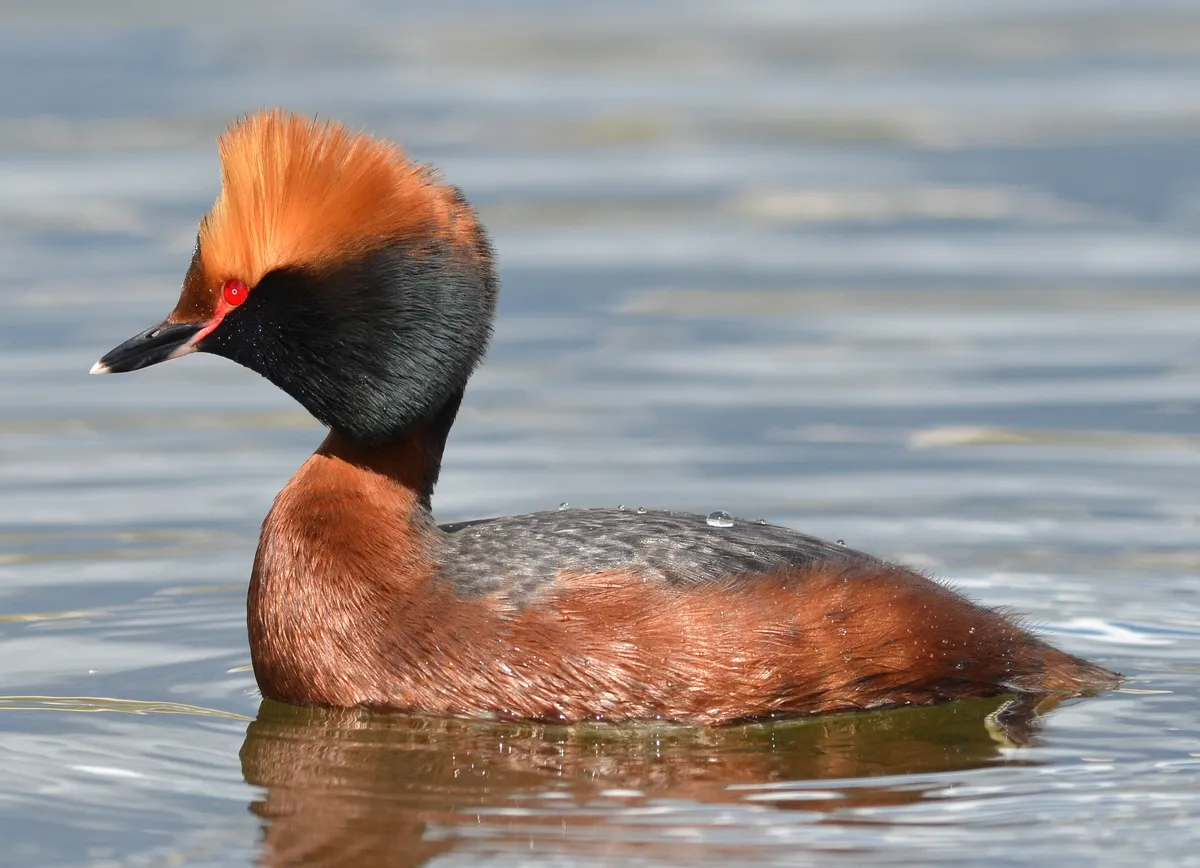
The species can be recognised by its orange-red and black breeding plumage, its black and white non-breeding plumage, and its characteristic "horns". It is 31–38 cm (12–15 in) long, has a wingspan 55–74 cm (22–29 in) wide and weighs 300–570 g (11–20 oz). It has a moderately long neck, flat forehead and a rear crown of black feathers. Its beak is straight and pointed, with a white tip. The breeding plumage has bright erectable "horns", black fan-shaped cheek feathers and an overall red-and-black colour. The neck, flanks, lores and upper-chest are chestnut brown, while the crown and back are black. The belly is a dull white. Males are slightly larger and brighter than females but are generally indistinguishable. The non-breeding plumage is overall black and white. The neck, chest and cheeks are white, while the back and crown are a dull black-grey. The border between the crown and the cheeks extend in a straight line behind the eyes. The winter plumage does not have the "horns". Juveniles appear similar to a non-breeding adult except they are a slightly duller shade of white and their back is tinged with brown. The line separating the cheeks and crown is less distinct and their beak is paler. The chicks are fluffy, with a dull grey back, a white belly and distinct black-and-white facial and neck striping.
Habitat and range
The species breeds primarily in boreal and subarctic regions with a frost-free period of around 90 days or less, but also in temperate zones, including prairies and parklands. They breed in small to moderately sized (0.5-10 ha) shallow freshwater ponds, marshes and shallow bays on lake edges with beds of emergent vegetation. They prefer lakes less than 2.5 m deep, with submerged vegetation, rather than bare gravel, silt or mud lakefloors, and marginal vegetation with sedgess, rushes, and bulrushes along with large areas of open water.
Text from Wikipedia — Horned grebe, revision 1365097959, CC BY-SA 4.0, retrieved 2026-09-04. Encyclopedic text reused under CC BY-SA 4.0. Sentences about hunting or regulation are removed: on this site, the rule comes from Québec.ca.
Other names
French
English
Presence in Quebec
- Origin
- Indigène
- Occurrence
- Régulier
- Population status
- Reproducteur
- Certainty
- Confirmé
Conservation
Québec.ca
Official periods
Source: Québec.ca — tables reproduced as published (retrieved 2026-08-30).
Regulations change. Always check Québec.ca before hunting or trapping.
Where this data comes from
This species is listed in an official government dataset. The identification and status shown in the data sheet are reproduced from it.
Source: List of Quebec’s vertebrate wildlife (LFVQ) — Ministère de l’Environnement, de la Lutte contre les changements climatiques, de la Faune et des Parcs. File LFVQ_25_03_2026.csv, retrieved 2026-08-30 · CC BY 4.0.
Measurements, habitat, diet and reproduction are not shown: no official source is attached to them yet.