
No period published by Québec.ca
Québec.ca publishes no hunting or trapping period for this species. Check the official regulations.
Wikipedia
Grèbe jougris
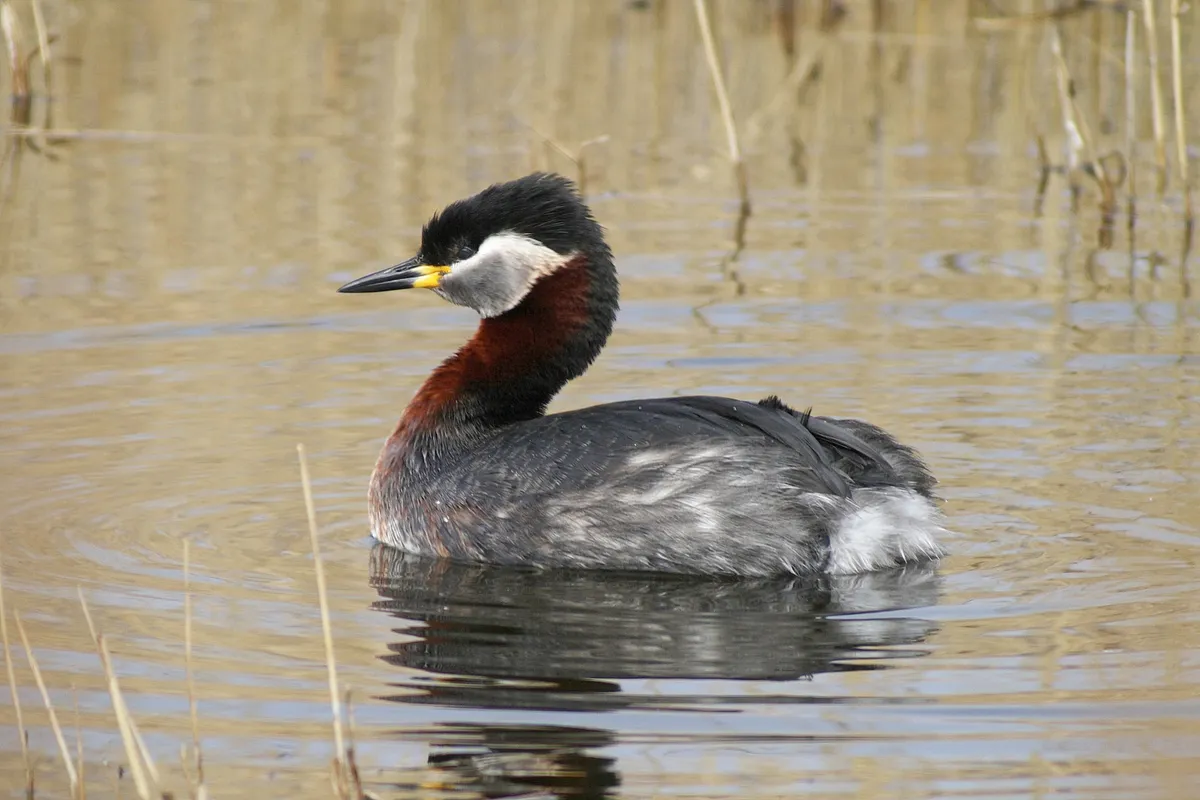
The red-necked grebe (Podiceps grisegena) is an aquatic bird found in the temperate regions of the northern hemisphere. A migratory bird, its wintering habitat is largely restricted to calm waters just beyond the waves around ocean coasts, although some birds may winter on large lakes. Grebes prefer shallow bodies of fresh water such as lakes, marshes or fish-ponds as breeding sites. The red-necked grebe is a fairly drab dusky-grey bird in winter. During the breeding season, it acquires the distinctive red neck plumage, black cap and contrasting pale grey face from which its name was derived. It also has an elaborate courtship display and a variety of loud mating calls. Once paired, it builds a nest from water plants on top of floating vegetation in a shallow lake or bog. Like all grebes, the red-necked is a good swimmer and particularly swift diver, and responds to danger by diving rather than flying. The feet are positioned far back on the body, near the tail, which makes the bird ungainly on land. It dives for fish or picks insects off vegetation; it also swallows its own feathers, possibly to protect the digestive system. The conservation status of its two subspecies, P. g. grisegena, found in Europe and western Asia, and the larger P. g. holbolii (sometimes called Holbøll's grebe), found in North America and eastern Siberia, is evaluated as Least Concern, and the global population is stable or growing.
Description
The red-necked grebe is a medium-large grebe, smaller than the great crested grebe of Eurasia, and the western and Clark's grebes of North America, but noticeably larger than other northern grebe species. In breeding plumage, it has a black cap that extends below the eye, very pale grey cheeks and throat, a rusty red neck, dark grey back and flanks, and white underparts. The eyes are dark brown and the long, pointed bill is black with a yellow base. The winter plumage of the red-necked grebe is duskier than that of other grebes; its dark grey cap is less defined, and merges into the grey face, and a pale crescent that curves around the rear of the face contrasts with the rest of the head. The front of the neck is whitish or light grey, the hind neck is darker grey, and the yellow of the bill is less obvious than in summer. Although the red-necked grebe is unmistakable in breeding plumage, it is less distinctive in winter and can be confused with similar species. It is larger than the Slavonian (horned) grebe, with a relatively larger bill and a grey, rather than white face. It is closer in size to the Eurasian great crested grebe, but that species is longer-necked, has a more contrasting head pattern, and always shows white above the eye. The sexes are similar in appearance, although the male averages heavier than the female. Chicks have a striped head and breast, and older juveniles have a striped face, diffuse blackish cap, pale red neck and extensive yellow on the bill.
Text from Wikipedia — Red-necked grebe, revision 1361168481, CC BY-SA 4.0, retrieved 2026-09-04. Encyclopedic text reused under CC BY-SA 4.0. Sentences about hunting or regulation are removed: on this site, the rule comes from Québec.ca.
Other names
French
English
Presence in Quebec
- Origin
- Indigène
- Occurrence
- Régulier
- Population status
- Reproducteur
- Certainty
- Confirmé
Conservation
Québec.ca
Official periods
Source: Québec.ca — tables reproduced as published (retrieved 2026-08-30).
Regulations change. Always check Québec.ca before hunting or trapping.
Where this data comes from
This species is listed in an official government dataset. The identification and status shown in the data sheet are reproduced from it.
Source: List of Quebec’s vertebrate wildlife (LFVQ) — Ministère de l’Environnement, de la Lutte contre les changements climatiques, de la Faune et des Parcs. File LFVQ_25_03_2026.csv, retrieved 2026-08-30 · CC BY 4.0.
Measurements, habitat, diet and reproduction are not shown: no official source is attached to them yet.