
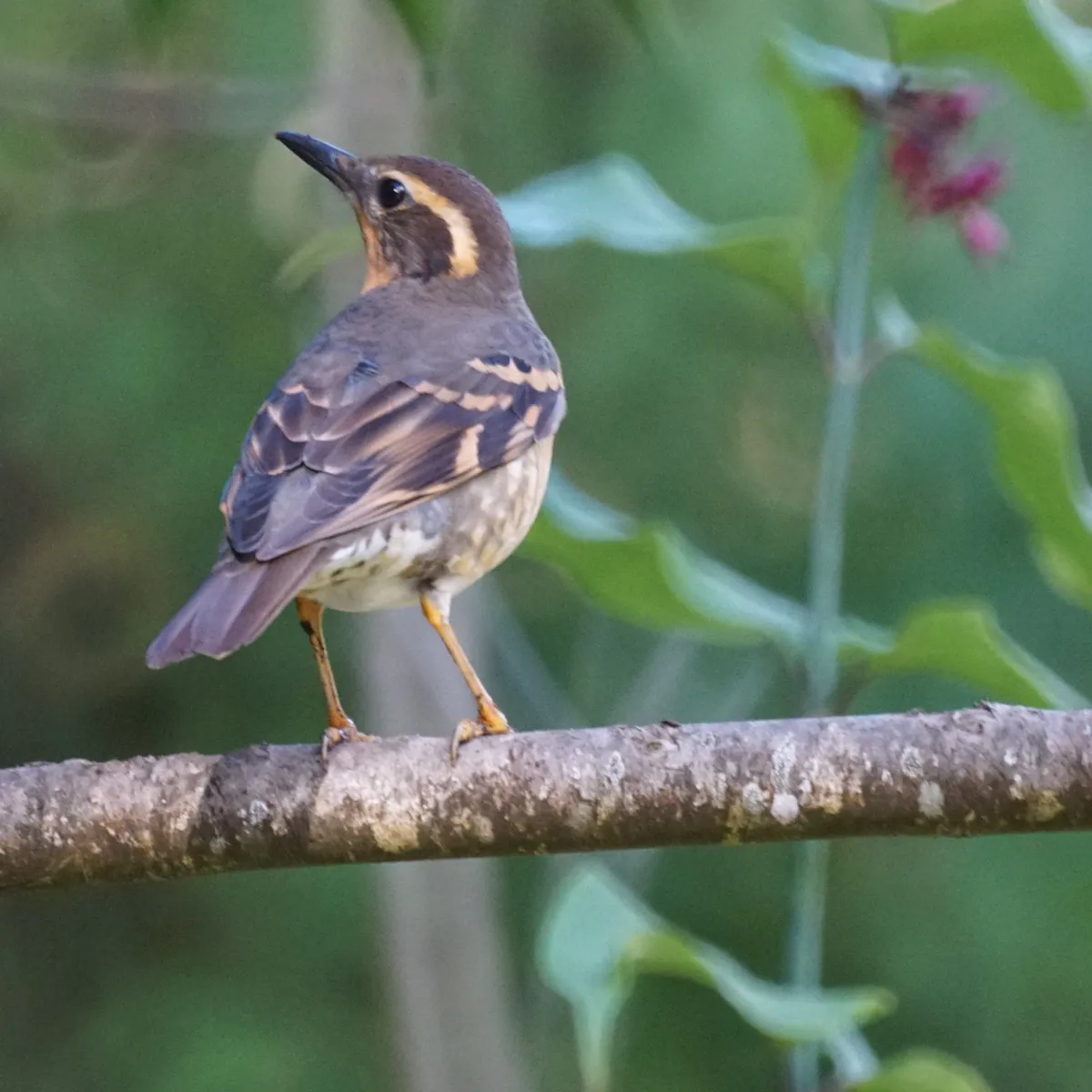
Grive à collier— Quebec wildlife
Ixoreus naevius
TurdidaeNo period published by Québec.ca
Québec.ca publishes no hunting or trapping period for this species. Check the official regulations.
Wikipedia
Grive à collier
The varied thrush (Ixoreus naevius) is a member of the thrush family, Turdidae. It is the only species in the monotypic genus Ixoreus.
Description
The varied thrush is a fairly large thrush species. It can range from 20 to 26 cm (7.9 to 10.2 in) in length and can span 34 to 42 cm (13 to 17 in) across the wings. Body mass can vary from 65 to 100 g (2.3 to 3.5 oz). Among standard measurements, the wing chord is 11.8 to 13.6 cm (4.6 to 5.4 in), the bill is 1.8 to 2.3 cm (0.71 to 0.91 in) and the tarsus is 2.9 to 3.3 cm (1.1 to 1.3 in). It is similar in size to the widespread American robin, though the varied is on average shorter with a heavier, more robust build. In general, varied thrushes feature intense orange and black feathers. Adult males exhibit medium orange with a curved gray pattern at the breasts and throats, with grayish-blue tail ends, scruffs, and crowns. They also possess a tufted supraloral stripe and streaks of dark colors on its flight feathers. Its bill is also achromatic, but tan near the bottom of the lower jaw. Its legs are often tawny or dark brown. Females' markings are not as well-defined, with olive-browns and grays, brown hind feathers, and indiscernible gray-brown plumage near the breasts. Young varied thrushes are generally brown, though their stomach feathers are white, and initially harbor two orange stripes at the covert feathers. Eggs are generally 3–4 per nest, but sometimes 2–5. Pale blue, lightly dotted with brown. Incubation is by female, probably about 2 weeks. Young: Both parents feed nestlings. Development of young and age at which they leave the nest are not well known. Probably 2 broods per year. There is an extremely rare variant of this species in which all the orange in the plumage is replaced by white. A very rare British vagrant in 1982 was of this type, leading to speculation that whatever mutation causes the colour variation also affects the navigational abilities of this thrush. There have been only five recorded sightings since 1921.
Diet
The varied thrush is predominantly insectivorous, though its diet varies throughout the course of the year. During the summer, ground-dwelling arthropods make up the bulk of its diet. During migration and winter, however, the focus of the thrush's diet shifts to fruits, seeds, and acorns, though arthropods are still taken in some quantity. Varied thrushes consume a wide variety of berries throughout the year, including snowberry, red huckleberry, California honeysuckle, madrone, salmonberry, and thimbleberry. Varied thrushes forage primarily on the ground, except when foraging for fruits and berries.
Reproduction
The breeding habitat is dense coniferous forest, with two to five eggs being laid in a tree nest.
Text from Wikipedia — Varied thrush, revision 1371443533, CC BY-SA 4.0, retrieved 2026-09-04. Encyclopedic text reused under CC BY-SA 4.0. Sentences about hunting or regulation are removed: on this site, the rule comes from Québec.ca.
Other names
French
English
Presence in Quebec
- Origin
- Indigène
- Occurrence
- Accidentel/non régulier
- Population status
- Migrateur
- Certainty
- Confirmé
Conservation
Québec.ca
Official periods
Source: Québec.ca — tables reproduced as published (retrieved 2026-08-30).
Regulations change. Always check Québec.ca before hunting or trapping.
Where this data comes from
This species is listed in an official government dataset. The identification and status shown in the data sheet are reproduced from it.
Source: List of Quebec’s vertebrate wildlife (LFVQ) — Ministère de l’Environnement, de la Lutte contre les changements climatiques, de la Faune et des Parcs. File LFVQ_25_03_2026.csv, retrieved 2026-08-30 · CC BY 4.0.
Measurements, habitat, diet and reproduction are not shown: no official source is attached to them yet.