
No period published by Québec.ca
Québec.ca publishes no hunting or trapping period for this species. Check the official regulations.
Wikipedia
Grive à dos olive
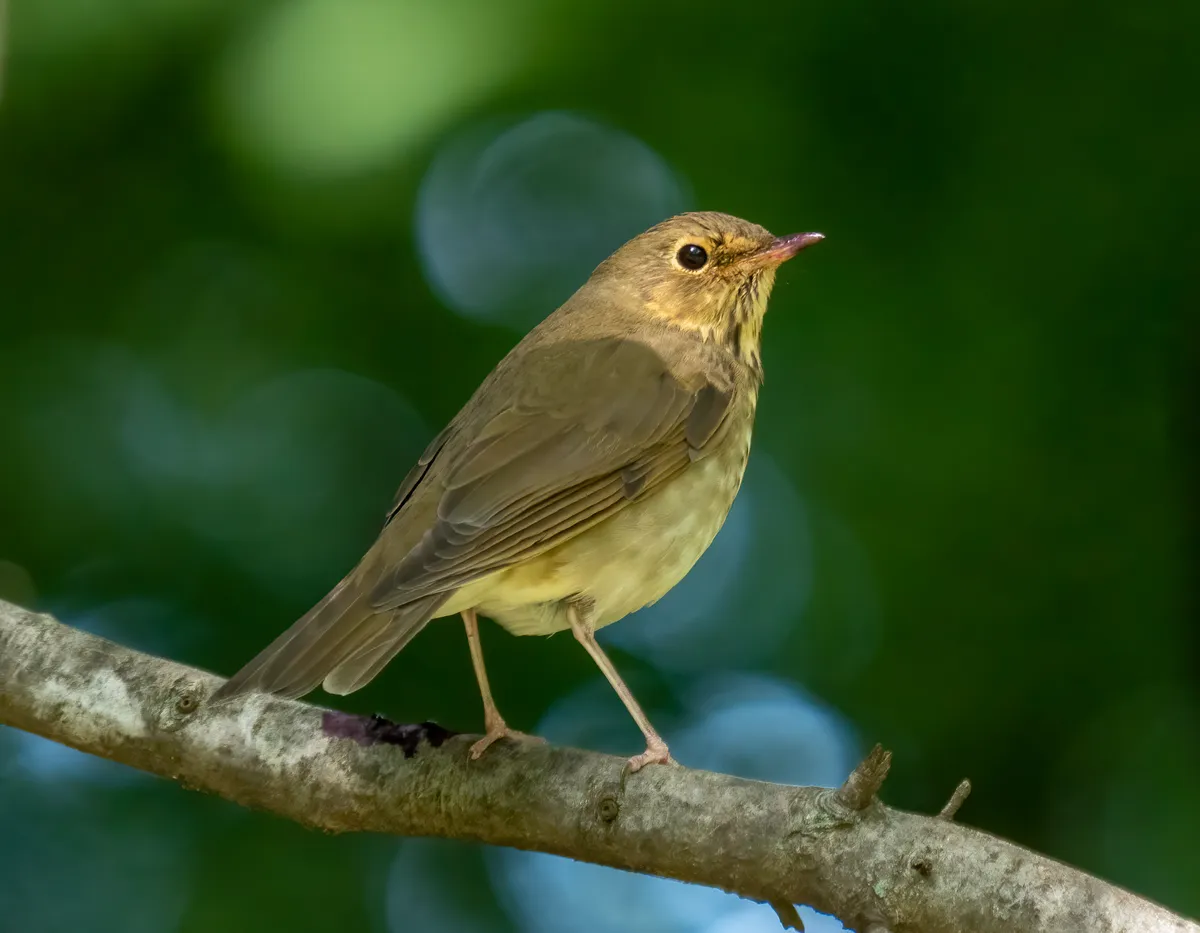
Swainson's thrush (Catharus ustulatus), also called olive-backed thrush, russet-backed thrush, and salmonberry bird is a medium-sized thrush. It is a member of genus Catharus and is typical of it in terms of its subdued coloration and beautiful, ascending flute-like voice. Swainson's thrush was named after William Swainson, an English ornithologist.
Description
This species is 16–20 cm (6.3–7.9 in) in length. The wingspan averages at 30 cm (12 in) and the wing chord is 8.7–10.5 cm (3.4–4.1 in). The bill measures 1.5–1.9 cm (0.59–0.75 in) in length and the tarsus is 2.5 to 3.1 cm (0.98 to 1.22 in) long. This species' body mass can range from 23 to 45 g (0.81 to 1.59 oz). This thrush has the white-dark-white underwing pattern characteristic of Catharus thrushes. Adults are brown on the upperparts. The underparts are white with brown on the flanks; the breast is lighter brown with darker spots. They have pink legs and a light brown eye ring. Birds in the east are more olive-brown on the upperparts; western birds are more reddish brown. This bird's song is a hurried series of flute-like tones spiralling upwards.
Habitat and range
The breeding habitat of Swainson's thrush is coniferous woods with dense undergrowth across Canada, Alaska, and the northern United States; also, deciduous wooded areas on the Pacific coast of North America.
Diet
They forage on the forest floor, also in trees. Swainson's thrushes mainly eat insects, fruits and berries. They make a cup nest on a horizontal tree branch. A study in the White Mountains of New Hampshire found that Swainson's thrushes eat different insects depending on their elevation, with detritivores, particularly woodlice and ghost spiders, making up more of their diet at higher elevations. These prey items are generally more abundant at higher elevations but are also more nutrient-poor. Its song is said by local tribes to make salmonberries ripen, including the Saanich people who claim the bird says, "xwexwelexwelexwelexwesh!" meaning "ripen, ripen, ripen, ripen!" A similar belief appears among the Tlingit, Haida, Haisla, Oweekeno, Kwakwaka'wakw, Nuu-Chah-Nulth, Ditidaht, Sḵwx̱wú7mesh, and the Straits Salish people.
Text from Wikipedia — Swainson's thrush, revision 1363018780, CC BY-SA 4.0, retrieved 2026-09-04. Encyclopedic text reused under CC BY-SA 4.0. Sentences about hunting or regulation are removed: on this site, the rule comes from Québec.ca.
Other names
French
English
Presence in Quebec
- Origin
- Indigène
- Occurrence
- Régulier
- Population status
- Reproducteur
- Certainty
- Confirmé
Conservation
Québec.ca
Official periods
Source: Québec.ca — tables reproduced as published (retrieved 2026-08-30).
Regulations change. Always check Québec.ca before hunting or trapping.
Where this data comes from
This species is listed in an official government dataset. The identification and status shown in the data sheet are reproduced from it.
Source: List of Quebec’s vertebrate wildlife (LFVQ) — Ministère de l’Environnement, de la Lutte contre les changements climatiques, de la Faune et des Parcs. File LFVQ_25_03_2026.csv, retrieved 2026-08-30 · CC BY 4.0.
Measurements, habitat, diet and reproduction are not shown: no official source is attached to them yet.