
No period published by Québec.ca
Québec.ca publishes no hunting or trapping period for this species. Check the official regulations.
Wikipedia
Grive à joues grises
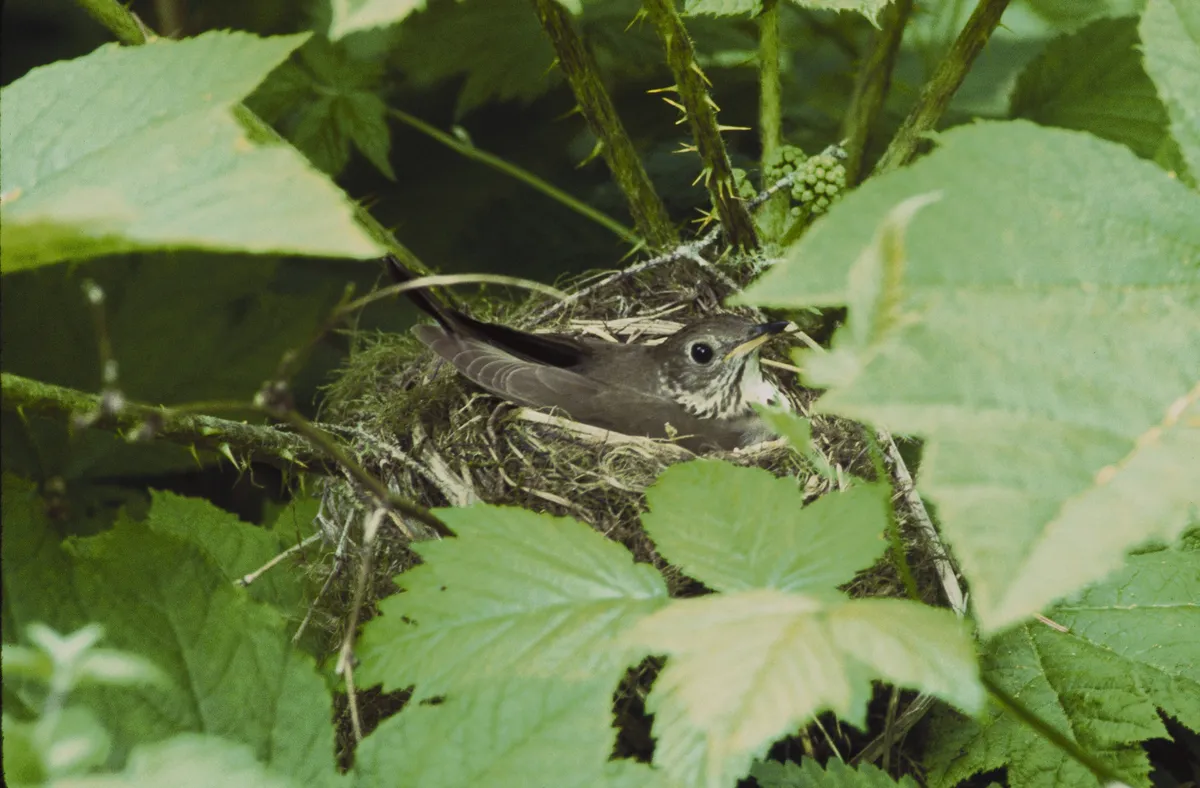
The gray-cheeked thrush (Catharus minimus) is a medium-sized thrush. This species is 15–17 cm (5.9–6.7 in) in length, and has the white-dark-white underwing pattern characteristic of Catharus thrushes. It is a member of a close-knit group of migrant species together with the veery and Bicknell's thrush; it forms a cryptic species pair with the latter. The gray-cheeked thrush is all but indistinguishable from Bicknell's thrush except by its slightly larger size and different song. The two were formerly considered conspecific. Of all the American spotted thrushes, the gray-cheeked has the most northern breeding range.
Description
The gray-cheeked thrush is slightly larger than other Catharus thrushes, about 16 to 17 cm (6.7 in) in height and weighing between 26 and 30g. Wingspan ranges from 12.6-13.4 in (32-34 cm). The bird can be identified by its grayish face, partial pale eyering, drab gray-brown upperside and extensively dusky flanks. The area between the eye and the beak is grayish as well, but the area running from the beak to above the eye is grayish white. The gray-cheeked thrush is nearly identical to the Bicknell's Thrush. There are two subspecies: the northern gray-cheeked thrush (Catharus minimus aliciae), and the nominate subspecies, the Newfoundland gray-cheeked thrush (C. m. minimus). C. m. minimus can be distinguished by its overall browner coloration and buffer wash to the breast compared to C. m. aliciae. C. m. minimus also has an extensive brighter yellow area at the base of the lower part of the beak. C. m. aliciae has a grayish olive upperpart (whereas C. m. minimus has a brownish olive upperpart) and flanks, a lightly washed cream breast and duller lower part of the beak.
Text from Wikipedia — Gray-cheeked thrush, revision 1369098956, CC BY-SA 4.0, retrieved 2026-09-04. Encyclopedic text reused under CC BY-SA 4.0. Sentences about hunting or regulation are removed: on this site, the rule comes from Québec.ca.
Presence in Quebec
- Origin
- Indigène
- Occurrence
- Régulier
- Population status
- Reproducteur
- Certainty
- Confirmé
Conservation
Québec.ca
Official periods
Source: Québec.ca — tables reproduced as published (retrieved 2026-08-30).
Regulations change. Always check Québec.ca before hunting or trapping.
Where this data comes from
This species is listed in an official government dataset. The identification and status shown in the data sheet are reproduced from it.
Source: List of Quebec’s vertebrate wildlife (LFVQ) — Ministère de l’Environnement, de la Lutte contre les changements climatiques, de la Faune et des Parcs. File LFVQ_25_03_2026.csv, retrieved 2026-08-30 · CC BY 4.0.
Measurements, habitat, diet and reproduction are not shown: no official source is attached to them yet.