
No period published by Québec.ca
Québec.ca publishes no hunting or trapping period for this species. Check the official regulations.
Wikipedia
Grive de Bicknell
Bicknell's thrush (Catharus bicknelli) is a medium-sized thrush, at 17.5 cm (6.9 in) and 28 g (0.99 oz). One of North America's rarest and most localized songbirds, it breeds on coniferous mountain tops and disturbed habitats of northeastern North America. While very similar in appearance and vocalization to the gray-cheeked thrush (Catharus minimus), the two species differ slightly in their morphology and vocalizations, although they have with completely different breeding ranges. It was named after Eugene Bicknell, an American amateur ornithologist, who made the first scientific discovery of the species on Slide Mountain in the Catskills in the late 19th century. John Burroughs, in his essay, "The Heart of the Southern Catskills" (1886), writes effusively about the voice of Bicknell's thrush heard near the summit on his climbs of Slide Mountain, and how on his stays on Slide saw them nowhere else but "about the summit", and saw no other thrush but Bicknell's.
Description
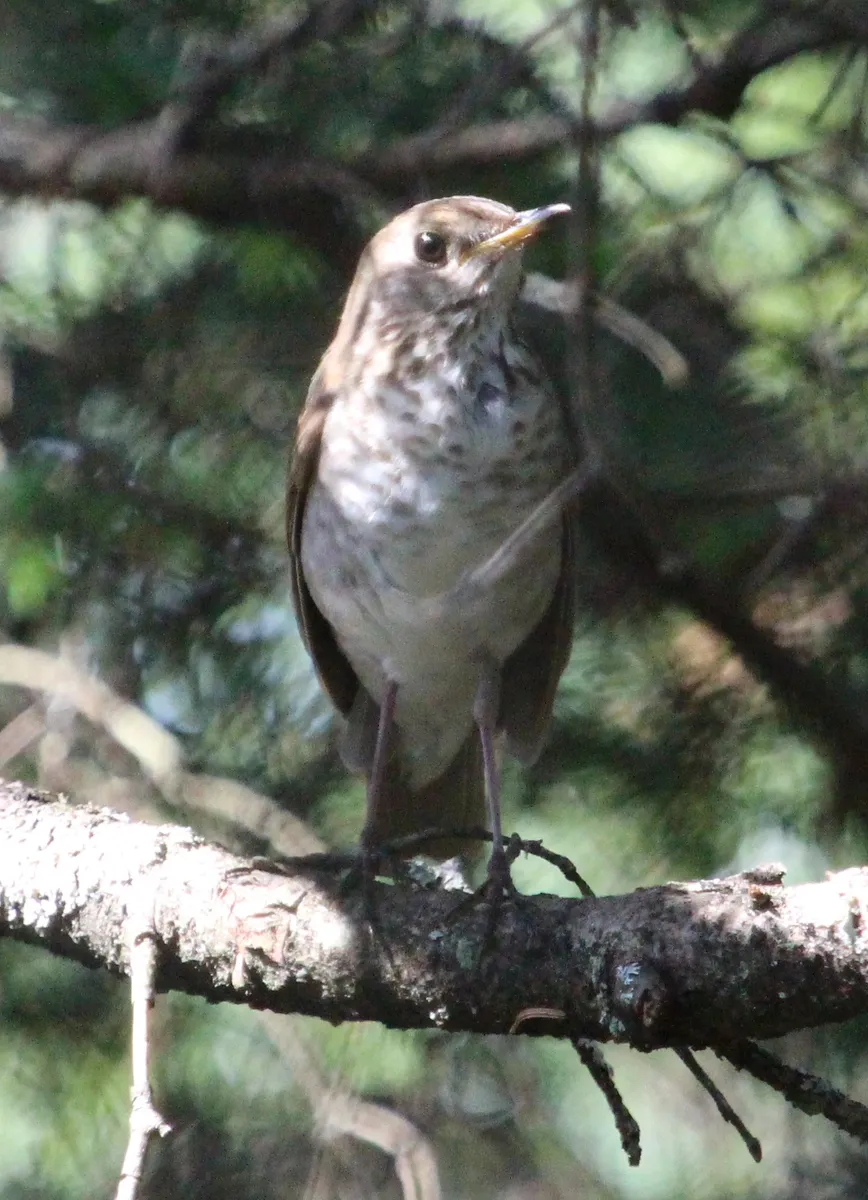
Bicknell's thrush is just slightly smaller than the other northern migratory Catharus thrushes, with an average length of approximately 17 cm (6.7 in) and a weight ranging generally from 26 to 30g. Both sexes are identical in the field and are roughly the same size, although males average slightly larger in wing length. Adults are olive-brown to brownish on the upperparts (head, nape, back) contrasting with chestnut-tinged tail. The contrast is, however, less evident in worn plumage. The underparts are off-white with gray on the flanks; the breast is off-white with buffy wash, showing dusky spots that becomes more diffuse toward the sides and the lower breast. They have pink legs, a faint grey eye ring, and gray cheeks. Two-thirds of the lower mandible is yellow colored, while the tip of the lower mandible and upper mandible is blackish. They average slightly smaller than the very similar gray-cheeked thrush but are all but indistinguishable in outward appearance. The song is a jumbled series of flute-like tones ending on a higher note.
Text from Wikipedia — Bicknell's thrush, revision 1361686406, CC BY-SA 4.0, retrieved 2026-09-04. Encyclopedic text reused under CC BY-SA 4.0. Sentences about hunting or regulation are removed: on this site, the rule comes from Québec.ca.
Presence in Quebec
- Origin
- Indigène
- Occurrence
- Régulier
- Population status
- Reproducteur
- Certainty
- Confirmé
Conservation
Québec.ca
Official periods
Source: Québec.ca — tables reproduced as published (retrieved 2026-08-30).
Regulations change. Always check Québec.ca before hunting or trapping.
Where this data comes from
This species is listed in an official government dataset. The identification and status shown in the data sheet are reproduced from it.
Source: List of Quebec’s vertebrate wildlife (LFVQ) — Ministère de l’Environnement, de la Lutte contre les changements climatiques, de la Faune et des Parcs. File LFVQ_25_03_2026.csv, retrieved 2026-08-30 · CC BY 4.0.
Measurements, habitat, diet and reproduction are not shown: no official source is attached to them yet.