
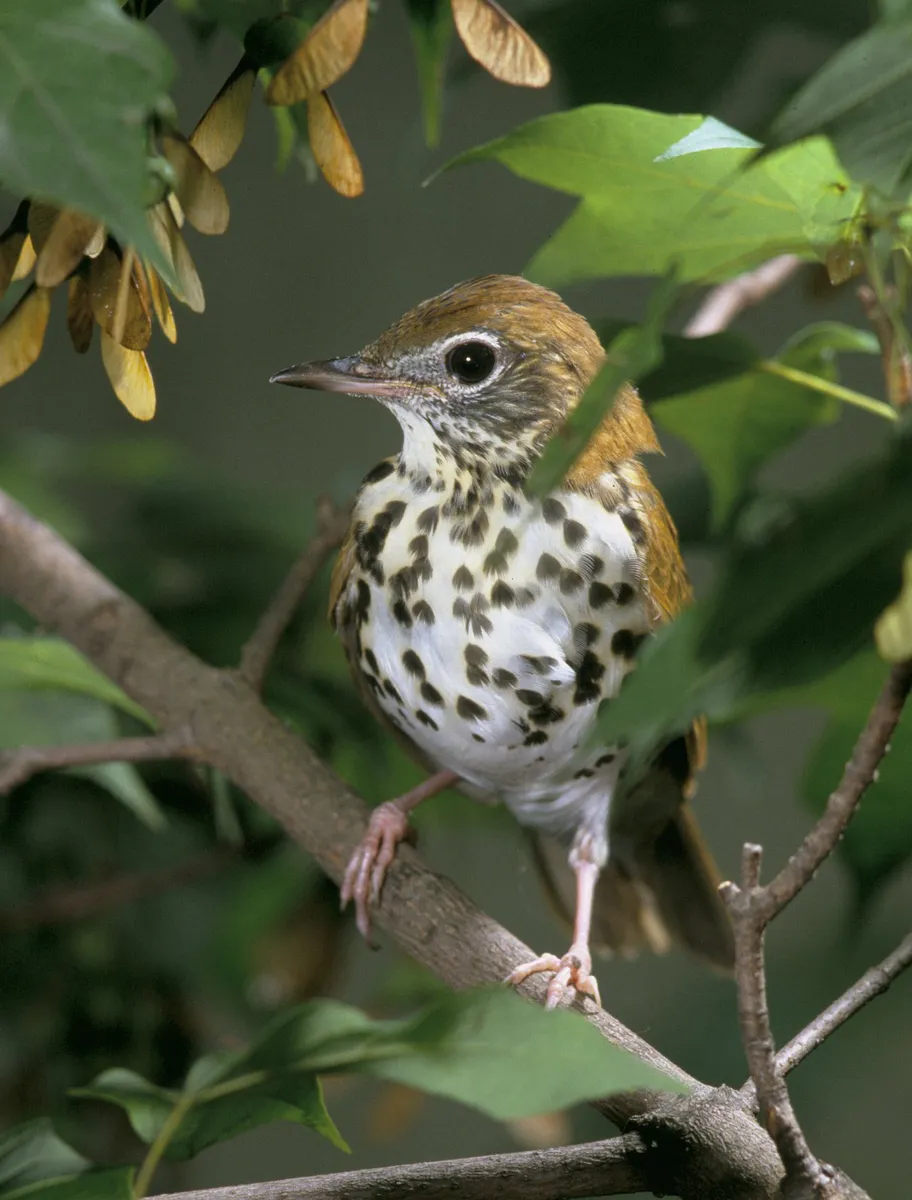
Grive des bois— Quebec wildlife
Hylocichla mustelina
TurdidaeNo period published by Québec.ca
Québec.ca publishes no hunting or trapping period for this species. Check the official regulations.
Wikipedia
Grive des bois
The wood thrush (Hylocichla mustelina) is a North American passerine bird in the family Turdidae and is the only species placed in the genus Hylocichla. It is closely related to other thrushes such as the American robin and is widely distributed across North America, wintering in Central America and southern Mexico. The wood thrush is the official bird of the District of Columbia. The wood thrush is a medium-sized thrush, with brown upper parts with mottled brown and white underparts. The male and female are similar in appearance. The song of the male is often cited as being the most beautiful in North America. The wood thrush is an omnivore, and feeds preferentially on soil invertebrates and larvae, but will also eat fruits. In the summer, it feeds on insects continuously in order to meet daily metabolic needs. It is solitary, but sometimes forms mixed-species flocks. The wood thrush defends a territory that ranges in size from 800 to 28,000 m2 (960 to 33,490 sq yd). The wood thrush is monogamous, and its breeding season begins in the spring; about 50% of all mated pairs are able to raise two broods, ranging in size from two to four chicks.
Description
The adult wood thrush is 18 to 21.5 cm (7.1 to 8.5 in) long, with a wingspan of 30 to 40 cm (12 to 16 in) and a body mass of 48 to 72 g (1.7 to 2.5 oz). Among standard measurements, the wing chord is 9.6 to 11.6 cm (3.8 to 4.6 in), the bill is 1.6 to 2 cm (0.63 to 0.79 in) and the tarsus is 2.8 to 3.3 cm (1.1 to 1.3 in). It is distinctly larger than the Catharus thrushes with which the species is often sympatric but slightly smaller than the common American robin. The longest known lifespan for a wood thrush in the wild is 8 years, 11 months. The crown, nape, and upper back are cinnamon-brown, while the back wings, and tail are a slightly duller brown. The breast and belly are white with large dark brown spots on the breast, sides, and flanks. It has white eye rings and pink legs. Other brownish thrushes have finer spotting on the breast. The juvenile looks similar to adults, but has additional spots on the back, neck, and wing coverts. The male and female are similar in size and plumage.
Text from Wikipedia — Wood thrush, revision 1369812536, CC BY-SA 4.0, retrieved 2026-09-04. Encyclopedic text reused under CC BY-SA 4.0. Sentences about hunting or regulation are removed: on this site, the rule comes from Québec.ca.
Other names
French
English
Presence in Quebec
- Origin
- Indigène
- Occurrence
- Régulier
- Population status
- Reproducteur
- Certainty
- Confirmé
Conservation
Québec.ca
Official periods
Source: Québec.ca — tables reproduced as published (retrieved 2026-08-30).
Regulations change. Always check Québec.ca before hunting or trapping.
Where this data comes from
This species is listed in an official government dataset. The identification and status shown in the data sheet are reproduced from it.
Source: List of Quebec’s vertebrate wildlife (LFVQ) — Ministère de l’Environnement, de la Lutte contre les changements climatiques, de la Faune et des Parcs. File LFVQ_25_03_2026.csv, retrieved 2026-08-30 · CC BY 4.0.
Measurements, habitat, diet and reproduction are not shown: no official source is attached to them yet.