
No period published by Québec.ca
Québec.ca publishes no hunting or trapping period for this species. Check the official regulations.
Wikipedia
Grive fauve
The veery (Catharus fuscescens) is a small North American thrush species, a member of a group of closely related and similar species in the genus Catharus, also including the gray-cheeked thrush (C. minimus), Bicknell's thrush (C. bicknelli), Swainson's thrush (C. ustulatus), and hermit thrush (C. guttatus). Alternate names for this species include Wilson's thrush (named so after Alexander Wilson) and tawny thrush. Up to six subspecies exist, which are grouped into the eastern veery (C. fuscescens fuscescens), the western veery or willow thrush (C. fuscescens salicicolus), and the Newfoundland veery (C. fuscescens fuliginosus). The specific name fuscescens is Neo-Latin for "blackish", from Latin fuscus, "dark". The English name may imitate the call.
Description
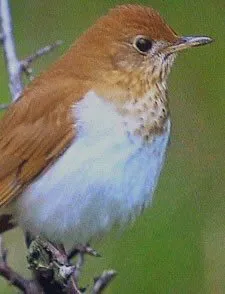
This species measures 16–19.5 cm (6.3–7.7 in) in length. Its mass is 26–39 g (0.92–1.38 oz), exceptionally up to 54 g (1.9 oz). The wingspan averages 28.5 cm (11.2 in). Each wing measures 8.9–10.4 cm (3.5–4.1 in), the bill measures 1.2–1.9 cm (0.47–0.75 in) and the tarsus is 2.7–3.25 cm (1.06–1.28 in). The veery shows the characteristic under-wing stripe of Catharus thrushes. Adults are mainly light brown on the upperparts. The underparts are white; the breast is light tawny with faint brownish spots. Veeries have pink legs and a poorly defined eye ring. Birds in the eastern portions of the species' breeding range are more cinnamon on the upper parts; western birds are more olive-brown. In the east, the veery is distinguished easily by its coloration; distinguishing western veeries from other Catharus thrushes is more difficult. This bird has a breezy, downward-spiraling, flute-like song, often given from a low and concealed perch. The most common call is a harsh, descending vee-er, which gave the bird its name. Other calls include a chuckle, a sharp and low "wuck", and a slow wee-u. Veeries have been shown to decrease the rate and duration of singing when exposed to barred owl playback, possibly to decrease the chance of predation.
Text from Wikipedia — Veery, revision 1353253810, CC BY-SA 4.0, retrieved 2026-09-04. Encyclopedic text reused under CC BY-SA 4.0. Sentences about hunting or regulation are removed: on this site, the rule comes from Québec.ca.
Other names
French
English
Presence in Quebec
- Origin
- Indigène
- Occurrence
- Régulier
- Population status
- Reproducteur
- Certainty
- Confirmé
Conservation
Québec.ca
Official periods
Source: Québec.ca — tables reproduced as published (retrieved 2026-08-30).
Regulations change. Always check Québec.ca before hunting or trapping.
Where this data comes from
This species is listed in an official government dataset. The identification and status shown in the data sheet are reproduced from it.
Source: List of Quebec’s vertebrate wildlife (LFVQ) — Ministère de l’Environnement, de la Lutte contre les changements climatiques, de la Faune et des Parcs. File LFVQ_25_03_2026.csv, retrieved 2026-08-30 · CC BY 4.0.
Measurements, habitat, diet and reproduction are not shown: no official source is attached to them yet.