
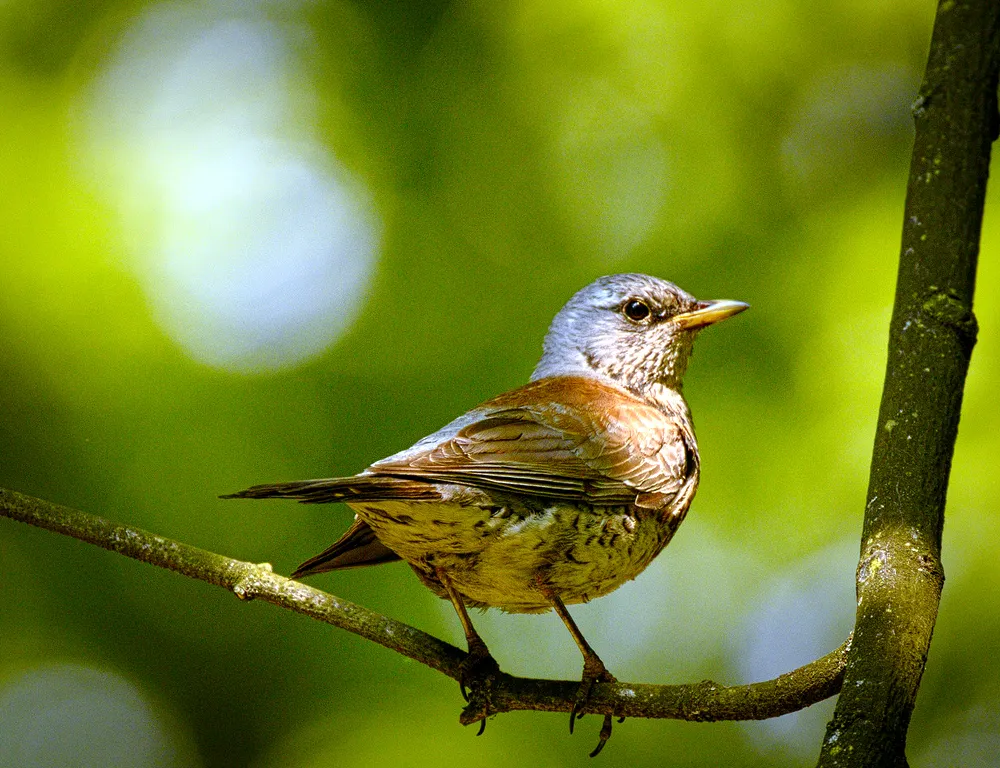
Grive litorne— Quebec wildlife
Turdus pilaris
TurdidaeNo period published by Québec.ca
Québec.ca publishes no hunting or trapping period for this species. Check the official regulations.
Wikipedia
Grive litorne
The fieldfare (Turdus pilaris) is a member of the thrush family Turdidae. It breeds in woodland and scrub in northern Europe and across the Palearctic. It is strongly migratory, with many northern birds moving south during the winter. It is a very rare breeder in the British Isles, but winters in large numbers in the United Kingdom, Southern Europe, North Africa and the Middle East. It is omnivorous, eating a wide range of molluscs, insects and earthworms in the summer, and berries, grain and seeds in the winter. Fieldfares often nest in small colonies, possibly for protection from predators. The nest is built in a tree where five or six eggs are laid. The chicks are fed by both parents and leave the nest after a fortnight (a period of two weeks). There may be two broods in southern parts of the range but only one further north. Migrating birds and wintering birds often form large flocks, often in the company of redwings. The fieldfare is 25 cm (10 in) long, with a grey crown, neck and rump, a plain brown back, dark wings and tail and white underwings. The breast and flanks are heavily spotted. The breast has a reddish wash and the rest of the underparts are white. The sexes are similar in appearance but the females are slightly more brown. The male has a simple chattering song and the birds have various guttural flight and alarm calls.
Description
The fieldfare is easily recognisable with its slate-grey head, nape and rump, dark brown back, blackish tail and boldly speckled breast. In flight, its white under wing-coverts and axillaries are conspicuous. The harsh flight call "tsak tsak" is also distinctive. The forehead and crown of the male are bluish-grey and each feather has a central brownish-black band. The lores and under-eye regions are black and there are faint, pale streaks above the eyes. The ear-coverts, nape, hind neck and rump are bluish-grey, usually with a white streak near the shaft of each rump feather. The scapulars and mantle feathers are dark chestnut-brown with dark central streaks and pale tips. There are fourteen tail feathers each with a pointed tip, the outer two slightly shorter than the others giving a rounded tail. They are brownish-black, with inconspicuous darker bars visible in some lights. The outer edge of each tail feather is fringed with grey near the base and the outer pair of feathers have a narrow white border on the inner edge. The chin, throat and upper breast are creamy-buff with bold streaks and speckles of brownish-black. The lower breast is creamy-white with a diminishing buff tinge and fewer speckles and the belly is similarly creamy-white, with the speckles restricted to the uppermost parts. The primaries are brownish-black with the leading edge fringed grey and the inner edge of the outer feathers grey near the base whereas the inner feathers are fringed with brown near the base. The secondaries are similar but fringed with chestnut-brown on the leading edge.
Text from Wikipedia — Fieldfare, revision 1371937958, CC BY-SA 4.0, retrieved 2026-09-04. Encyclopedic text reused under CC BY-SA 4.0. Sentences about hunting or regulation are removed: on this site, the rule comes from Québec.ca.
Other names
French
Presence in Quebec
- Origin
- Indigène
- Occurrence
- Accidentel/non régulier
- Population status
- Migrateur
- Certainty
- Confirmé
Conservation
Québec.ca
Official periods
Source: Québec.ca — tables reproduced as published (retrieved 2026-08-30).
Regulations change. Always check Québec.ca before hunting or trapping.
Where this data comes from
This species is listed in an official government dataset. The identification and status shown in the data sheet are reproduced from it.
Source: List of Quebec’s vertebrate wildlife (LFVQ) — Ministère de l’Environnement, de la Lutte contre les changements climatiques, de la Faune et des Parcs. File LFVQ_25_03_2026.csv, retrieved 2026-08-30 · CC BY 4.0.
Measurements, habitat, diet and reproduction are not shown: no official source is attached to them yet.