
No period published by Québec.ca
Québec.ca publishes no hunting or trapping period for this species. Check the official regulations.
Wikipedia
Grive musicienne
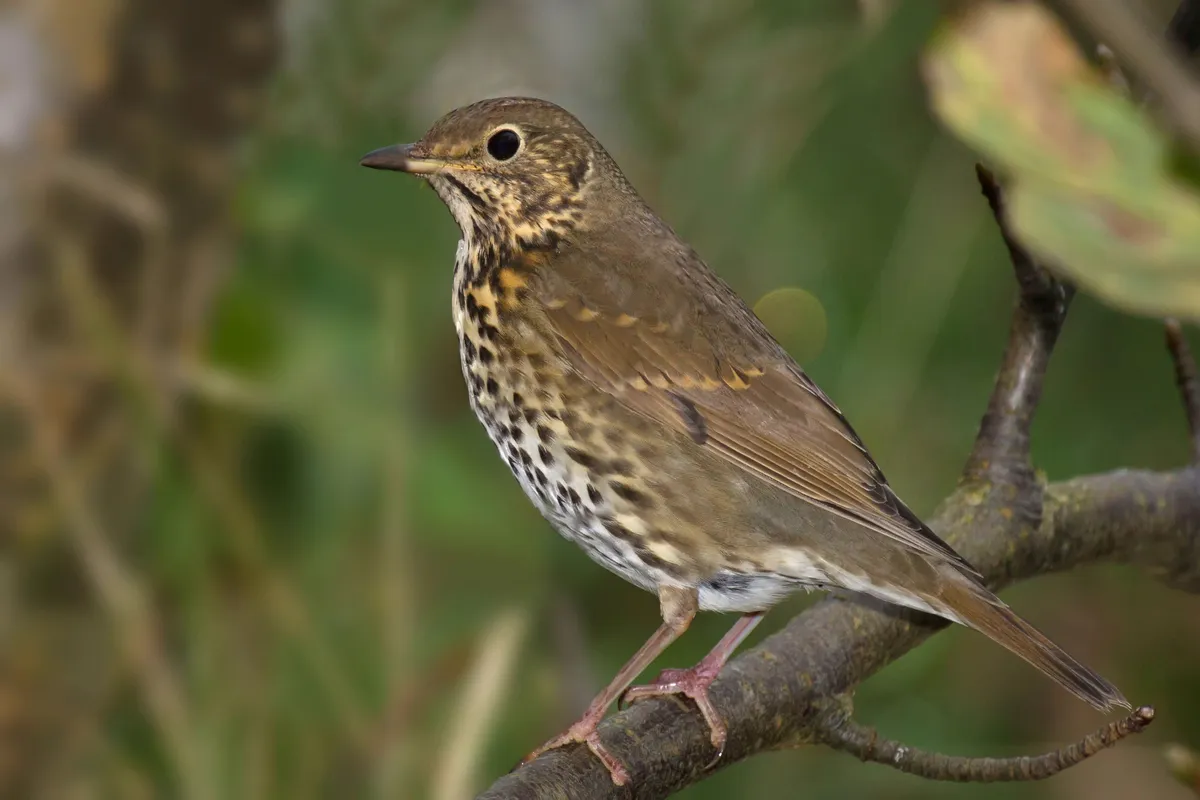
The song thrush (Turdus philomelos) is a thrush that breeds across the West Palearctic. It has brown upperparts and black-spotted cream or buff underparts and has four recognised subspecies. Its distinctive song, which features repeated musical phrases, has frequently been referenced in poetry. The song thrush breeds in forests, gardens and parks. It is partially migratory, with many birds wintering in southern Europe, North Africa and the Middle East. The species has also been introduced into New Zealand and Australia. While it is not globally threatened, serious population declines have been observed in some European regions, potentially due to changes in farming practices. The song thrush builds a neat, mud-lined cup nest in a bush or tree and lays four to five dark-spotted blue eggs. It is omnivorous and has the habit of using a favourite stone as an "anvil" on which to break open the shells of snails. Like other perching birds (passerines), it is susceptible to external and internal parasites and is vulnerable to predation by cats and birds of prey.
Description
The song thrush (as represented by the nominate subspecies T. p. philomelos) is 20 to 23.5 centimetres (7+3⁄4 to 9+1⁄4 inches) in length and weighs 50 to 107 grams (1+3⁄4 to 3+3⁄4 ounces). The sexes are similar, with plain brown backs and neatly black-spotted cream or yellow-buff underparts, becoming paler on the belly. The underwing is warm yellow, the bill is yellowish and the legs and feet are pink. The upperparts of this species become colder in tone from west to east across the breeding range from Sweden to Siberia. The juvenile resembles the adult, but has buff or orange streaks on the back and wing coverts. The most similar European thrush species is the redwing (T. iliacus), but that bird has a strong white supercilium, red flanks, and shows a red underwing in flight. The mistle thrush (T. viscivorus) is much larger and has white tail corners, and the Chinese thrush (T. mupinensis), although much more similar in plumage, has black face markings and does not overlap in range. The song thrush has a short, sharp tsip call, replaced on migration by a thin high seep, similar to the redwing's call but shorter. The alarm call is a chook-chook becoming shorter and more strident with increasing danger. The male's song, given from trees, rooftops or other elevated perches, is a loud clear run of musical phrases, repeated two to four times, filip filip filip codidio codidio quitquiquit tittit tittit tereret tereret tereret, and interspersed with grating notes and mimicry. It is given mainly from February to June by the Outer Hebridean race, but from November to July by the more widespread subspecies. For its weight, this species has one of the loudest bird calls. An individual male may have a repertoire of more than 100 phrases, many of which are copied from its parents and neighbouring birds.
Text from Wikipedia — Song thrush, revision 1371949296, CC BY-SA 4.0, retrieved 2026-09-04. Encyclopedic text reused under CC BY-SA 4.0. Sentences about hunting or regulation are removed: on this site, the rule comes from Québec.ca.
Presence in Quebec
- Origin
- Indigène
- Occurrence
- Accidentel/non régulier
- Population status
- Migrateur
- Certainty
- Confirmé
Conservation
Official remark
Présence de l'espèce plutôt imprévisible; elle peut ne pas être observée pendant de longues périodes. Une mention confirmée en 2006.
Québec.ca
Official periods
Source: Québec.ca — tables reproduced as published (retrieved 2026-08-30).
Regulations change. Always check Québec.ca before hunting or trapping.
Where this data comes from
This species is listed in an official government dataset. The identification and status shown in the data sheet are reproduced from it.
Source: List of Quebec’s vertebrate wildlife (LFVQ) — Ministère de l’Environnement, de la Lutte contre les changements climatiques, de la Faune et des Parcs. File LFVQ_25_03_2026.csv, retrieved 2026-08-30 · CC BY 4.0.
Measurements, habitat, diet and reproduction are not shown: no official source is attached to them yet.