
No period published by Québec.ca
Québec.ca publishes no hunting or trapping period for this species. Check the official regulations.
Wikipedia
Grive solitaire
Description
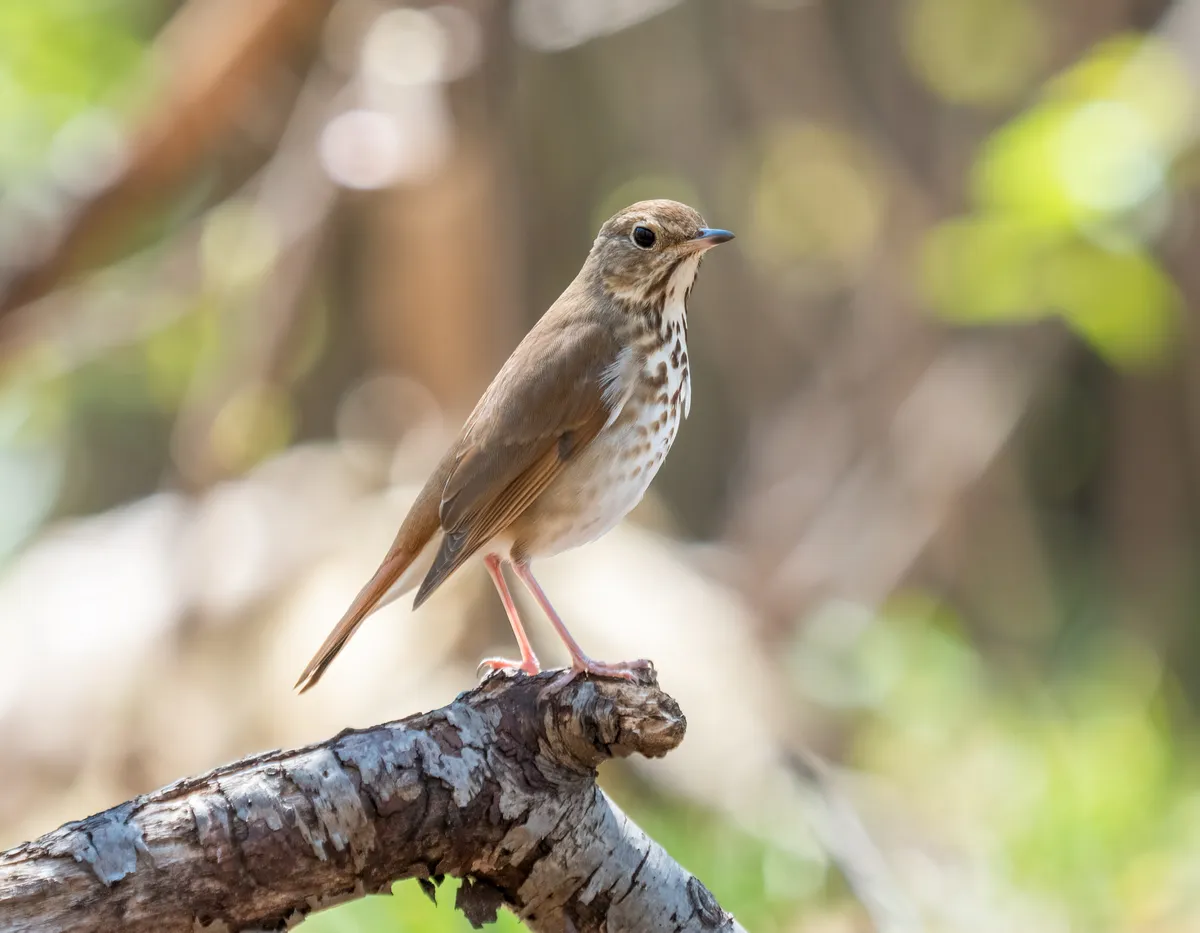
This species measures 15 to 18 cm (5.9 to 7.1 in) in length, spans 25 to 30 cm (9.8 to 11.8 in) across the wings and weighs 18 to 37 g (0.63 to 1.31 oz). Among standard measurements, the wing chord is 7.8 to 11.1 cm (3.1 to 4.4 in), the bill is 1.6 to 1.9 cm (0.63 to 0.75 in) and the tarsus is 2.7 to 3.3 cm (1.1 to 1.3 in). It is more compact and stockier than other North American Catharus thrushes, with relatively longer wings. The hermit thrush has the white-dark-white underwing pattern characteristic of Catharus thrushes. Adults are mainly brown on the upperparts, with reddish tails. The underparts are white with dark spots on the breast and grey or brownish flanks. They have pink legs and a white eye ring. Birds in the east are more olive-brown on the upperparts; western birds are more grey-brown.
Reproduction
Hermit thrushes make a cup nest on the ground or relatively low in a tree. They usually breed in forests, but will sometimes winter in parks and wooded suburban neighborhoods.
Text from Wikipedia — Hermit thrush, revision 1321326056, CC BY-SA 4.0, retrieved 2026-09-04. Encyclopedic text reused under CC BY-SA 4.0. Sentences about hunting or regulation are removed: on this site, the rule comes from Québec.ca.
Other names
French
English
Presence in Quebec
- Origin
- Indigène
- Occurrence
- Régulier
- Population status
- Reproducteur
- Certainty
- Confirmé
Conservation
Québec.ca
Official periods
Source: Québec.ca — tables reproduced as published (retrieved 2026-08-30).
Regulations change. Always check Québec.ca before hunting or trapping.
Where this data comes from
This species is listed in an official government dataset. The identification and status shown in the data sheet are reproduced from it.
Source: List of Quebec’s vertebrate wildlife (LFVQ) — Ministère de l’Environnement, de la Lutte contre les changements climatiques, de la Faune et des Parcs. File LFVQ_25_03_2026.csv, retrieved 2026-08-30 · CC BY 4.0.
Measurements, habitat, diet and reproduction are not shown: no official source is attached to them yet.