
No period published by Québec.ca
Québec.ca publishes no hunting or trapping period for this species. Check the official regulations.
Wikipedia
Gros-bec errant
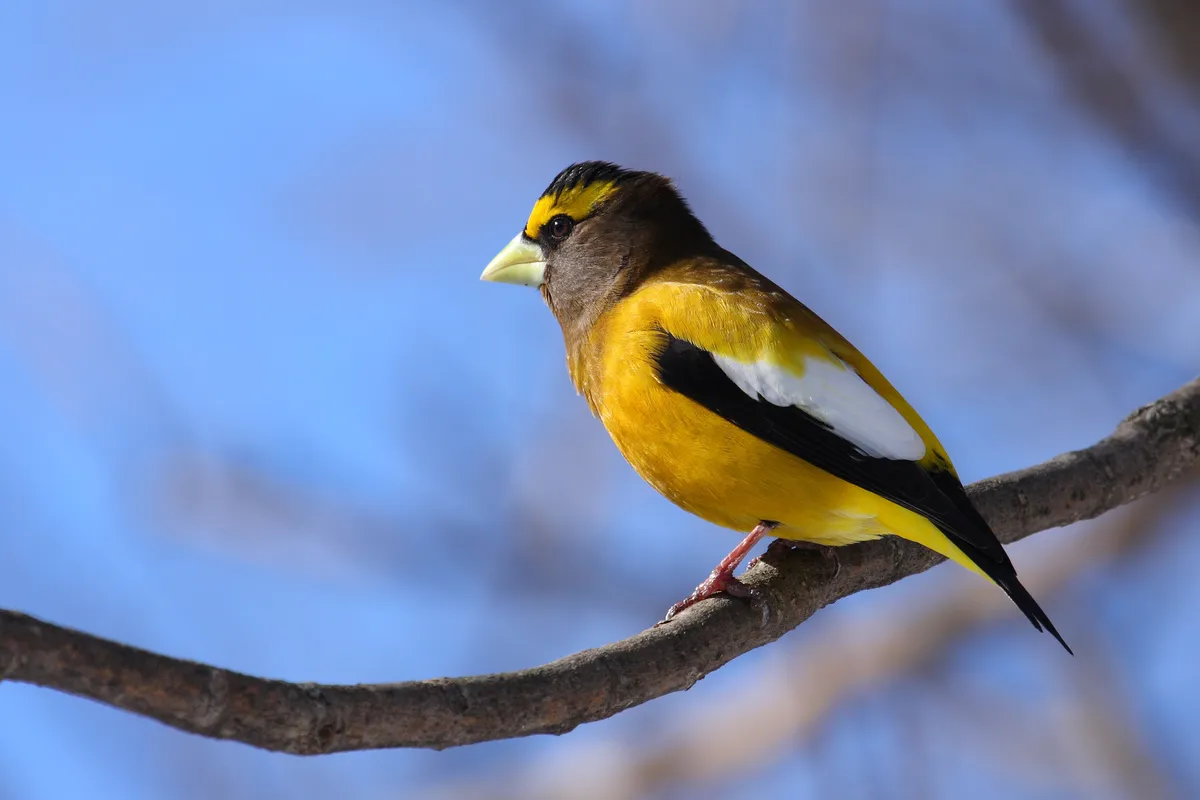
The evening grosbeak (Hesperiphona vespertina) is a passerine bird in the finch family Fringillidae found in North America. The evening grosbeak is bulky, with a large bill and short tail. The bird has a distinct appearance, with the adult male featuring a bright yellow forehead and body, brown head, and white wing patches, while the adult female has a mainly olive-brown body with greyer underparts and white wing patches. The evening grosbeak breeds in coniferous and mixed forests across Canada, the western mountainous areas of the United States, and Mexico. Its migration pattern is variable, sometimes reaching as far south as the southern U.S. in winters. These birds forage in trees and bushes, and their diet mainly consists of seeds, berries, and insects. The bird's range has expanded eastward in historical times, likely due to the planting of Manitoba maples and other shrubs near farms and the availability of bird feeders during winter.
Description
The evening grosbeak is similar in appearance to the Eurasian hawfinch, both being bulky, heavily built finches with large bills and short tails. The evening grosbeak ranges in length from 16 to 22 cm (6.3 to 8.7 in) and spans 30 to 36 cm (12 to 14 in) across the wings. In a large sampling of grosbeaks in Pennsylvania during winter, males weighed from 38.7 to 86.1 g (1.37 to 3.04 oz), with an average of 60 g (2.1 oz), while females weighed from 43.2 to 73.5 g (1.52 to 2.59 oz), with an average of 58.7 g (2.07 oz). Among standard measurements, the wing chord is 10.45 to 11.6 cm (4.11 to 4.57 in), the tail is 6 to 6.95 cm (2.36 to 2.74 in), the bill is 1.6 to 2 cm (0.63 to 0.79 in) and the tarsus is 1.95 to 2.2 cm (0.77 to 0.87 in). The adult has a short black tail, black wings and a large pale bill. The adult male has a bright yellow forehead and body; its head is brown and there is a large white patch in the wing. The adult female is mainly olive-brown, greyer on the underparts and with white patches in the wings. They also have a loud distinctive 'chew' call, similar to a glorified house sparrow.
Text from Wikipedia — Evening grosbeak, revision 1357311529, CC BY-SA 4.0, retrieved 2026-09-04. Encyclopedic text reused under CC BY-SA 4.0. Sentences about hunting or regulation are removed: on this site, the rule comes from Québec.ca.
Other names
French
English
Presence in Quebec
- Origin
- Indigène
- Occurrence
- Régulier
- Population status
- Toute l'année
- Certainty
- Confirmé
Conservation
Québec.ca
Official periods
Source: Québec.ca — tables reproduced as published (retrieved 2026-08-30).
Regulations change. Always check Québec.ca before hunting or trapping.
Where this data comes from
This species is listed in an official government dataset. The identification and status shown in the data sheet are reproduced from it.
Source: List of Quebec’s vertebrate wildlife (LFVQ) — Ministère de l’Environnement, de la Lutte contre les changements climatiques, de la Faune et des Parcs. File LFVQ_25_03_2026.csv, retrieved 2026-08-30 · CC BY 4.0.
Measurements, habitat, diet and reproduction are not shown: no official source is attached to them yet.