
No period published by Québec.ca
Québec.ca publishes no hunting or trapping period for this species. Check the official regulations.
Wikipedia
Grue blanche
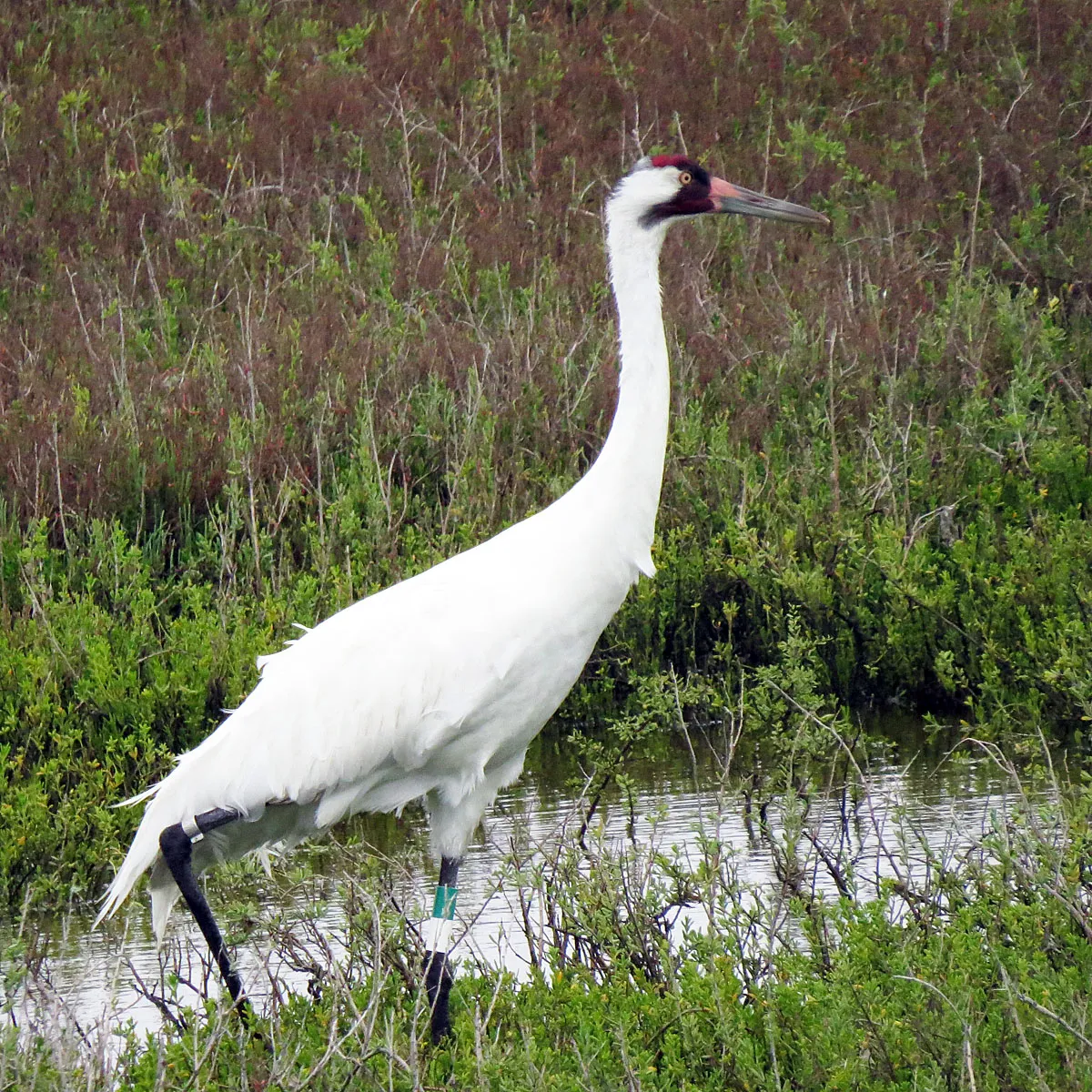
The whooping crane (Grus americana) is an endangered crane species, native to North America, named for its "whooping" calls. Along with the sandhill crane (Antigone canadensis), it is one of only two crane species native to North America, and it is also the tallest North American bird species, with an estimated 22–30+ year life expectancy in the wild. The total number of cranes in the surviving migratory population, plus three reintroduced flocks and in-captivity, is just over 830 birds as of 2025. This includes about 560 individuals in the remnant population that migrates between coastal Texas, USA, and the Northwest Territories, Canada, which is termed the "Aransas-Wood Buffalo Population" after the protected areas that anchor the population's wintering and breeding ranges, respectively. Additionally, there are about 140 individuals in two reintroduced populations breeding in Wisconsin and Louisiana, USA, and an additional 130 individuals in captivity.
Description
An adult whooping crane is white with a red crown and a long, dark, pointed bill. However, immature whooping cranes are cinnamon brown. While in flight, their long necks are kept straight and their long dark legs trail behind. Adult whooping cranes' black wing tips are visible during flight.
Diet
These birds forage while walking in shallow water or in fields, sometimes probing with their bills. They are omnivorous but tend to be more inclined to animal material than most other cranes. Only the red-crowned crane may have a more carnivorous diet among living cranes. In their Texas wintering grounds, this species feeds on various crustaceans, mollusks, grasshoppers, fish (such as eel), small reptiles (such as snakes), mice, voles, aquatic plants, acorns and fruits (such as wolfberry [Lycium carolinianum]). Potential foods of breeding birds in summer include frogs, snakes, small rodents, small birds, fish (such as minnows), aquatic insects, crayfish, clams, snails, aquatic tubers, and berries. Six studies from 1946 to 2005 have reported that blue crabs (Callinectes sapidus) are a significant food source for whooping cranes wintering at Aransas National Wildlife Refuge, constituting up to 90 percent of their energy intake in two winters; 1992–93 and 1993–94. Waste grain, including wheat, barley, and corn, is an important food for migrating whooping cranes, but they do not swallow gizzard stones; they digest grain less efficiently than sandhill cranes.
Text from Wikipedia — Whooping crane, revision 1369112844, CC BY-SA 4.0, retrieved 2026-09-04. Encyclopedic text reused under CC BY-SA 4.0. Sentences about hunting or regulation are removed: on this site, the rule comes from Québec.ca.
Presence in Quebec
- Origin
- Indigène
- Occurrence
- Accidentel/non régulier
- Population status
- Migrateur
- Certainty
- Confirmé
Conservation
Québec.ca
Official periods
Source: Québec.ca — tables reproduced as published (retrieved 2026-08-30).
Regulations change. Always check Québec.ca before hunting or trapping.
Where this data comes from
This species is listed in an official government dataset. The identification and status shown in the data sheet are reproduced from it.
Source: List of Quebec’s vertebrate wildlife (LFVQ) — Ministère de l’Environnement, de la Lutte contre les changements climatiques, de la Faune et des Parcs. File LFVQ_25_03_2026.csv, retrieved 2026-08-30 · CC BY 4.0.
Measurements, habitat, diet and reproduction are not shown: no official source is attached to them yet.