
No period published by Québec.ca
Québec.ca publishes no hunting or trapping period for this species. Check the official regulations.
Wikipedia
Grue cendrée
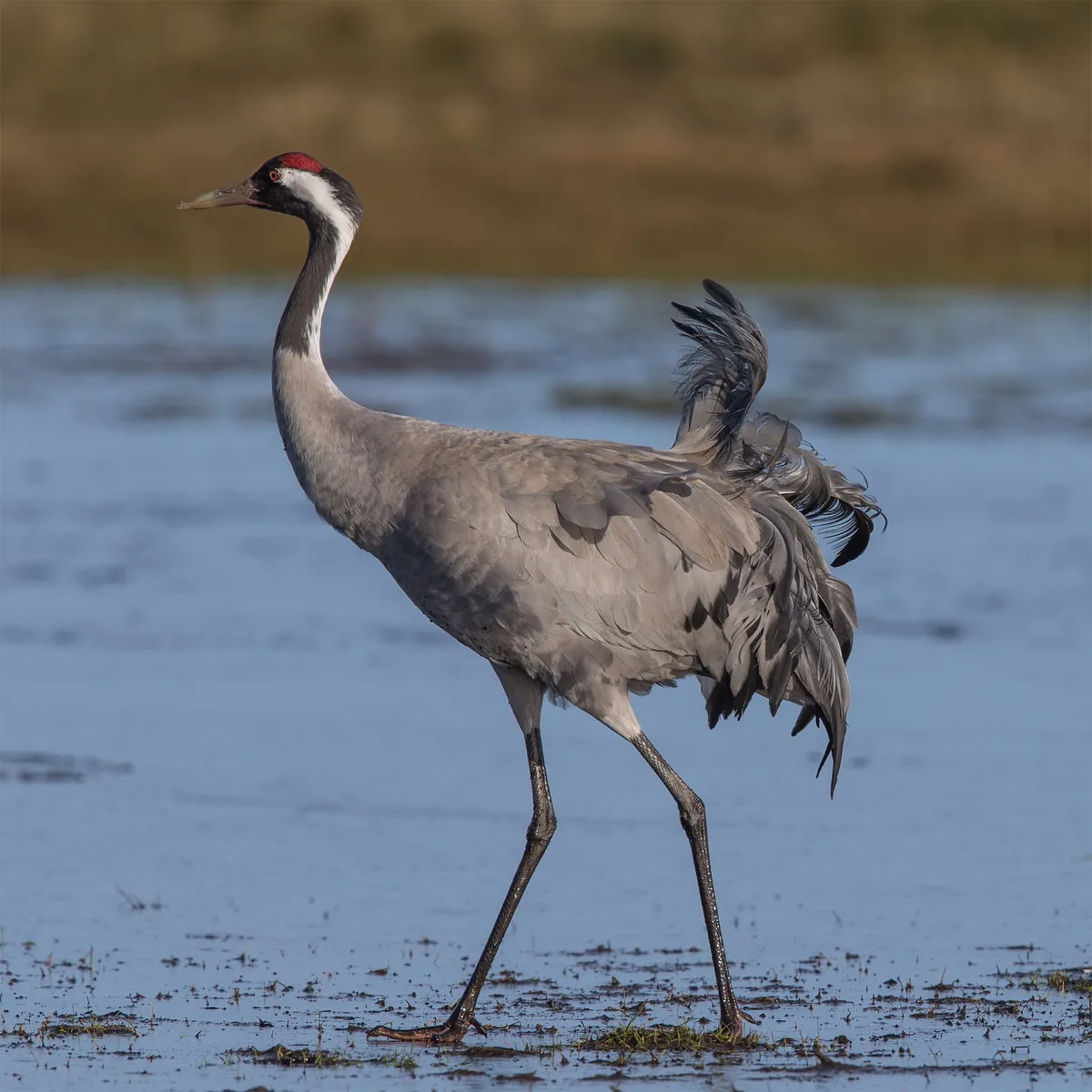
The common crane (Grus grus), also known as the Eurasian crane, is a bird of the family Gruidae, the cranes. A medium-sized species, it is the only crane commonly found in Europe besides the demoiselle crane (Grus virgo) and the Siberian crane (Leucogeranus leucogeranus) that only are regular in the far eastern part of the continent. Along with the sandhill crane (Antigone canadensis), demoiselle crane and the brolga (Antigone rubicunda), it is one of only four crane species not currently classified as threatened with extinction or conservation dependent on the species level. Despite the species' large numbers, local extinctions and extirpations have taken place in part of its range, and an ongoing reintroduction project is underway in the United Kingdom.
Description
The common crane is a large, stately bird and a medium-sized crane. It is 100–130 cm (39–51 in) long with a 180–240 cm (71–94 in) wingspan. The body weight can range from 3 to 6.1 kg (6.6 to 13.4 lb), with the nominate subspecies averaging around 5.4 kg (12 lb) and the eastern subspecies (G. g. lilfordi) averaging 4.6 kg (10 lb). Among standard measurements, the wing chord is 50.7–60.8 cm (20.0–23.9 in) long, the tarsus is 20.1–25.2 cm (7.9–9.9 in) and the exposed culmen is 9.5–11.6 cm (3.7–4.6 in). Males are slightly heavier and larger than females, with weight showing the largest sexual size dimorphism, followed by wing, central toe, and head length in adults and juveniles. This species is slate-grey overall. The forehead and lores are blackish with a bare red crown and a white streak extending from behind the eyes to the upper back. The overall colour is darkest on the back and rump and palest on the breast and wings. The primaries, the tips of secondaries, the alula, the tip of the tail, and the edges of upper tail coverts are all black and the greater coverts droop into explosive plumes. This combination of colouration ultimately distinguishes it from similar species in Asia, like the hooded (G. monacha) and black-necked cranes (G. nigricollis). The juvenile has yellowish-brown tips to its body feathers and lacks the drooping wing feathers and the bright neck pattern of the adult, and has a fully feathered crown. Every two years, before migration, the adult common crane undergoes a complete moult, remaining flightless for six weeks, until the new feathers grow. It has a loud trumpeting call, given in flight and display. The call is piercing and can be heard from a considerable distance. It has a dancing display, leaping with wings uplifted, described in detail below.
Habitat and range
The common crane breeds in Europe and across the Palearctic to Siberia. By far the largest breeding populations can be found in Russia, Finland and Sweden. It is a rare breeder in southern and western Europe, with larger numbers breeding in the central and eastern parts of the continent.
Text from Wikipedia — Common crane, revision 1370170671, CC BY-SA 4.0, retrieved 2026-09-04. Encyclopedic text reused under CC BY-SA 4.0. Sentences about hunting or regulation are removed: on this site, the rule comes from Québec.ca.
Presence in Quebec
- Origin
- Indigène
- Occurrence
- Accidentel/non régulier
- Population status
- Migrateur
- Certainty
- Confirmé
Conservation
Québec.ca
Official periods
Source: Québec.ca — tables reproduced as published (retrieved 2026-08-30).
Regulations change. Always check Québec.ca before hunting or trapping.
Where this data comes from
This species is listed in an official government dataset. The identification and status shown in the data sheet are reproduced from it.
Source: List of Quebec’s vertebrate wildlife (LFVQ) — Ministère de l’Environnement, de la Lutte contre les changements climatiques, de la Faune et des Parcs. File LFVQ_25_03_2026.csv, retrieved 2026-08-30 · CC BY 4.0.
Measurements, habitat, diet and reproduction are not shown: no official source is attached to them yet.