
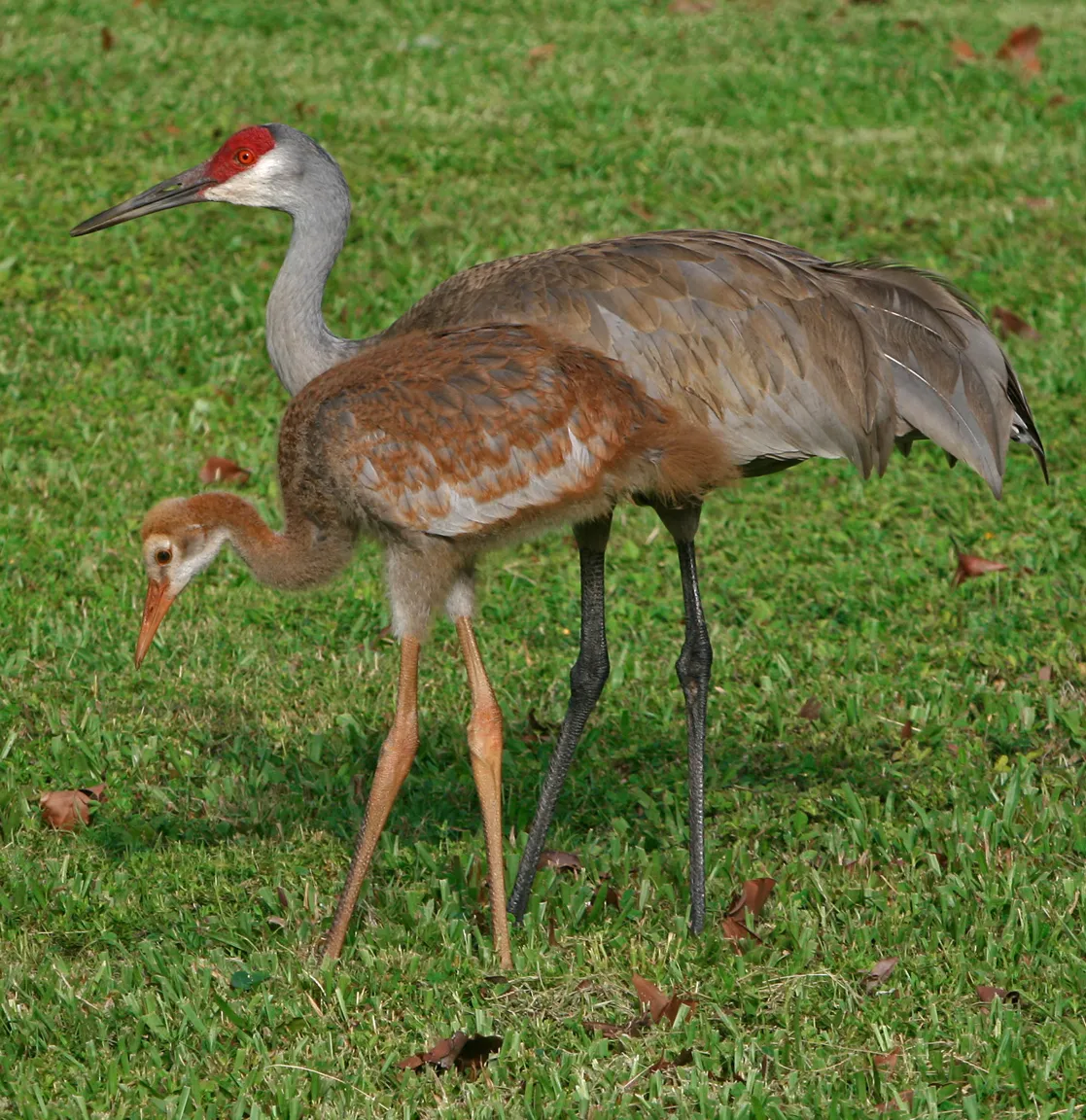
Grue du Canada— Quebec wildlife
Antigone canadensis
GruidaeMigratory game bird — federal regulations
Seasons and bag limits are set by Environment and Climate Change Canada.
Wikipedia
Grue du Canada
The sandhill crane (Antigone canadensis) is a species of large crane of North America and extreme northeastern Siberia. The common name of this bird refers to its habitat, such as the Platte River, on the edge of Nebraska's Sandhills on the American Great Plains. Sandhill cranes are known to frequent the edges of bodies of water. The central Platte River Valley in Nebraska is the most important stopover area for the nominotypical subspecies, the lesser sandhill crane (A. c. canadensis), with up to 450,000 of these birds migrating through annually.
Description
Adults are gray overall; during breeding, their plumage is usually much worn and stained, particularly in the migratory populations, and looks nearly ochre. The average weight of the larger males is 4.57 kg (10.1 lb), while the average weight of females is 4.02 kg (8.9 lb), with a range of 2.7 to 6.7 kg (6.0 to 14.8 lb) across the subspecies. Sandhill cranes have red foreheads, white cheeks, and long, dark, pointed bills. In flight, their long, dark legs trail behind, and their long necks keep straight. Immature birds have reddish-brown upper parts and gray underparts. The juveniles do not have the characteristic red foreheads, making distinguishing the young from the parents possible, even when they are the same height. The sexes look alike. Sizes vary among the different subspecies; the typical height of these birds is around 80 to 136 cm (2 ft 7 in to 4 ft 6 in). Their wing chords are typically 41.8–60.0 cm (16.5–23.6 in), tails are 10.0–26.4 cm (3.9–10.4 in), the exposed culmens are 6.9–16 cm (2.7–6.3 in) long, and the tarsi measure 15.5–26.6 cm (6.1–10.5 in). Wingspan is 200 cm (78.7 in). These cranes frequently give a loud, trumpeting call that suggests a rolled "r" in the throat, and they can be heard from a long distance. Mated pairs of cranes engage in "unison calling". The cranes stand close together, calling in a synchronized and complex duet. The female makes two calls for every one from the male. Sandhill cranes' large wingspans, typically 1.65 to 2.30 m (5 ft 5 in to 7 ft 7 in), make them very skilled soaring birds, similar in style to hawks and eagles. Using thermals to obtain lift, they can stay aloft for many hours, requiring only occasional flapping of their wings, thus expending little energy. Migratory flocks contain hundreds of birds, and can create clear outlines of the normally invisible rising columns of air (thermals) they ride. Sandhill cranes fly south for the winter. In their wintering areas, they form flocks over 10,000. One place this happens is at Bosque del Apache National Wildlife Refuge, 100 miles (160 km) south of Albuquerque, New Mexico. An annual Sandhill Crane Festival is held there in November.
Text from Wikipedia — Sandhill crane, revision 1370186666, CC BY-SA 4.0, retrieved 2026-09-04. Encyclopedic text reused under CC BY-SA 4.0. Sentences about hunting or regulation are removed: on this site, the rule comes from Québec.ca.
Other names
French
English
Presence in Quebec
- Origin
- Indigène
- Occurrence
- Régulier
- Population status
- Reproducteur
- Certainty
- Confirmé
Conservation
Québec.ca
Official periods
Source: Québec.ca — tables reproduced as published (retrieved 2026-08-30).
Regulations change. Always check Québec.ca before hunting or trapping.
Where this data comes from
This species is listed in an official government dataset. The identification and status shown in the data sheet are reproduced from it.
Source: List of Quebec’s vertebrate wildlife (LFVQ) — Ministère de l’Environnement, de la Lutte contre les changements climatiques, de la Faune et des Parcs. File LFVQ_25_03_2026.csv, retrieved 2026-08-30 · CC BY 4.0.
Measurements, habitat, diet and reproduction are not shown: no official source is attached to them yet.