
No period published by Québec.ca
Québec.ca publishes no hunting or trapping period for this species. Check the official regulations.
Wikipedia
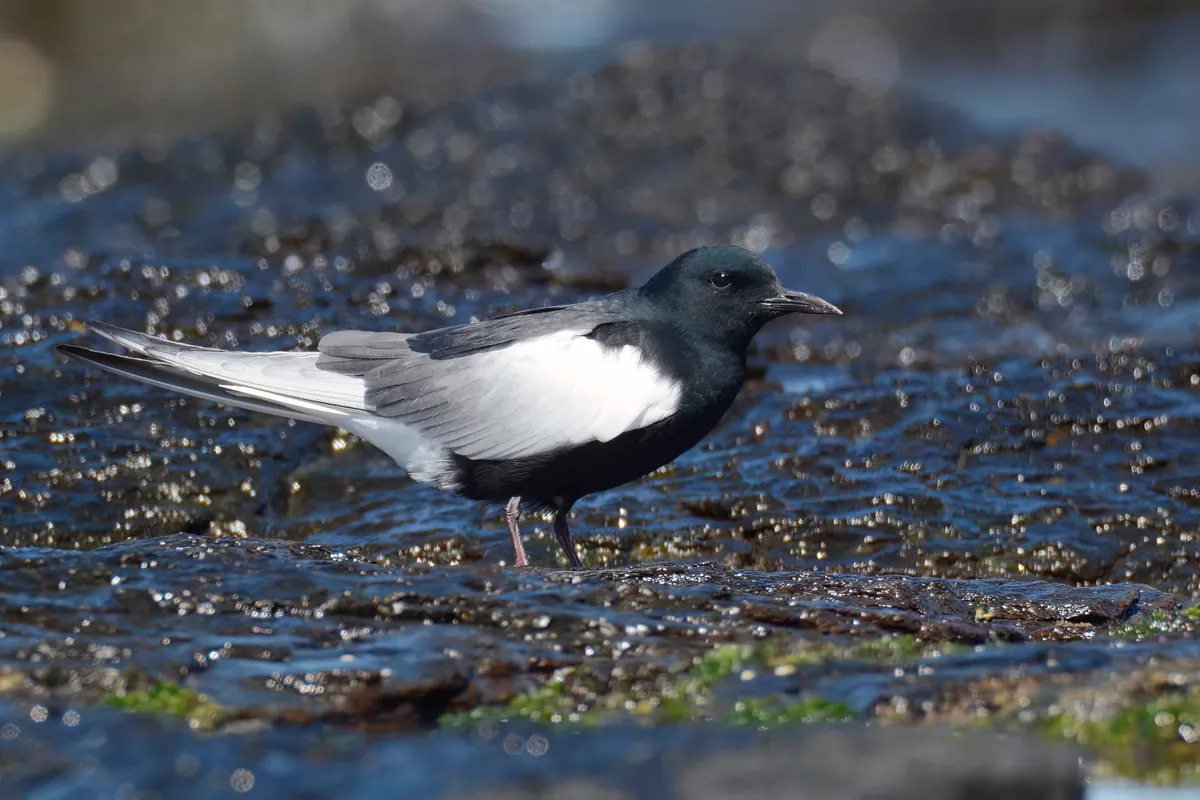
Guifette leucoptère
The white-winged tern or white-winged black tern (Chlidonias leucopterus) is a species of tern in the family Laridae. It is a small species generally found in or near bodies of fresh water across much of the world, including Europe, Africa, Asia, and Australia. The genus name is from Ancient Greek khelidonios, "swallow-like", from khelidon, "swallow". The name 'white-winged tern' is the standard in most English-speaking countries; in the United Kingdom, this name is also the one used by the formal ornithological recording authorities, but the older alternative 'white-winged black tern' is still frequent in popular use.
Description
Adult birds in summer have short red legs and a short black bill (small and stubby, measuring 22–25 mm from the feathers, decidedly shorter than the head), a black neck (often with a pale gray back) and belly, very dark grey back, with a white rump and light grey (almost white) tail, which often looks 'square' in juveniles. The face is tinged yellowish. The wings, as the name implies, are mainly white. The inner wing is grayish with brown-tipped coverts. In non-breeding plumage, most of the black is replaced by white or pale grey, though a few blackish feathers may be retained, admixed with white underparts. A good deal of black shows in the underwing-coverts. The head is black, with a white forehead. The crown is blackish-brown, flecked with white, and the hindcrown is blackish with a certain amount of white flecking. These white markings are pronounced in the winter adult. There is a dark triangular patch forward of the eye. The collar is fairly broad and white. In juveniles and moulting adults, the rump is pale gray, becoming grey in both phases late in the year. The clear white collar and rump isolate the mantle as a dark brown 'saddle'. The mantle feathers have narrow paler brown tips, as have the tertials and scapulars.
Text from Wikipedia — White-winged tern, revision 1317889453, CC BY-SA 4.0, retrieved 2026-09-04. Encyclopedic text reused under CC BY-SA 4.0. Sentences about hunting or regulation are removed: on this site, the rule comes from Québec.ca.
Other names
French
English
Presence in Quebec
- Origin
- Indigène
- Occurrence
- Accidentel/non régulier
- Population status
- Migrateur
- Certainty
- Confirmé
Conservation
Québec.ca
Official periods
Source: Québec.ca — tables reproduced as published (retrieved 2026-08-30).
Regulations change. Always check Québec.ca before hunting or trapping.
Where this data comes from
This species is listed in an official government dataset. The identification and status shown in the data sheet are reproduced from it.
Source: List of Quebec’s vertebrate wildlife (LFVQ) — Ministère de l’Environnement, de la Lutte contre les changements climatiques, de la Faune et des Parcs. File LFVQ_25_03_2026.csv, retrieved 2026-08-30 · CC BY 4.0.
Measurements, habitat, diet and reproduction are not shown: no official source is attached to them yet.