
No period published by Québec.ca
Québec.ca publishes no hunting or trapping period for this species. Check the official regulations.
Wikipedia
Guifette noire
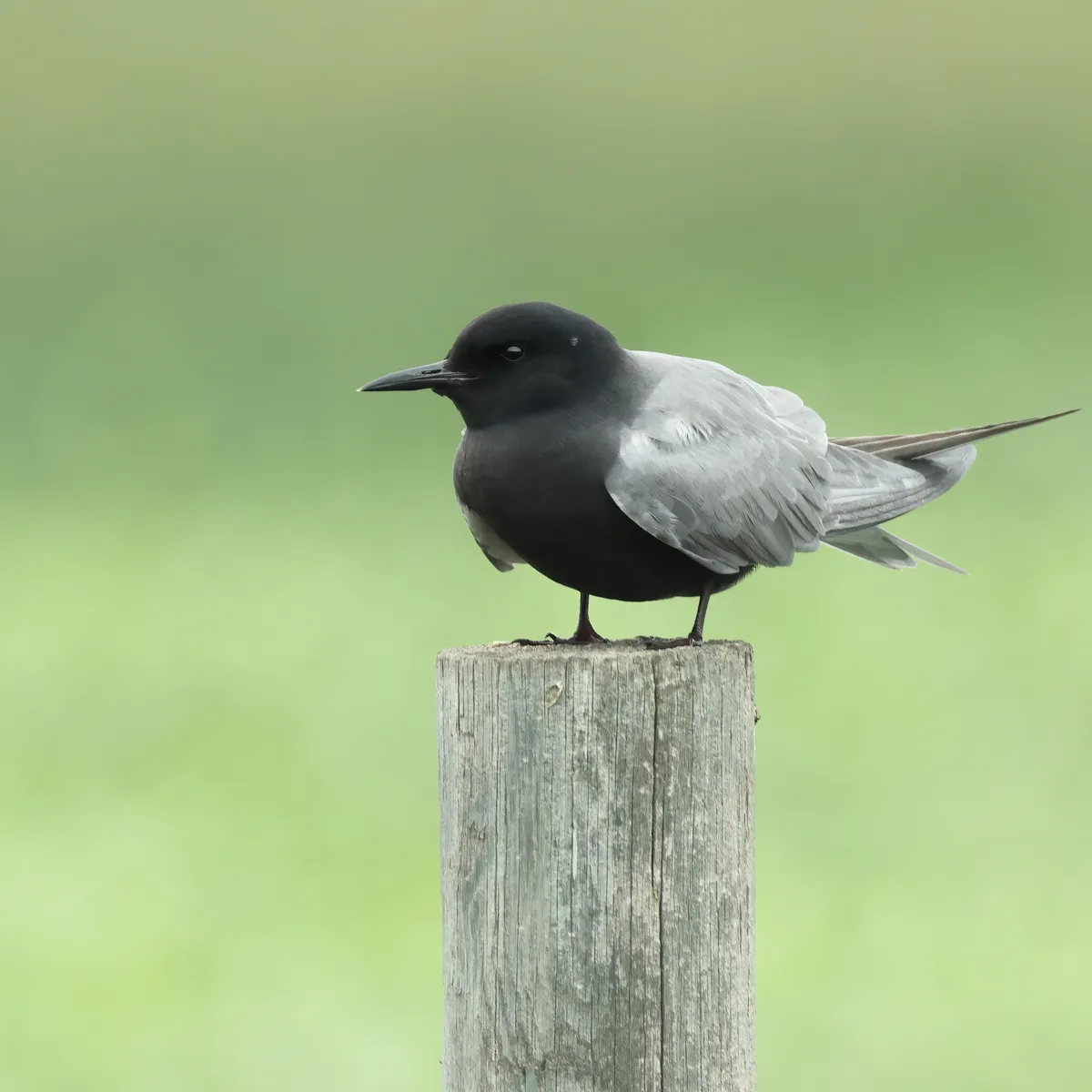
The black tern (Chlidonias niger) is a small tern generally found in or near inland water that breeds in Europe, Western Asia and North America. In winter the birds migrate to coastal areas of Africa and South America.
Description
Adults are 25 cm (10 in) long, with a wingspan 61 cm (24 in), and weigh 62 g (2+1⁄8 oz). They have short dark legs and a short, weak-looking black bill, measuring 27 mm (1+1⁄16 in), nearly as long as the head. The bill is long, slender, and looks slightly decurved. They have a dark grey back, with a white forewing, black head, neck (occasionally suffused with grey in the adult) and belly, black or blackish-brown cap (which unites in color with the ear coverts, forming an almost complete hood), and a light brownish-grey, 'square' tail. The face is white. There is a big dark triangular patch in front of the eye, and a broadish white collar in juveniles. There are greyish-brown smudges on the ides of the white breast, a downwards extension of the plumage of the upperparts. These marks vary in size and are not conspicuous. In non-breeding plumage, most of the black, apart from the cap, is replaced by grey. The plumage of the upperparts is drab, with pale feather-edgings. The rump is brownish-grey. The North American race, C. n. surinamensis, is distinguishable from the European form in all plumages, and is considered by some to be a separate species. In flight, the build appears slim. The wing-beats are full and dynamic, and flight is often erratic as it dives to the surface for food; similar to other tern species. Its call has been described as a high-pitched "kik"; the sound of a large flock has been called "deafening".
Text from Wikipedia — Black tern, revision 1321165390, CC BY-SA 4.0, retrieved 2026-09-04. Encyclopedic text reused under CC BY-SA 4.0. Sentences about hunting or regulation are removed: on this site, the rule comes from Québec.ca.
Other names
French
English
Presence in Quebec
- Origin
- Indigène
- Occurrence
- Régulier
- Population status
- Reproducteur
- Certainty
- Confirmé
Conservation
Québec.ca
Official periods
Source: Québec.ca — tables reproduced as published (retrieved 2026-08-30).
Regulations change. Always check Québec.ca before hunting or trapping.
Where this data comes from
This species is listed in an official government dataset. The identification and status shown in the data sheet are reproduced from it.
Source: List of Quebec’s vertebrate wildlife (LFVQ) — Ministère de l’Environnement, de la Lutte contre les changements climatiques, de la Faune et des Parcs. File LFVQ_25_03_2026.csv, retrieved 2026-08-30 · CC BY 4.0.
Measurements, habitat, diet and reproduction are not shown: no official source is attached to them yet.