
Guillemot à miroir— Quebec wildlife
Cepphus grylle
AlcidaeNo period published by Québec.ca
Québec.ca publishes no hunting or trapping period for this species. Check the official regulations.
Wikipedia
Guillemot à miroir
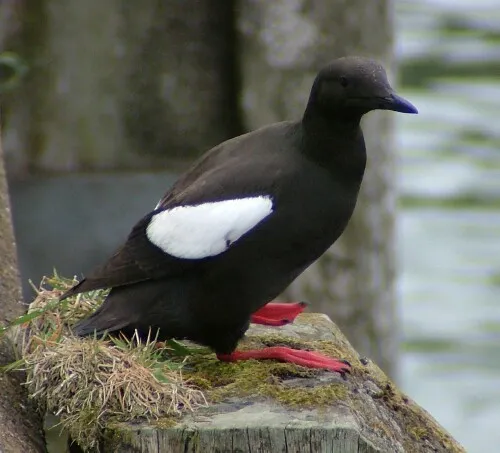
The black guillemot or tystie (Cepphus grylle) is a medium-sized seabird of the Alcidae family, native throughout northern Atlantic coasts and eastern North American coasts. It is resident in much of its range, but large populations from the high arctic migrate southwards in winter. The bird can be seen in and around its breeding habitat of rocky shores, cliffs and islands in single or smalls groups of pairs. They feed mainly by diving towards the sea floor feeding on fish, crustaceans or other benthic invertebrates. They are listed on the IUCN red list as a species of least concern. Both sexes have very similar appearances with black plumage and a large white patch on the upper side of their wings in summer. The bill is also black, being rather long and slender, while the feet are coral-red. In winter adult underparts are white and the upperparts are a pale grey with the back and shoulders exhibiting barred light grey and white patterning. The birds breed in solitary pairs or small groups during their breeding season starting in late February and early May. Pairs nest above the high tide mark, usually in cliff crevices or gaps in boulders. Many pairs lack true nests and lay directly on the ground. Breeding pairs will typically lay 2-egg clutches and raise 2 chicks to fledging. The eggs are dull white to pale green, boldly marked with dark spots and blotches. Incubation by both parents typically lasts 28 to 32 days. Once hatched, chicks are covered with black down and receive care from the parents until they fledge aged 30 – 40 days, unaccompanied by their parents. Once fledged, chicks are totally independent and by age three or four years they will begin to re-join their natal colony.
Description
The black guillemot is a medium-sized bird with adults normally 30 to 32 centimetres (12 to 12+1⁄2 inches) in length and with wingspans of 52 to 58 cm (20+1⁄2 to 23 in). The bodyweight can range from 300 to 460 grams (10+1⁄2 to 16 ounces). Adults have both summer and winter plumage and there is no sexual difference in this that can be identified in the field. The English common name "Black Guillemot" references their strikingly black breeding summer plumage which is totally black except for a large white patch on the upper side of their wings. During the summer plumage, their legs, feet and inside of the mouth are all a bright coral-red, and their beak is black. Adults lose their summer plumage in an early fall moult where their upper plumage become barred with light grey and white, their head is a pale grey, their underparts white, and legs and feet a pale red. They retain their white wing patch, black beak and red inside their mouth. The call in the breeding season is a high whistle. The red gape is also prominent then. Juveniles and immatures can easily be identified by the spotting of the white wing patch with grey or brown feathers and is easy to see even at far distances in the field.
Text from Wikipedia — Black guillemot, revision 1357252582, CC BY-SA 4.0, retrieved 2026-09-04. Encyclopedic text reused under CC BY-SA 4.0. Sentences about hunting or regulation are removed: on this site, the rule comes from Québec.ca.
Other names
French
English
Presence in Quebec
- Origin
- Indigène
- Occurrence
- Régulier
- Population status
- Reproducteur
- Certainty
- Confirmé
Conservation
Québec.ca
Official periods
Source: Québec.ca — tables reproduced as published (retrieved 2026-08-30).
Regulations change. Always check Québec.ca before hunting or trapping.
Where this data comes from
This species is listed in an official government dataset. The identification and status shown in the data sheet are reproduced from it.
Source: List of Quebec’s vertebrate wildlife (LFVQ) — Ministère de l’Environnement, de la Lutte contre les changements climatiques, de la Faune et des Parcs. File LFVQ_25_03_2026.csv, retrieved 2026-08-30 · CC BY 4.0.
Measurements, habitat, diet and reproduction are not shown: no official source is attached to them yet.