
No period published by Québec.ca
Québec.ca publishes no hunting or trapping period for this species. Check the official regulations.
Wikipedia
Guillemot de Brünnich
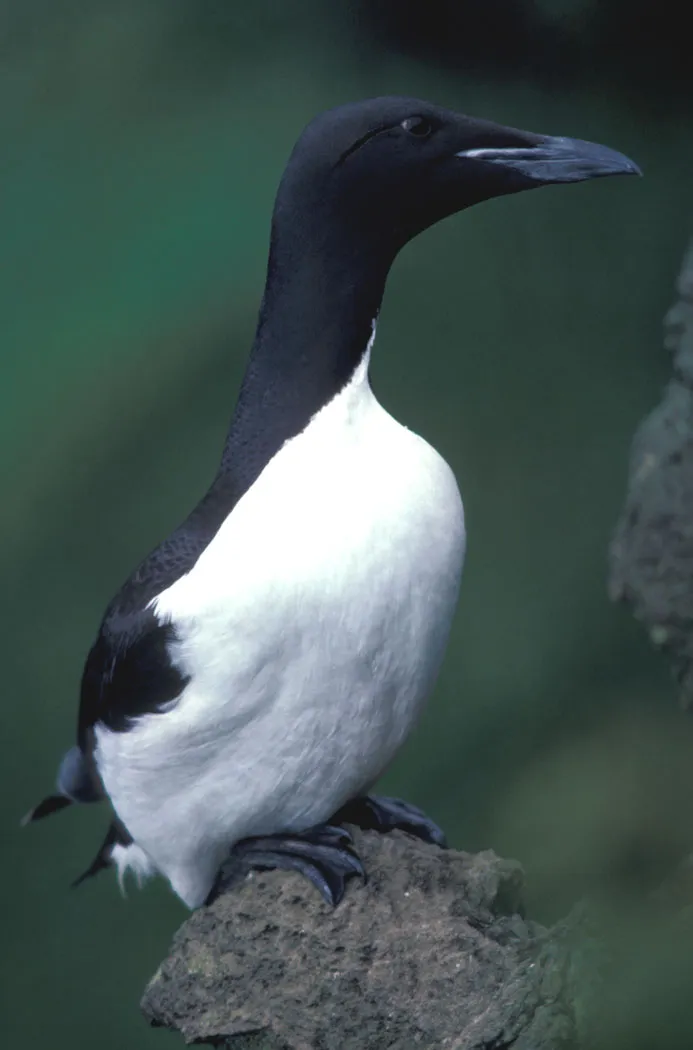
The thick-billed murre or Brünnich's guillemot (Uria lomvia) is a bird in the auk family (Alcidae). This bird is named after the Danish zoologist Morten Thrane Brünnich. The very deeply black North Pacific subspecies Uria lomvia arra is also called Pallas' murre after its describer.
Description
Since the extinction of the great auk in the mid-19th century, the murres are the largest living members of the Alcidae. The thick-billed murre and the closely related common guillemot (or common murre, U. aalge) are similarly sized, but the thick-billed murre is larger in both average and maximum size. The thick-billed murre measures 40–48 cm (16–19 in) in total length, spans 64–81 cm (25–32 in) across the wings and weighs 736–1,481 g (26.0–52.2 oz). The Pacific race (U. l. arra) is larger than the Atlantic race, especially in bill dimensions. Adult birds are black on the head, neck, back and wings with white underparts. The bill is long and pointed. They have a small rounded black tail. The lower face becomes white in winter. This species produces a variety of harsh cackling calls at the breeding colonies, but is silent at sea. They differ from the common murre in their thicker, shorter bill with a white gape stripe and their darker head and back; the "bridled" morph is unknown in U. lomvia – a murre has either a white eye-stripe, or a white bill-stripe, or neither, but never both; it may be that this is character displacement, enabling individual birds to recognize conspecifics at a distance in the densely packed breeding colonies as the bridled morph is most common by far in North Atlantic colonies where both species of guillemots breed. In winter, there is less white on the thick-billed murre's face. They look shorter than the common murre in flight. First-year birds have smaller bills than adults and the white line on the bill is often obscure, making the bill an unreliable way to identify them at this age. The head pattern is the best way to distinguish first-year birds from common murres.
Text from Wikipedia — Thick-billed murre, revision 1371132289, CC BY-SA 4.0, retrieved 2026-09-04. Encyclopedic text reused under CC BY-SA 4.0. Sentences about hunting or regulation are removed: on this site, the rule comes from Québec.ca.
Other names
French
English
Presence in Quebec
- Origin
- Indigène
- Occurrence
- Régulier
- Population status
- Reproducteur
- Certainty
- Confirmé
Conservation
Québec.ca
Official periods
Source: Québec.ca — tables reproduced as published (retrieved 2026-08-30).
Regulations change. Always check Québec.ca before hunting or trapping.
Where this data comes from
This species is listed in an official government dataset. The identification and status shown in the data sheet are reproduced from it.
Source: List of Quebec’s vertebrate wildlife (LFVQ) — Ministère de l’Environnement, de la Lutte contre les changements climatiques, de la Faune et des Parcs. File LFVQ_25_03_2026.csv, retrieved 2026-08-30 · CC BY 4.0.
Measurements, habitat, diet and reproduction are not shown: no official source is attached to them yet.