
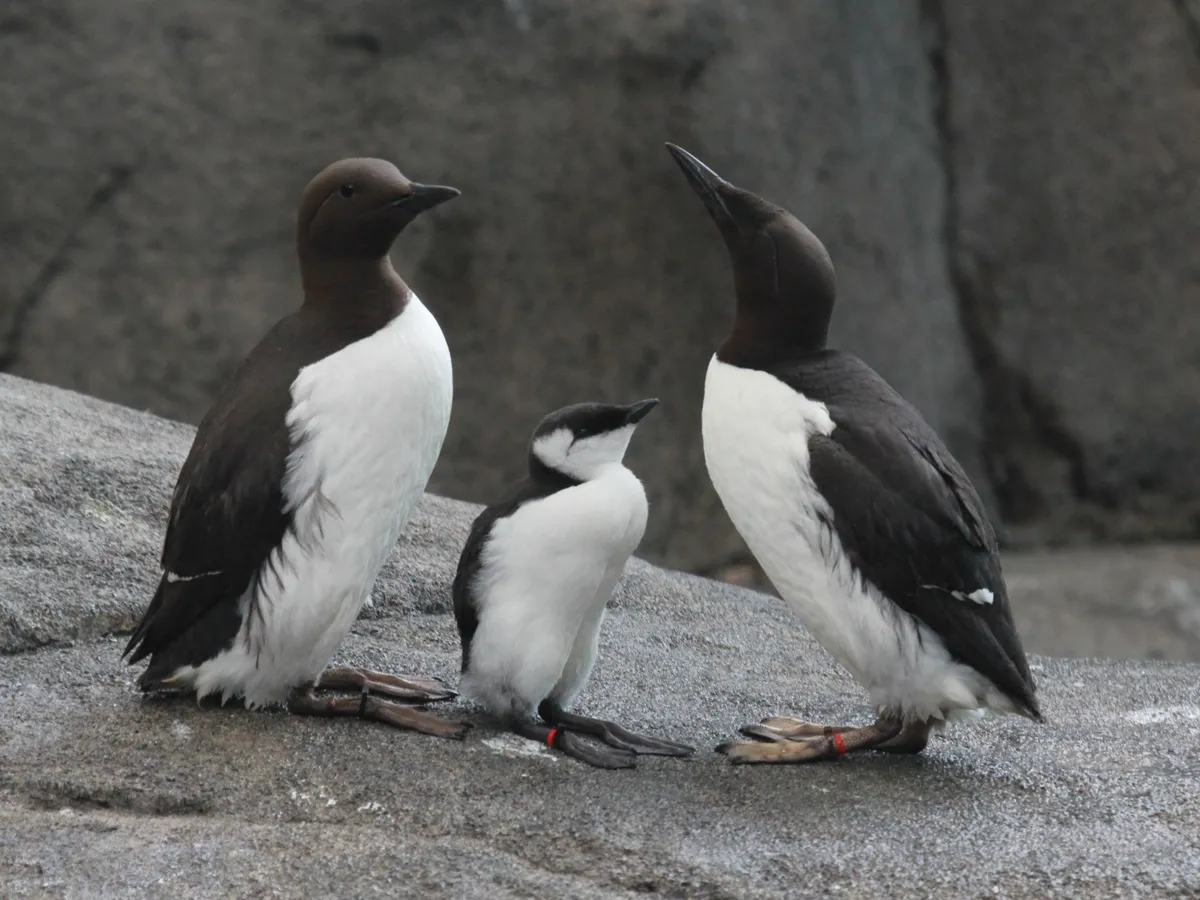
Guillemot marmette— Quebec wildlife
Uria aalge
AlcidaeNo period published by Québec.ca
Québec.ca publishes no hunting or trapping period for this species. Check the official regulations.
Wikipedia
Guillemot marmette
The common murre or common guillemot (Uria aalge) is a large auk, one of several species called murre or guillemot. It has a circumpolar distribution, occurring in low-Arctic and boreal waters in the North Atlantic and North Pacific. It spends most of its time at sea, only coming to land to breed on rocky cliff shores or islands. Common murres are fast in direct flight but are not very agile. They are highly mobile underwater using their wings to 'fly' through the water column, where they typically dive to depths of 30–60 m (100–195 ft). Depths of up to 180 m (590 ft) have been recorded. Common murres breed in colonies at high densities. Nesting pairs may be in bodily contact with their neighbours. They make no nest; their single egg is incubated between the adult's feet on a bare rock ledge on a cliff face. Eggs hatch after ~30 days' incubation. The chick is born downy and can regulate its body temperature after 10 days. Some 20 days after hatching, the chick leaves its nesting ledge and heads for the sea, unable to fly, but gliding for some distance with fluttering wings, accompanied by its male parent. Male guillemots spend more time diving, and dive more deeply than females during this time. Chicks are capable of diving as soon as they hit the water. The female stays at the nest site for some 14 days after the chick has left. Both male and female common murres moult after breeding and become flightless for 1–2 months. Some populations have short migration distances, instead remaining close to the breeding site year-round. Such populations return to the nest site from autumn onwards. Adult birds balance their energetic budgets during the winter by reducing the time that they spend flying and are able to forage nocturnally.
Description
The common murre is 38–46 cm (15–18 in) in length with a 61–73 cm (24–29 in) wingspan. Male and female are indistinguishable in the field and weight ranges between 945 g (2 lb 1+1⁄2 oz) in the south of their range and 1,044 g (2 lb 5 oz) in the north. A weight range of 775–1,250 g (1 lb 11+1⁄2 oz – 2 lb 12 oz) has been reported. In breeding plumage, the nominate subspecies U. a. aalge is black on the head, back and wings, and has white underparts. It has a thin dark pointed bill and a small rounded black tail. After the post-breeding moult, the face is white with a dark spur behind the eye, and there are often dark streaks on the flanks. Birds of the subspecies U. a. albionis are dark brown rather than black, most obviously so in colonies in southern Britain. The legs and the bill are dark grey. Occasionally, adults have been seen with yellow-grey legs. In May 2008, an aberrant adult was photographed with a bright yellow bill. The adults moult into breeding plumage in December–February, even starting as early as November in U. a. albionis, and back into winter plumage soon after leaving the breeding colonies in July to August. The plumage of first winter birds is the same as the adult winter plumage.
Text from Wikipedia — Common murre, revision 1362495741, CC BY-SA 4.0, retrieved 2026-09-04. Encyclopedic text reused under CC BY-SA 4.0. Sentences about hunting or regulation are removed: on this site, the rule comes from Québec.ca.
Other names
French
English
Presence in Quebec
- Origin
- Indigène
- Occurrence
- Régulier
- Population status
- Reproducteur
- Certainty
- Confirmé
Conservation
Québec.ca
Official periods
Source: Québec.ca — tables reproduced as published (retrieved 2026-08-30).
Regulations change. Always check Québec.ca before hunting or trapping.
Where this data comes from
This species is listed in an official government dataset. The identification and status shown in the data sheet are reproduced from it.
Source: List of Quebec’s vertebrate wildlife (LFVQ) — Ministère de l’Environnement, de la Lutte contre les changements climatiques, de la Faune et des Parcs. File LFVQ_25_03_2026.csv, retrieved 2026-08-30 · CC BY 4.0.
Measurements, habitat, diet and reproduction are not shown: no official source is attached to them yet.