
No period published by Québec.ca
Québec.ca publishes no hunting or trapping period for this species. Check the official regulations.
Wikipedia
Harelde kakawi
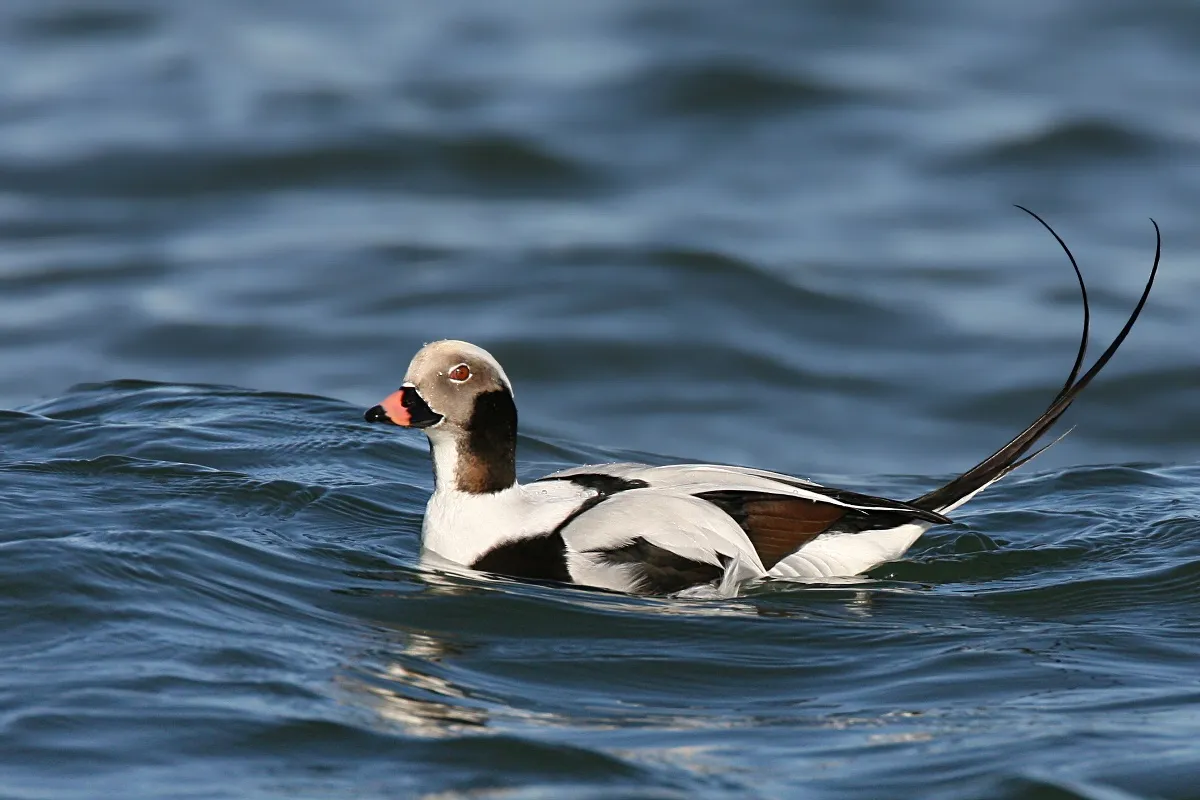
The long-tailed duck (Clangula hyemalis) is a medium-sized sea duck that breeds in the tundra and taiga regions of the arctic and winters along the northern coastlines of the Atlantic and Pacific Oceans. It is the only member of the genus Clangula.
Description
Adults have white underparts, though the rest of the plumage goes through a complex moulting process. The male has a long pointed tail (10 to 15 cm (3.9 to 5.9 in) long) and a dark grey bill crossed by a pink band. In winter, the male has a dark cheek patch on a mainly white head and neck, a dark breast and mostly white body. In summer, the male is dark on the head, neck and back with a white cheek patch. The female has a brown back and a relatively short pointed tail. In winter, the female's head and neck are white with a dark crown. In summer, the head is dark. Juveniles resemble adult females in autumn plumage, though with a lighter, less distinct cheek patch. The males are vocal and have a musical yodelling call ow, ow, owal-ow.
Habitat and range
Long-tailed ducks breed on tundra across northern Eurasia (in Russian Siberia, Kamchatka, and Karelia, for example), the Faroe Islands, Finland, parts of southern Greenland, Iceland, Norway, as well as across northern North America (Alaska and northern Canada). In winter, they are found on and near large bodies of seawater, such as the Northern Pacific Ocean, the North Atlantic Ocean, Hudson Bay and the North American Great Lakes. Small numbers are found on the Missouri river.
Text from Wikipedia — Long-tailed duck, revision 1356930448, CC BY-SA 4.0, retrieved 2026-09-04. Encyclopedic text reused under CC BY-SA 4.0. Sentences about hunting or regulation are removed: on this site, the rule comes from Québec.ca.
Other names
French
English
Presence in Quebec
- Origin
- Indigène
- Occurrence
- Régulier
- Population status
- Reproducteur
- Certainty
- Confirmé
Conservation
Québec.ca
Official periods
Source: Québec.ca — tables reproduced as published (retrieved 2026-08-30).
Regulations change. Always check Québec.ca before hunting or trapping.
SIT Québec register
Outfitters hunting this species
90 outfitters list this species among the game they hunt.
Where this data comes from
This species is listed in an official government dataset. The identification and status shown in the data sheet are reproduced from it.
Source: List of Quebec’s vertebrate wildlife (LFVQ) — Ministère de l’Environnement, de la Lutte contre les changements climatiques, de la Faune et des Parcs. File LFVQ_25_03_2026.csv, retrieved 2026-08-30 · CC BY 4.0.
Measurements, habitat, diet and reproduction are not shown: no official source is attached to them yet.