
No period published by Québec.ca
Québec.ca publishes no hunting or trapping period for this species. Check the official regulations.
Wikipedia
Harfang des neiges
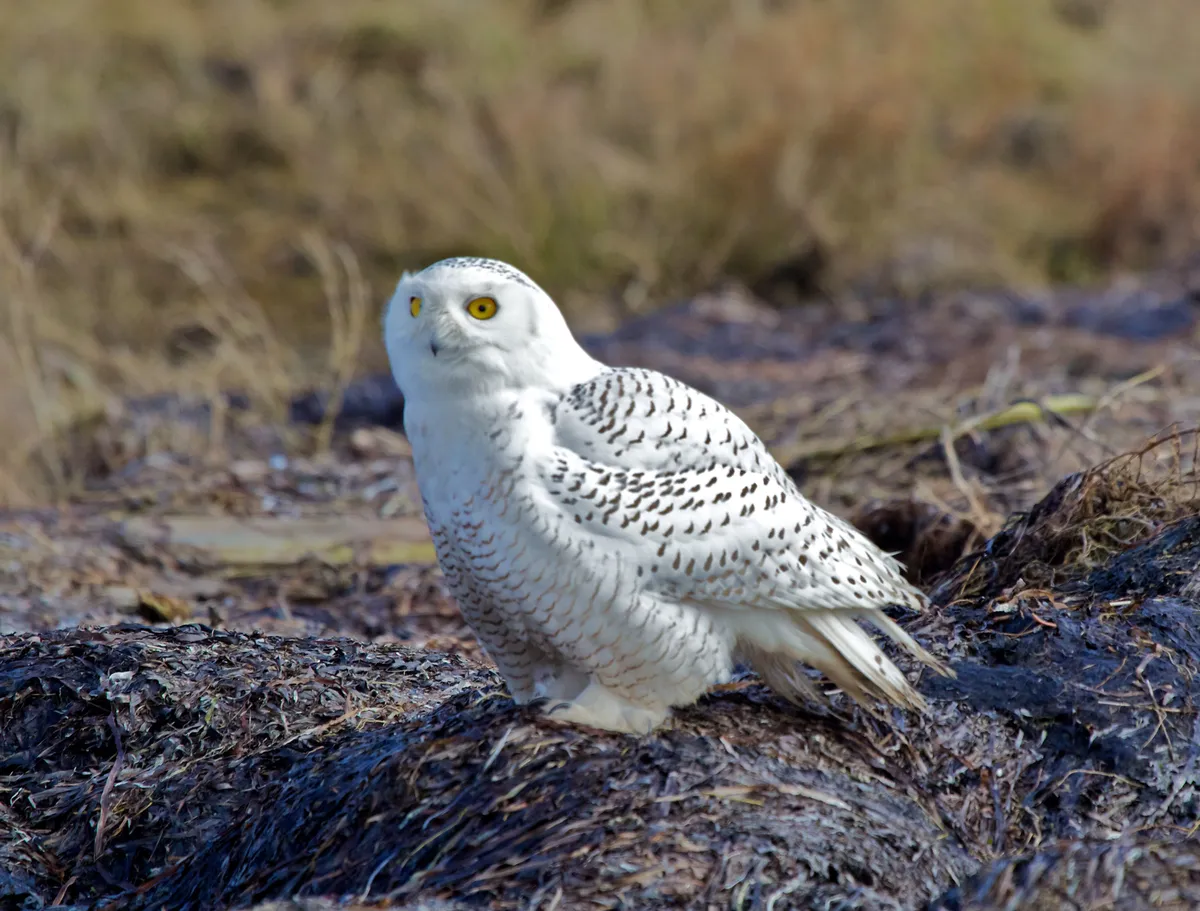
The snowy owl (Bubo scandiacus), also known as the polar owl, the white owl and the Arctic owl, is a large, white owl of the true owl family. Snowy owls are native to the Arctic regions of both North America and the Palearctic, breeding mostly on the tundra. It has a number of unique adaptations to its habitat and lifestyle, which are quite distinct from other extant owls. One of the largest species of owl, it is the only owl with mainly white plumage. Males tend to be a purer white overall while females tend to have more extensive flecks of dark brown. Juvenile male snowy owls have dark markings and may appear similar to females until maturity, at which point they typically turn whiter. The composition of brown markings about the wing, although not foolproof, is the most reliable technique for aging and sexing individual snowy owls. Its breeding efforts and global population are closely tied to the availability of tundra-dwelling lemmings, but in the non-breeding season, and occasionally during breeding, the snowy owl can adapt to almost any available prey – most often other small mammals and northerly water birds, as well as, opportunistically, carrion. Snowy owls typically nest on a small rise on the ground of the tundra. The snowy owl lays a very large clutch of eggs, often from about 5 to 11, with the laying and hatching of eggs considerably staggered. Despite the short Arctic summer, the development of the young takes a relatively long time and independence is sought in autumn. The snowy owl is a nomadic bird, rarely breeding at the same locations or with the same mates on an annual basis and often not breeding at all if prey is unavailable. A largely migratory bird, snowy owls can wander almost anywhere close to the Arctic, sometimes unpredictably irrupting to the south in large numbers. Given the difficulty of surveying such an unpredictable bird, there was little in-depth knowledge historically about the snowy owl's status; however, 2020s data suggests the species is declining precipitously. Whereas the global population was once estimated at over 200,000 individuals, 2010s–2020s data suggests that there are probably fewer than 100,000 individuals globally and that the number of successful breeding pairs is 28,000 or even considerably less. While the causes are not well understood, numerous, complex environmental factors often correlated with global warming are probably at the forefront of the fragility of the snowy owl's existence.
Description
The snowy owl is mostly white. They are purer white than predatory mammals such as polar bears (Ursus maritimus) and Arctic fox (Vulpes lagopus). Often when seen in the field, these owls can resemble a pale rock or a lump of snow on the ground.
Text from Wikipedia — Snowy owl, revision 1373052027, CC BY-SA 4.0, retrieved 2026-09-04. Encyclopedic text reused under CC BY-SA 4.0. Sentences about hunting or regulation are removed: on this site, the rule comes from Québec.ca.
Other names
French
English
Former scientific names
Presence in Quebec
- Origin
- Indigène
- Occurrence
- Régulier
- Population status
- Toute l'année
- Certainty
- Confirmé
Conservation
Québec.ca
Official periods
Source: Québec.ca — tables reproduced as published (retrieved 2026-08-30).
Regulations change. Always check Québec.ca before hunting or trapping.
Where this data comes from
This species is listed in an official government dataset. The identification and status shown in the data sheet are reproduced from it.
Source: List of Quebec’s vertebrate wildlife (LFVQ) — Ministère de l’Environnement, de la Lutte contre les changements climatiques, de la Faune et des Parcs. File LFVQ_25_03_2026.csv, retrieved 2026-08-30 · CC BY 4.0.
Measurements, habitat, diet and reproduction are not shown: no official source is attached to them yet.