
Hermine— species and hunting in Quebec
Mustela richardsonii
MustelidaeTrapping periods published by Québec.ca
Official tables below — trapping units (UGAF) and dates.
Wikipedia
Hermine
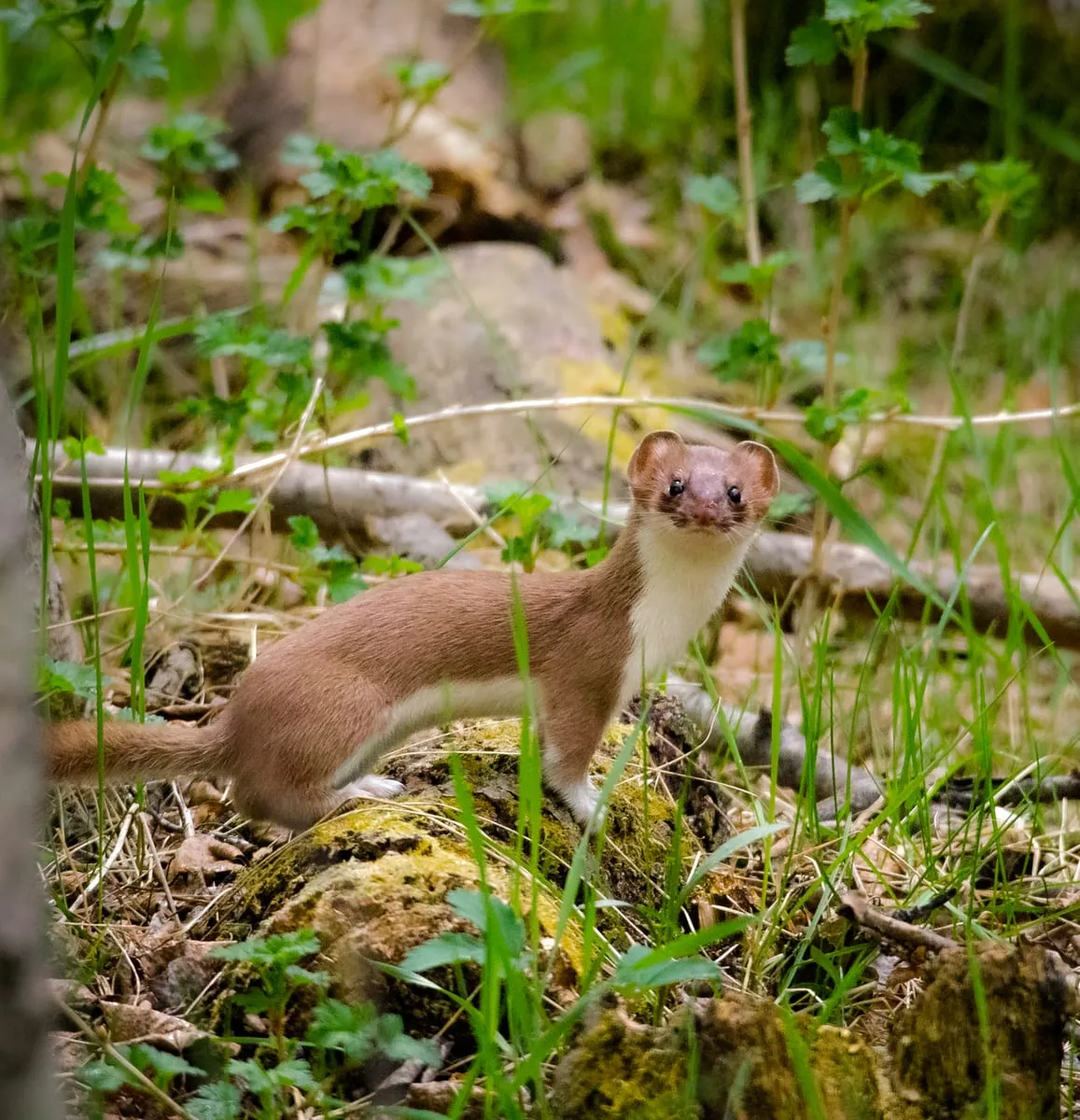
The American ermine or American stoat (Mustela richardsonii) is a member of the family Mustelidae and of the genus mustelid. Previously thought of as conspecific with the stoat (M. erminea), they have a body plan typical of weasels and are native to most of North America. There are currently 13 recognized subspecies. American ermines are small carnivorous mammals that live in a variety of terrestrial habitats, such as forests and wetlands.
Description
The American ermine has a body plan typical of weasels. It has short legs, a long body and neck, and a small triangular head with short round ears. It has a brown dorsum with a white venter (except during winter when the coat is fully white) and a short, black-tipped tail. The black coloring of the tail may serve to distract predators and divert attacks away from the body, which blends in more with its surroundings. American ermines are sexually dimorphic and males are 30% larger than females.
Habitat and range
The species is found throughout most of North America aside from most of Alaska (although it is found on some islands in southeastern Alaska), eastern Yukon, most of Arctic Canada, and Greenland, where it is replaced by M. erminea. It reaches the northern extent of its range in Ellesmere Island and a portion of eastern mainland Nunavut and ranges from here to cover almost all of western North America south to northern New Mexico, and eastern North America south to northern Virginia. It is absent from most of the Southeastern United States and the Great Plains.
Diet
In North America, where the ecological niche for rat- and rabbit-sized prey is taken by the larger long-tailed weasel (Neogale frenata), the carnivorous American ermine preys mainly on mice and voles. Shrews, young cottontails, chipmunks, deer mice, jumping mice, and house mice are also preyed on. Occasionally, small birds, frogs, small fish, and earthworms are eaten. Usually the ermine kills by biting at base of skull.
Text from Wikipedia — American ermine, revision 1364053096, CC BY-SA 4.0, retrieved 2026-09-04. Encyclopedic text reused under CC BY-SA 4.0. Sentences about hunting or regulation are removed: on this site, the rule comes from Québec.ca.
Other names
English
Former scientific names
Presence in Quebec
- Origin
- Indigène
- Occurrence
- Régulier
- Population status
- Toute l'année
- Certainty
- Confirmé
Conservation
Québec.ca
Official periods
Source: Québec.ca — tables reproduced as published (retrieved 2026-08-30).
Trapping
Long-tailed weasel, least weasel, Eastern grey squirrel, red squirrel, ermine, American marten and fisher
| UGAF | Periods |
|---|---|
| 1, 2, 3, 4, 5, 6, 7, 11, 13, 17, 31, 32, 39, 41, 42, 43, 44, 45, 46, 47, 48, 49, 50, 51, 52, 53 | From October 18 to March 1 |
| 8, 9, 10, 12, 14, 15, 18, 19, 20, 21, 22, 23, 26, 27, 28, 29, 30, 33, 34, 35, 36, 37, 38, 40 | From October 25 to February 15 |
| 16, 70, 71, 72, 73, 74, 75, 76, 77, 78, 79, 80, 81, 82 | From October 25 to February 1 |
| 24, 25, 83, 84, 85, 86 | From October 25 to March 1 |
| 54, 55, 56, 57, 58, 59, 60, 61, 62, 63, 64, 65, 66 | From October 18 to March 15 |
Regulations change. Always check Québec.ca before hunting or trapping.
Where this data comes from
This species is listed in an official government dataset. The identification and status shown in the data sheet are reproduced from it.
Source: List of Quebec’s vertebrate wildlife (LFVQ) — Ministère de l’Environnement, de la Lutte contre les changements climatiques, de la Faune et des Parcs. File LFVQ_25_03_2026.csv, retrieved 2026-08-30 · CC BY 4.0.
Measurements, habitat, diet and reproduction are not shown: no official source is attached to them yet.