
No period published by Québec.ca
Québec.ca publishes no hunting or trapping period for this species. Check the official regulations.
Wikipedia
Hibou moyen-duc
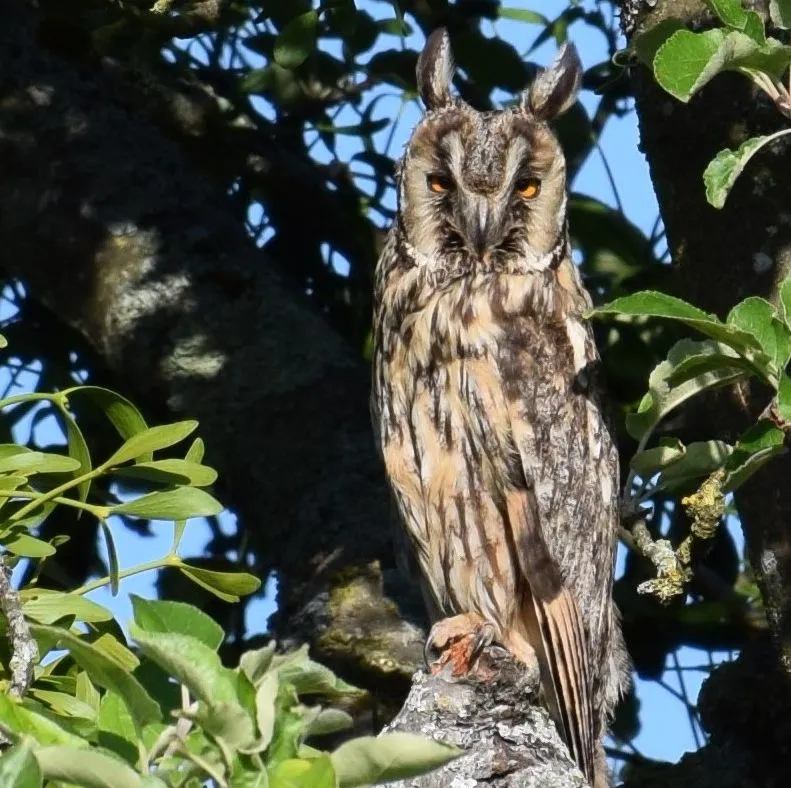
The long-eared owl (Asio otus), also known as the northern long-eared owl or, more informally, as the lesser horned owl or cat owl, is a medium-sized species of owl with an extensive breeding range. The genus name, Asio, is Latin for "horned owl", and the specific epithet, otus, is derived from Greek and refers to a small eared owl. The species breeds in Europe and the Palearctic, as well as in North America. This species is a part of the larger grouping of owls known as typical owls, of the family Strigidae, which contains most extant species of owl. The long-eared owl is a specialized predator, focusing its diet on small rodents, especially voles. Under some circumstances, such as population cycles of their regular prey, arid or insular regional habitats or urbanization, this species can adapt to a diversity of prey, including birds and insects. The long-eared owl utilizes nests built by other animals, in particular by corvids. Breeding success in this species is correlated with prey populations and predation risks. Unlike many owls, long-eared owls are not strongly territorial or sedentary. They are partially migratory and sometimes characterized as "nomadic". Another characteristic of this species is its partiality for regular roosts shared by a number of long-eared owls at once. The long-eared owl is one of the most widely distributed and most numerous owl species in the world, and due to its very broad range and numbers it is considered a least concern species by the IUCN. Nonetheless, strong declines have been detected for this owl in several parts of its range.
Description
This species is a slim and long winged owl with erectile ear tufts, which are positioned closer to the center of the head than in many other types of owl. Ear tufts, present in about half of living owls, are conjectured to be a means of intraspecies communication of intent and mood. In general coloration, the long-eared owl is a hue of ochraceous-tawny with a grayish or brownish wash variably manifesting. The base color is overlaid with variable blackish vertical streaks (and occasionally spots), which are more apparent about the wings and back. The scapulars are marked whitish, which provide further contrast when seen against the base color and blackish markings. On the underside, the body tends to be a somewhat paler ochraceous-tawny compared to the upperside. Long-eared owls tend to have dusky streaks on the upper breast, below which they may be heavily marked with herring bone pattern (which is created by dusky shaft-streaks and crossbars on these feathers).
Reproduction
Long-eared owls tend to be monogamous breeders. Non-migratory populations are usually monogamous throughout the year, the pair bond being renewed annually.A study in Idaho determined that long-eared owls were locally extremely monogamous, with no extra-pair fertilizations
Text from Wikipedia — Long-eared owl, revision 1372839780, CC BY-SA 4.0, retrieved 2026-09-04. Encyclopedic text reused under CC BY-SA 4.0. Sentences about hunting or regulation are removed: on this site, the rule comes from Québec.ca.
Other names
French
English
Presence in Quebec
- Origin
- Indigène
- Occurrence
- Régulier
- Population status
- Reproducteur
- Certainty
- Confirmé
Conservation
Québec.ca
Official periods
Source: Québec.ca — tables reproduced as published (retrieved 2026-08-30).
Regulations change. Always check Québec.ca before hunting or trapping.
Where this data comes from
This species is listed in an official government dataset. The identification and status shown in the data sheet are reproduced from it.
Source: List of Quebec’s vertebrate wildlife (LFVQ) — Ministère de l’Environnement, de la Lutte contre les changements climatiques, de la Faune et des Parcs. File LFVQ_25_03_2026.csv, retrieved 2026-08-30 · CC BY 4.0.
Measurements, habitat, diet and reproduction are not shown: no official source is attached to them yet.