
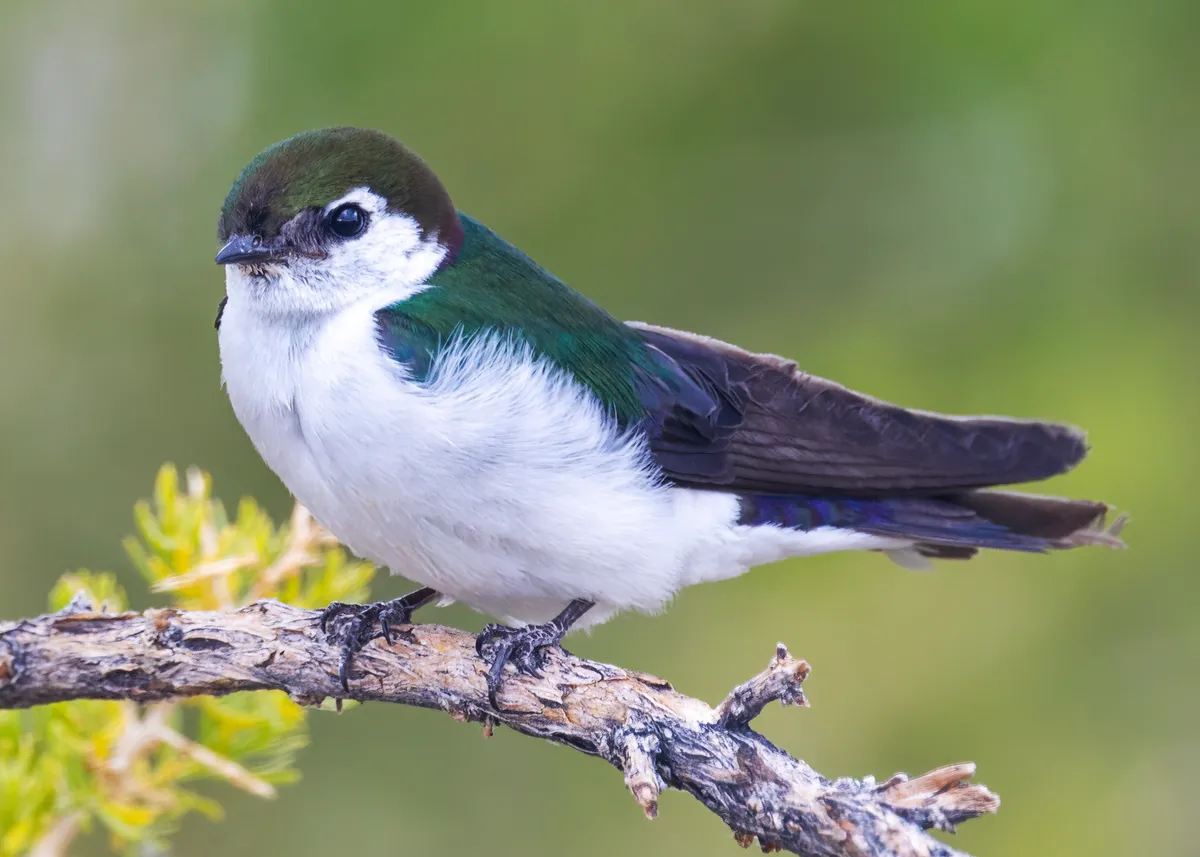
Hirondelle à face blanche— Quebec wildlife
Tachycineta thalassina
HirundinidaeNo period published by Québec.ca
Québec.ca publishes no hunting or trapping period for this species. Check the official regulations.
Wikipedia
Hirondelle à face blanche
The violet-green swallow (Tachycineta thalassina) is a small North American passerine bird in the swallow family. These aerial insectivores are distributed along the west coast from Alaska to Mexico, extending as far east as Montana and Texas. With an appearance very similar to the tree swallow, these individuals can be identified by the white rump side-patches that appear to separate their green back and purple tail. Violet-green swallows are secondary cavity nesters, found in a number of habitats including deciduous and coniferous forest. In addition to nesting in tree holes within these habitats, they are also widely observed nesting in the cracks of large cliffs.
Description
The distinct body form of swallows distinguishes them from other passerine birds. Their long pointed wings and slim, streamlined body evolved to catch insects while in flight; the violet-green swallow is no exception. With an average body length of 12–13 cm (4.7–5.1 in), the violet-green swallow is slightly shorter and appears more compact in flight compared to some other members of the genus Tachycineta. The violet-green swallow most closely resembles the tree swallow T. bicolor, but can be distinguished by the more extensive white on the sides of the rump, and its green-and-violet glossed colour.
Habitat and range
The type of habitat occupied by violet-green swallows varies depending on their geographical location and elevation. Across their range, these birds can be found in deciduous, coniferous and mixed forests, as well as within canyons and in close proximity to large cliffs. Breeding and non-breeding habitats do not differ much except that breeding habitat is usually at lower elevations. Violet-green swallows have also been observed nesting around buildings in more settled areas.
Text from Wikipedia — Violet-green swallow, revision 1371443560, CC BY-SA 4.0, retrieved 2026-09-04. Encyclopedic text reused under CC BY-SA 4.0. Sentences about hunting or regulation are removed: on this site, the rule comes from Québec.ca.
Presence in Quebec
- Origin
- Indigène
- Occurrence
- Accidentel/non régulier
- Population status
- Migrateur
- Certainty
- Confirmé
Conservation
Official remark
Présence de l'espèce plutôt imprévisible; elle peut ne pas être observée pendant de longues périodes. Une mention confirmée en 2013.
Québec.ca
Official periods
Source: Québec.ca — tables reproduced as published (retrieved 2026-08-30).
Regulations change. Always check Québec.ca before hunting or trapping.
Where this data comes from
This species is listed in an official government dataset. The identification and status shown in the data sheet are reproduced from it.
Source: List of Quebec’s vertebrate wildlife (LFVQ) — Ministère de l’Environnement, de la Lutte contre les changements climatiques, de la Faune et des Parcs. File LFVQ_25_03_2026.csv, retrieved 2026-08-30 · CC BY 4.0.
Measurements, habitat, diet and reproduction are not shown: no official source is attached to them yet.