
Hirondelle à front blanc— Quebec wildlife
Petrochelidon pyrrhonota
HirundinidaeNo period published by Québec.ca
Québec.ca publishes no hunting or trapping period for this species. Check the official regulations.
Wikipedia
Hirondelle à front blanc
The cliff swallow or American cliff swallow (Petrochelidon pyrrhonota) is a member of the passerine bird family Hirundinidae, the swallows and martins. The generic name Petrochelidon is derived from the Ancient Greek petros meaning "stone" and khelidon (χελιδών) "swallow", and the specific name pyrrhonota comes from purrhos meaning "flame-coloured" and -notos "-backed". Cliff swallows are extremely social songbirds that can be found in large nesting colonies reaching over 2,000 nests. They are frequently seen flying overhead in large flocks during migration, gracefully foraging over fields for flying insects or perching tightly together on a wire preening under the sun. Cliff swallows build gourd-shaped nests made from mud with small entrance holes. They build their nests tightly together, on top of one another, under bridges or alongside mountain cliffs. Living in large populations, these aerial insectivores use extensive vocalizations to communicate warnings or food availability to the other individuals.
Description
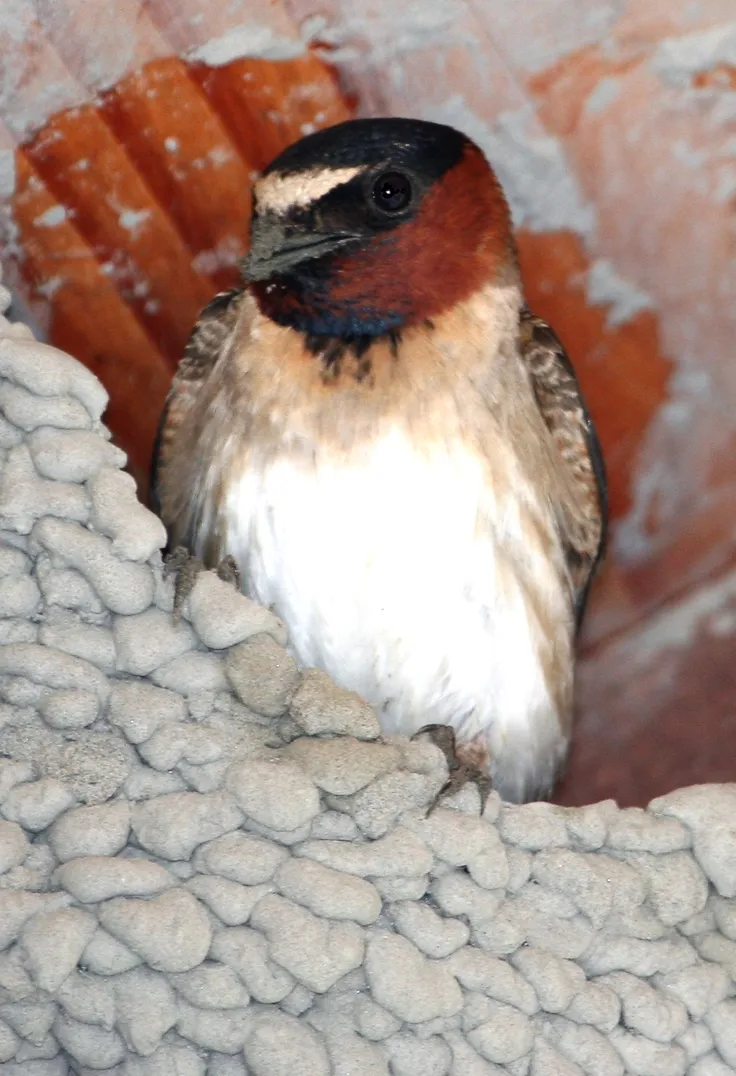
The cliff swallow's average body length is 13 cm (5.1 in), and they have short legs and small bills with relatively long pointed wings. Adult cliff swallows have an overall dark brownish plumage covering both their back and wings, and they have a characteristic white forehead, rich red-coloured cheeks with a dark throat, basic white underparts and a buffy-coloured rump. In good lighting conditions, their crowns and mantle feathers are iridescent. The Northern population is slightly larger in body size and also differs in facial markings from the Mexican population of cliff swallows, which have a chocolate-brown patch on their foreheads. The male and female have identical plumage, therefore sexing them must be done through palpation of the cloaca. During the breeding season, the males will have a harder cloaca that is more pronounced because the seminal vesicles are swollen. In addition, during incubation females will lose feathers on their lower breast to create a warm patch for sitting on their eggs. Cliff swallows are similar in body plumage colouring to the related barn swallow species but lack the characteristic fork-shaped tail of the barn swallow prominent during flight. The cliff swallows have a square-shaped tail. Juvenile cliff swallows have an overall similar body plumage colouring to the adults, with paler tones. The juveniles lack the iridescent adult plumages, and their foreheads and throats appear speckled white. The juvenile cliff swallows' white forehead and throat markings have high variance between unrelated individuals compared with those from the same clutch. These distinctive white facial markings disappear during maturity following their complex-basic moult pattern, because their pre-formative plumage is different from the basic plumage. The pre-formative facial plumage has been suggested as a possible way for parents nesting in large colonies to recognize their chicks.
Text from Wikipedia — Cliff swallow, revision 1358671406, CC BY-SA 4.0, retrieved 2026-09-04. Encyclopedic text reused under CC BY-SA 4.0. Sentences about hunting or regulation are removed: on this site, the rule comes from Québec.ca.
Other names
French
English
Former scientific names
Presence in Quebec
- Origin
- Indigène
- Occurrence
- Régulier
- Population status
- Reproducteur
- Certainty
- Confirmé
Conservation
Québec.ca
Official periods
Source: Québec.ca — tables reproduced as published (retrieved 2026-08-30).
Regulations change. Always check Québec.ca before hunting or trapping.
Where this data comes from
This species is listed in an official government dataset. The identification and status shown in the data sheet are reproduced from it.
Source: List of Quebec’s vertebrate wildlife (LFVQ) — Ministère de l’Environnement, de la Lutte contre les changements climatiques, de la Faune et des Parcs. File LFVQ_25_03_2026.csv, retrieved 2026-08-30 · CC BY 4.0.
Measurements, habitat, diet and reproduction are not shown: no official source is attached to them yet.