
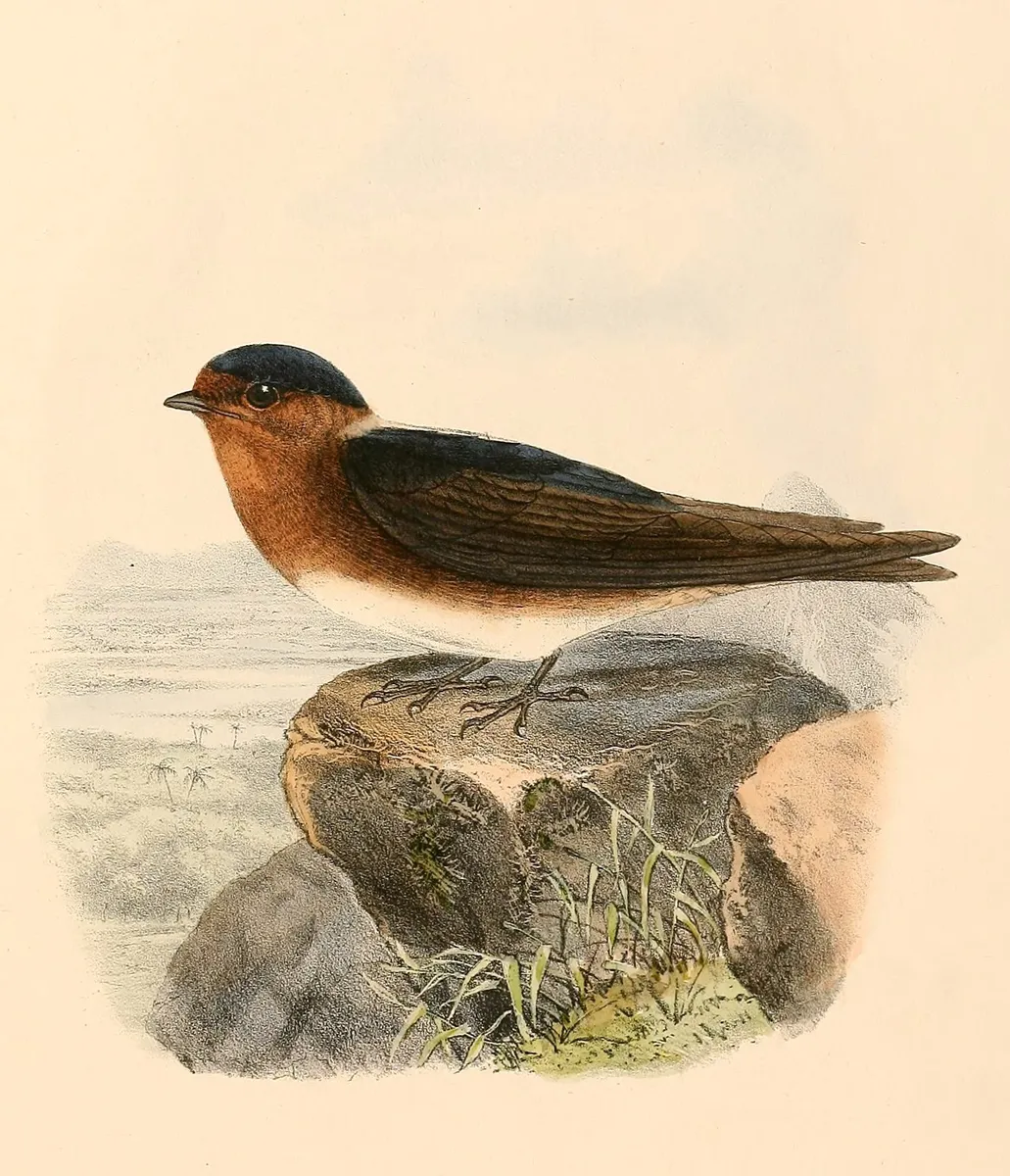
Hirondelle à front brun— Quebec wildlife
Petrochelidon fulva
HirundinidaeNo period published by Québec.ca
Québec.ca publishes no hunting or trapping period for this species. Check the official regulations.
Wikipedia
Hirondelle à front brun
The cave swallow (Petrochelidon fulva) is a medium-sized, squarish-tailed swallow belonging to the same genus as the more familiar and widespread cliff swallow of North America. The cave swallow, also native to the Americas, nests and roosts primarily in caves and sinkholes. Cave swallows are found in Mexico and the Greater Antilles, with fall and winter vagrants reaching the east and Gulf Coasts of the U.S. Breeding colonies occur in south-eastern New Mexico, Texas, Florida, the Greater Antilles, portions of southern Mexico, and along the west coast of South America. Five subspecies are currently recognized according to Birds of North America, three occurring in North America and two in South America.
Description
The cave swallow measures 12 to 14 cm in length and weighs 19 g on average. The largest of the five subspecies, P. f. pallida, has an average wing length between 107.0 and 112.3 mm; the smallest subspecies, P. f. aequatorialis, has an average wing length between 93.0 and 93.5 mm. Differences between the sexes are minimal, both are similar in size and weight and are difficult to distinguish from their plumage. It has grey-blue upperparts and brown-tangerine forefront and throat.
Habitat and range
During the breeding season, P. f. fulva, P. f. pallida, and P. f. citata, the North American subspecies of the cave swallow, will usually nest in a caves, sinkholes, and sometimes in man-made structures offering similar habitat, such as highway culverts. P. f. aequatorialis and P. f. rufocollaris, the South American subspecies, prefer to nest in open areas such as on cliff faces and the sides of buildings. All subspecies of the cave swallow forage for insects over open areas and water nearby their roosting sites. Their spring and fall migrations are poorly known; however, P. f. citata, P. f. aequatorialis and P. f. rufocollaris are considered resident species and winter in their breeding range.
Text from Wikipedia — Cave swallow, revision 1339020035, CC BY-SA 4.0, retrieved 2026-09-04. Encyclopedic text reused under CC BY-SA 4.0. Sentences about hunting or regulation are removed: on this site, the rule comes from Québec.ca.
Presence in Quebec
- Origin
- Indigène
- Occurrence
- Accidentel/non régulier
- Population status
- Migrateur
- Certainty
- Confirmé
Conservation
Québec.ca
Official periods
Source: Québec.ca — tables reproduced as published (retrieved 2026-08-30).
Regulations change. Always check Québec.ca before hunting or trapping.
Where this data comes from
This species is listed in an official government dataset. The identification and status shown in the data sheet are reproduced from it.
Source: List of Quebec’s vertebrate wildlife (LFVQ) — Ministère de l’Environnement, de la Lutte contre les changements climatiques, de la Faune et des Parcs. File LFVQ_25_03_2026.csv, retrieved 2026-08-30 · CC BY 4.0.
Measurements, habitat, diet and reproduction are not shown: no official source is attached to them yet.