
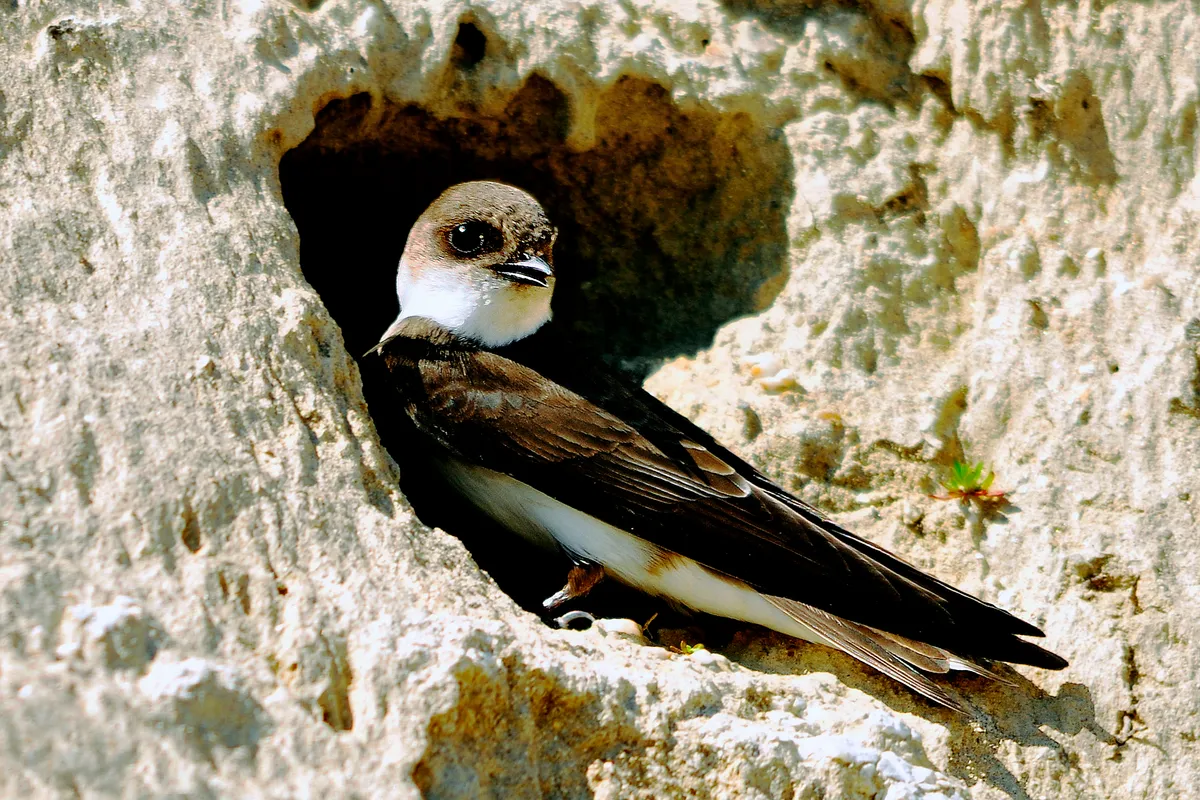
Hirondelle de rivage— Quebec wildlife
Riparia riparia
HirundinidaeNo period published by Québec.ca
Québec.ca publishes no hunting or trapping period for this species. Check the official regulations.
Wikipedia
Hirondelle de rivage
The sand martin (Riparia riparia), also known as the collared sand martin or common sand martin, and in the Americas as the bank swallow, is a migratory passerine bird in the swallow family Hirundinidae. It has a wide range in summer, embracing practically the whole Holarctic area, from Europe, across Asia to the Pacific Ocean, and throughout North America. It winters in eastern and southern Africa, southern Asia, and South America.
Description
The sand martin is brown above, white below with a narrow brown band on the breast; the bill is black, the legs brown. The young have rufous tips to the coverts and margins to the secondaries. Its brown back and breast band, white throat, small size and quick jerky flight separate it from similar swallows, such as the common house martin (Delichon urbicum), the American cliff swallow (Petrochelidon pyrrhonota) and the tree swallow (Tachycineta bicolor). The other species of Riparia are more similar; the sand martin generally only occurs them in the wintering range, though there is breeding range overlap with pale martin in central Asia, with both species sharing mixed colonies without interbreeding. The banded martin (Neophedina cincta) of sub-Saharan Africa is very similar in plumage pattern, but is markedly larger, nearly double the weight. Measurements: Length: 12–13 cm (4.7–5.1 in) Wingspan: 26.5–29 cm (10.4–11.4 in) Weight: 11–16 g (0.39–0.56 oz) (to 19.5 g (0.69 oz) before migration) The song is a continuous gravelly twittering when the birds are on the wing and becomes a conversational undertone after they have settled in the roost. The harsh alarm is heard when a passing falcon, crow or other suspected predator requires combined action to drive it away.
Text from Wikipedia — Sand martin, revision 1345374505, CC BY-SA 4.0, retrieved 2026-09-04. Encyclopedic text reused under CC BY-SA 4.0. Sentences about hunting or regulation are removed: on this site, the rule comes from Québec.ca.
Other names
French
English
Presence in Quebec
- Origin
- Indigène
- Occurrence
- Régulier
- Population status
- Reproducteur
- Certainty
- Confirmé
Conservation
Québec.ca
Official periods
Source: Québec.ca — tables reproduced as published (retrieved 2026-08-30).
Regulations change. Always check Québec.ca before hunting or trapping.
Where this data comes from
This species is listed in an official government dataset. The identification and status shown in the data sheet are reproduced from it.
Source: List of Quebec’s vertebrate wildlife (LFVQ) — Ministère de l’Environnement, de la Lutte contre les changements climatiques, de la Faune et des Parcs. File LFVQ_25_03_2026.csv, retrieved 2026-08-30 · CC BY 4.0.
Measurements, habitat, diet and reproduction are not shown: no official source is attached to them yet.