
No period published by Québec.ca
Québec.ca publishes no hunting or trapping period for this species. Check the official regulations.
Wikipedia
Hirondelle noire
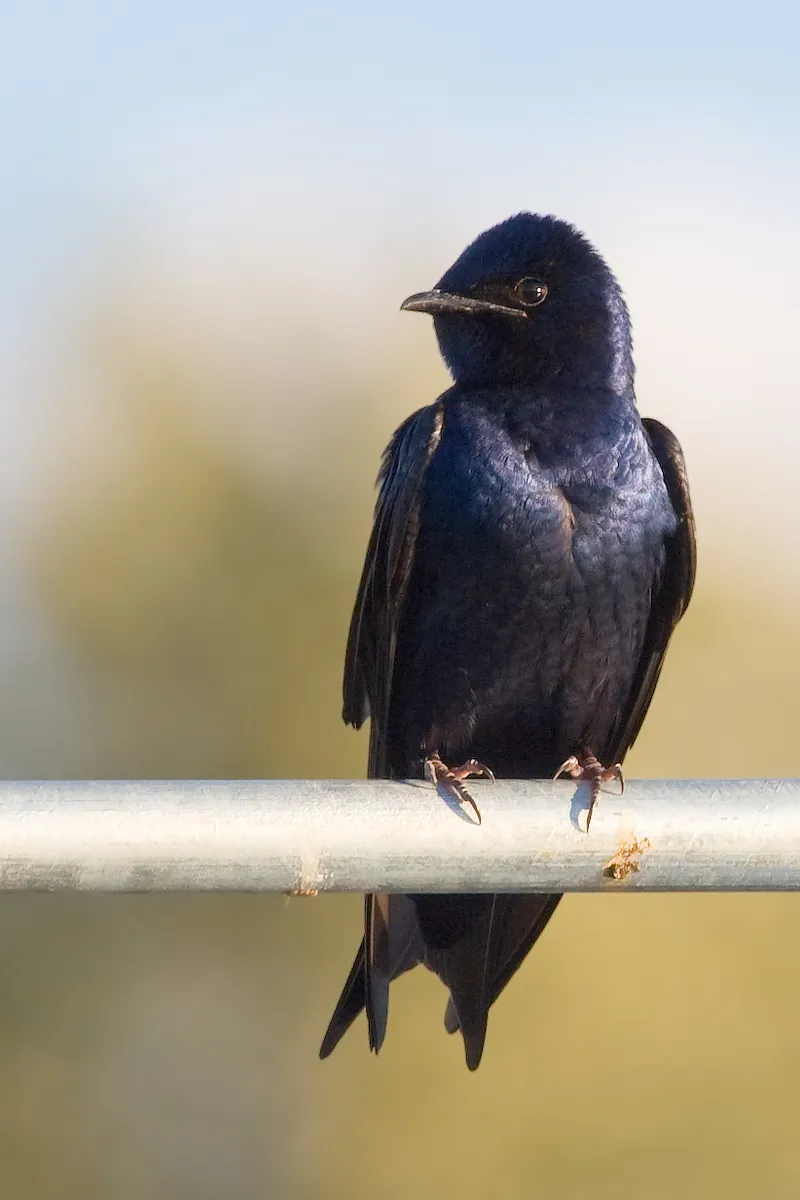
The purple martin (Progne subis) is a passerine bird in the swallow family Hirundinidae. It is the largest swallow in North America. Despite its name, the purple martin is not truly purple. The dark blackish-blue feathers have an iridescent sheen caused by the diffraction of incident light giving them a bright blue to navy blue or deep purple appearance. In some light, they may even appear green in color. They are migratory, with their breeding range including all of the eastern United States and southeastern Canada, as well as the coastal Pacific Northwest, Baja California, Arizona, and New Mexico. Most make a brief stopover in the Yucatán Peninsula or Cuba during pre-breeding migration to North America and during post-breeding migration before reaching their overwintering site in South America. They are known for their speed, agility, and their characteristic mix of rapid, flapping, and gliding flight patterns.
Description
With an average length of 20 cm (7.9 in) and a wingspan of up to 38 cm (15 in), the purple martin is the largest amongst the around 90 species in the family Hirundinidae. Measurement ranges: Length: 7.5–7.9 in (19–20 cm) Weight: 1.6–2.1 oz (45–60 g) Wingspan: 15.3–16.1 in (39–41 cm) Purple martins are sexually dimorphic. Adult males are entirely black with a glossy steel blue sheen, the only swallow in North America with such coloration. Adult females are dark on top with some steel blue sheen, and lighter underparts. Adults have a slightly forked tail. Both male and female purple martins exhibit delayed plumage maturation, meaning it takes them two years before they acquire full adult plumage. Subadult females look similar to adult females minus the steel blue sheen and browner on the back. Subadult males look very much like females, but solid black feathers emerge on their chests in a blotchy, random pattern as they molt to their adult plumage. Purple martins are quite vocal. They are known to chirp, chortle, rattle, and croak. Their various calls are described as "throaty and rich" and can be rendered as tchew-wew, pew pew, choo, cher, zweet, and zwrack. The males have a gurgling and guttural courtship song, a dawn song, and even a subsong used at the end of the breeding season. Recordings of purple martin song are sold to attract martins to newly established birdhouses. The species of this genus are very closely related, and some view the purple martin, gray-breasted martin, caribbean martin, and southern martin, as a superspecies.
Text from Wikipedia — Purple martin, revision 1370911637, CC BY-SA 4.0, retrieved 2026-09-04. Encyclopedic text reused under CC BY-SA 4.0. Sentences about hunting or regulation are removed: on this site, the rule comes from Québec.ca.
Other names
French
Presence in Quebec
- Origin
- Indigène
- Occurrence
- Régulier
- Population status
- Reproducteur
- Certainty
- Confirmé
Conservation
Québec.ca
Official periods
Source: Québec.ca — tables reproduced as published (retrieved 2026-08-30).
Regulations change. Always check Québec.ca before hunting or trapping.
Where this data comes from
This species is listed in an official government dataset. The identification and status shown in the data sheet are reproduced from it.
Source: List of Quebec’s vertebrate wildlife (LFVQ) — Ministère de l’Environnement, de la Lutte contre les changements climatiques, de la Faune et des Parcs. File LFVQ_25_03_2026.csv, retrieved 2026-08-30 · CC BY 4.0.
Measurements, habitat, diet and reproduction are not shown: no official source is attached to them yet.