
No period published by Québec.ca
Québec.ca publishes no hunting or trapping period for this species. Check the official regulations.
Wikipedia
Huîtrier d'Amérique
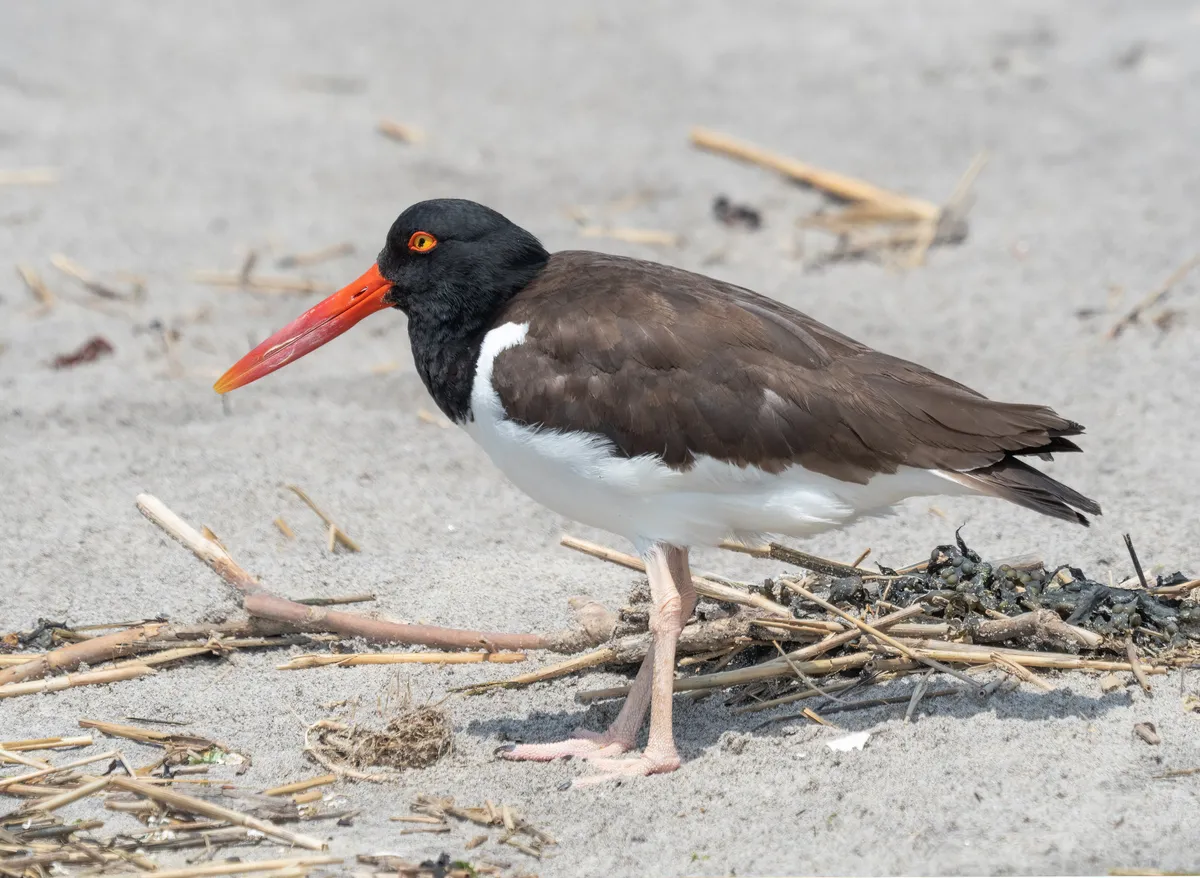
The American oystercatcher (Haematopus palliatus), occasionally called the American pied oystercatcher, is a member of family Haematopodidae. Originally called the "sea pie", it was renamed in 1731 when naturalist Mark Catesby claimed that he had observed the bird eating oysters. The current population of American oystercatchers is estimated to be 50,000 – 99,999 mature individuals. There are estimated to be 1,500 breeding pairs along the Atlantic and Gulf Coasts of the US. The bird is marked by its black and white body and a long, thick orange beak.
Description
The American oystercatcher has distinctive black and white plumage and a long, bright orange beak. The head and breast are black and the back, wings and tail greyish-black. The underparts are white, as are feathers on the inner part of the wing which become visible during flight. The irises are yellow and the eyes have orange orbital rings. The legs are pink. Adults are between 42–52 cm (17–20 in) in length.
Habitat and range
The American oystercatcher is found on the Atlantic coast of North America from coastal Massachusetts to northern Florida, where it is also found on the Gulf coast, the Caribbean, and south to Brazil, Uruguay and Argentina. It is found also in the Pacific coast of California, Mexico, Central America, Peru, and Chile. After receiving protection under the Migratory Bird Treaty Act, their range extended northward to re-occupy historical habitat in the coastal Northeast. During the breeding season, these birds are found along the Atlantic and Gulf Coasts and from Massachusetts south to Argentina and Chile. In winter, they are found in flocks along the coast from central New Jersey to the Gulf of Mexico.
Text from Wikipedia — American oystercatcher, revision 1358933808, CC BY-SA 4.0, retrieved 2026-09-04. Encyclopedic text reused under CC BY-SA 4.0. Sentences about hunting or regulation are removed: on this site, the rule comes from Québec.ca.
Other names
French
English
Presence in Quebec
- Origin
- Indigène
- Occurrence
- Accidentel/non régulier
- Population status
- Migrateur
- Certainty
- Confirmé
Conservation
Québec.ca
Official periods
Source: Québec.ca — tables reproduced as published (retrieved 2026-08-30).
Regulations change. Always check Québec.ca before hunting or trapping.
Where this data comes from
This species is listed in an official government dataset. The identification and status shown in the data sheet are reproduced from it.
Source: List of Quebec’s vertebrate wildlife (LFVQ) — Ministère de l’Environnement, de la Lutte contre les changements climatiques, de la Faune et des Parcs. File LFVQ_25_03_2026.csv, retrieved 2026-08-30 · CC BY 4.0.
Measurements, habitat, diet and reproduction are not shown: no official source is attached to them yet.